
Bernard Lewis
last updated: September 17, 2018
Please note: The Militarist Monitor neither represents nor endorses any of the individuals or groups profiled on this site.
Affiliations
- Princeton University: Former Professor, Near Eastern Studies
- Committee for Peace and Security in the Gulf: Signatory
- American Enterprise Institute: Irving Kristol Award Recipient, 2007
Government
- Defense Policy Board: Guest, September 19-20, 2001
Education
- University of London: Ph.D., 1939
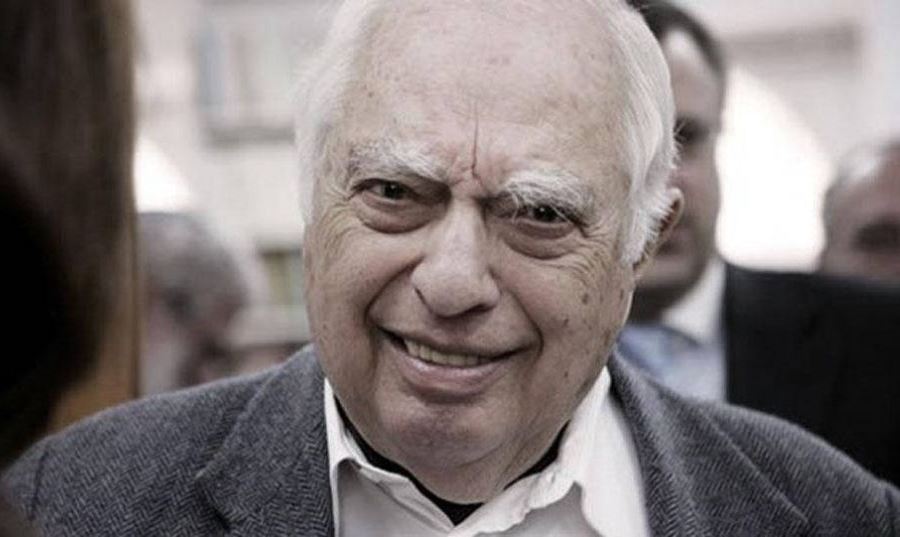
Bernard Lewis, who passed away in May 2018, was a renowned British-American historian of Islam and the Middle East. A former British intelligence officer, Foreign Office staffer, and Princeton University professor, Lewis was the author of some three-dozen books about the Middle East.
Lewis received praise from both admirers and critics for the nuance and breadth of his work, with many considering his accounts on the origins of the Shiite Ismaili sect and the modern Turkish republic to be authoritative. But Lewis also stoked controversy for his frequently chauvinistic attitude towards the Arab and Islamic worlds. The late Palestinian-American literary theorist Edward Said—who had a long-running feud with Lewis—once accused him of promoting “demagogy and downright ignorance.”[1]

Lewis also drew criticism for his associations with prominent neoconservatives and foreign policy hawks, particularly former Vice President Dick Cheney, and for his purported influence on the George W. Bush administration’s Middle East policies.
Differing views on his legacy
Reactions to Lewis’s death reflected the polarized attitude toward his work through the years. While even his sharpest critics would not deny his academic stature, views of his disposition toward the region he studied varied wildly.
U.S. Secretary of State Mike Pompeowrote of Lewis, “Bernard Lewis was a true scholar and great man. I owe a great deal of my understanding of the Middle East to his work. He was a man who believed, as I do, that Americans must be more confident in the greatness of our country, not less.”[2]
Yousef Munayyer, the executive director of the U.S. Campaign for Palestinian Rights expressed a very different view, writing, “He fathered the farce we have come to know as “terrorism experts”, non-Muslims explaining to westerners why Muslims are bad, proliferating orientalism and Islamophobia.”[3]
Prof. Timur Kuran struck a more centrist tone, tweeting, “Bernard Lewis … will be remembered for decades of controversial activism, but also for several decades of brilliant scholarship up to around age 60. Istanbul, Emergence of Modern Turkey, and Muslim Discovery of Europe are among his gems that are still read profitably.”[4]
Israeli Prime Minister Benjamin Netanyahu said of Lewis, “We will be forever grateful for his robust defense of Israel. I will always feel privileged to have witnessed firsthand his extraordinary erudition and I gleaned invaluable insights from our many meetings over the years.”[5]
By contrast, the journalist Peter Oborne was unyielding in his criticism of Lewis, stating, “Lewis was intellectually a towering figure. This meant he had the ability to do great good. Instead, he became the intellectual high priest for the calamitous wars which have caused such bloodshed across the Middle East, while doing unlimited damage to the standing of the United States.”[6]
Neoconservatism and Military Intervention in the Middle East
Lewis’ assertions about conflict between Islam and the West—as well as his insistence on the potential receptiveness of the Muslim world to democracy—have made him a favorite thinker among neoconservatives for decades.
In the 1970s, he emerged as a staunch critic of the Soviet Union and a strident supporter of Israel. Historian Joel Beinin called Lewis “perhaps the most articulate and learned Zionist advocate in the North American Middle East academic community.”[7]In a 2006 Weekly Standardpiece marking Lewis’ 90th birthday,Reuel Marc Gerecht—a neoconservative writer who called Lewis the marja-e-taqlid,a term from Shiite Muslim legal scholarship that means “the source”—recalled that in 1970, “Richard Perle, as a young staffer for Washington Sen. Henry ‘Scoop’ Jackson, observed Lewis giving a speech, and was astonished by his eloquence and historical reach.”[8]
Lewis forged particularly close relations with Dick Cheney, first when Cheney served as George H.W. Bush’s secretary of defense, and later when he was George W. Bush’s vice president. In a May 2006 speech honoring Lewis, Cheney recalled that Lewis had come to Washington to advise him on a “way forward in the Middle East” soon after Iraq had invaded Kuwait. “I decided that day that this was a man I wanted to keep in touch with, and whose work I should follow carefully in the years ahead,” said Cheney. “Since then we have met often, particularly during the last four-and-a-half years, and Bernard has always had some very good meetings with President Bush.”[9]
Observers have pointed to Lewis’ influence as being instrumental in shaping Cheney’s worldview, and ultimately impacting the direction of U.S. foreign policy after the 9/11 attacks. For instance, Brent Scowcroft, George H.W. Bush’s national security adviser,once argued that Cheney’s transformation into a Middle East hawk was partly due to the influence of Lewis. As Jeffrey Goldberg reported: “Lewis, Scowcroft said, fed a feeling in the White House that the United States must assert itself. … Cheney, in particular, Scowcroft thinks, accepted Lewis’s view of Middle East politics.” Said Scowcroft: “It’s that idea that we’ve got to hit somebody hard. … And Bernard Lewis says, ‘I believe that one of the things you’ve got to do to Arabs is hit them between the eyes with a big stick. They respect power.’”[10]
Despite his later assertions that he opposed the Iraq war, Lewis directly participated in campaigns to agitate for regime change in the years preceding the U.S. invasion. In 1998, he signed a letter sent by the Committee for Peace and Security in the Gulf (a spinoff of the Center for Security Policy) to President Bill Clinton that called for a “comprehensive political and military strategy for bringing down Saddam and his regime.” Other signatories, most of whom also supported the then-newly created Project for the New American Century, included such figures as Perle, John Bolton, Donald Rumsfeld,Frank Gaffney,Paul Wolfowitz,William Kristol,Robert Kagan,Elliott Abrams,Douglas Feith, and Zalmay Khalizad.[11]
After the 9/11 attacks, Lewis’s views converged closely with those of neoconservatives and Republican hawks pressing for military action in Middle East. In various opinion pieces he wrote following the attacks, Lewis expressed his support for the “war on terror,”[12]cautioned against making alliances of convenience with authoritarian regimes, and asserted that “real peace” in the Middle East “will only come” from the “defeat, or, preferably, collapse” of dictatorships in the region. “Regime change,” he wrote in the Wall Street Journalin 2002, “may well be dangerous, but sometimes the dangers of inaction are greater than those of action.”[13]
In late September 2001, the Pentagon’s Defense Policy Board, an advisory panel led by Richard Perle, held a closed session to consider military action against Iraq. Perle invited Lewis to attend the meeting along with Ahmed Chalabi, leader of a U.S.-funded Iraqi exile group that advocated Saddam Hussein’s ouster and enjoyed cozy ties with several high-profile neoconservatives. Lewis told the board that the United States should support democratic reformers in the Middle East, “such as my friend here, Ahmed Chalabi.”[14]
In 2004, the New Yorkerpublished an extensive examination of Lewis’ influence in the post-9/11 period by Ian Buruma. “A mentor to Henry (Scoop) Jackson in the early nineteen-seventies, and a friend to several Israeli Prime Ministers, Lewis has been especially sought after in Washington since September 11,” Buruma wrote. “Karl Roveinvited him to speak at the White House. Richard Perleand Dick Cheney are among his admirers. Lewis has championed his friend Ahmed Chalabifor a leading role in Iraq. And his best-selling book What Went Wrong?, about the decline of Muslim civilization, is regarded in some circles as a kind of handbook in the war against Islamist terrorism. Lewis, in short, is a thoroughly political don, and if anyone can be said to have provided the intellectual muscle for recent U.S. policy toward the Middle East it would have to be him.”[15]
Similarly, while reflecting on Lewis’ influence on the Bush administration, journalist Jacob Weisberg anointed him “perhaps the most significant intellectual influence behind the invasion of Iraq.”[16]
In his 2012 memoir Notes on a Century, however, Lewis denied this characterization, claiming that while he did have a personal audience with President Bush and members of his administration, he actually advised againstinvading Iraq. According to a review by Middle East Forumfellow David P. Goldman, “Lewis explicitly warned against a simple-minded rush to parliamentary forms in the Muslim world, hoping instead for a gradual expansion of existing consultative mechanisms into something that would approach democracy at some undermined date. But Lewis and the neoconservatives shared an inherent optimism about the changing Muslim culture that informed the national mood after Sept. 11.”[17]
Instead of invading Iraq, Lewis said, he told the Bush administration to focus more on supporting dissidents inside Iran. “My primary concern was Iran’s nuclear program,” he wrote in his memoir, “not toppling Saddam Hussein.”[18]
Indeed, Lewis claimed—despite the insistence of the U.S. intelligence community to the contrary—that Iran is building a nuclear weapon. In a 2006 op-ed for the Wall Street Journal, Lewis not only asserted that Iran had been working on a nuclear bomb for some 15 years, but also speculated that it might even have been planning an “apocalyptic” attack on Israel for that very year.[19](The attack never materialized, and the following year a U.S. intelligence estimate reported that Iran’s nuclear weapons research had been suspended years earlier.)
Lewis also peddled the notion, common among many neoconservative ideologues, that millenarian beliefs among Iran’s leaders make them impervious to rational decision-making about nuclear weapons, claiming that they would use the weapons even knowing that they could be wiped out as a result. “For them,” Lewis told the Hoover Institution’s Peter Robinson, mutually assured destruction is “not a deterrent, it’s an inducement.”[20]Realist scholars,[21]and even some Israeli military officers,[22]have long disputed this notion, arguing that Iran’s leaders are as rational as those of any other country when it comes to ensuring their own survival.
Lewis continued to be an icon for many neoconservatives. The American Enterprise Institute, the institutional home of many of the Bush era’s most vigorous Iraq hawks, awarded Lewis its annual Irving Kristolaward in 2007—putting Lewis in the company of such right-wing dignitaries as Dick Cheney,Robert Bork, Jeane Kirkpatrick, Ronald Reagan, Clarence Thomas, and Norman Podhoretz, among others.[23]According to a Wall Street Journalaccount of the awards ceremony, Lewis used the occasion to describe “Muslim migration to Europe as an Islamic attack on the West” and gave a “ringing endorsement of the ill-fated Crusades.” According to the Journal, Lewis said that “as atrocious as they were,” the Crusades “were nonetheless an understandable response to the Islamic onslaught of the preceding centuries, and that it was ridiculous to apologize for them.”[24]
Writings and Critics
In his writings on the Middle East, Lewis often seemed to swing from well-cultivated admiration to nuanced criticism, and sometimes to outright antipathy. This apparent inconsistency led one reviewer to wonder “whether Lewis possessed two minds, one of the diligent and cautious historian, the other belonging to a glib and strident advocate of neo-liberal force.”[25]
Lewis characterized the Islamic world as a “great civilization” with a vibrant culture, and fervently rejected the notion that Muslims are incapable of building a democracy rooted in their own traditions.[26]Unlike hard-right “Islamophobes” who paint terrorism or violent jihadas intrinsic to the faith, Lewis characterized Islamic terrorism as having “no antecedents in Islamic history, and no justification in terms of Islamic theology, law, or tradition.”[27]Countering fear-mongering critics like Frank Gaffneyand Daniel Pipes, who have accused Muslims of trying to impose “dhimmitude” on non-believers, Lewis asserted that historically, “Muslim tolerance of unbelievers was far better than anything available in Christendom.”[28]
However, Lewis was also one of the foremost proponents of the notion that the West and the Islamic world are engaged in a “clash of civilizations.” In fact, although the phrase is more associated with the late Samuel Huntington, Lewis is thought to have coined it in a 1990 essay called “The Roots of Muslim Rage.”[29]Among his other controversial statements, Lewis asserted that the “capacity for empathy, vicariously experiencing the feelings of others, is a peculiarly Western feature,”[30]and claimed that Muslims consider it “right and normal” for Muslims to “rule over non-Muslims,” while the reverse is “an offense against the laws of God and nature.”[31]In one particularly stark example from his 2010 book Faith and Power: Religion and Politics in the Middle East, Lewis wrote that “Either we bring them freedom, or they destroy us.”[32]
Many critics, including Edward Said, have charged that Lewis’ work, in its focus on precolonial history as a prism for interpreting Middle East affairs, downplays the role of recent foreign intervention in shaping current events. Echoing these critics, Buruma said that Lewis’ “writings give the impression that British and French imperialism, U.S. interventions, and Israeli oppression of Palestinians are simply alibis for the region’s political failures.”[33]
In 2004, Michael Hirsh, senior editor at Newsweek, sharply critiqued Lewis in Washington Monthly, proclaiming that “America’s misreading of the Arab world—and our current misadventure in Iraq—may have recently begun in 1950.” That year, Lewis went to Turkey and, while studying, had a “vision of a secularized Westernized Arab democracy that casts off the medieval shackles of Islam and enters modernity at last.” Hirsh noted that the Bush administration’s main rationale for its occupation of Iraq, after failing to find weapons of mass destruction, was what the Wall Street Journalcalled the “Lewis Doctrine.” But instead of resulting in “a Western polity, reconstituted and imposed from above like Kemal’s Turkey, that is to become a bulwark of security for America and a model for the region,” Hirsh observed that the legacy of the so-called Lewis Doctrine in Iraq has been the “passing from a secular to an increasingly radicalized and Islamicized society.”[34]
By interpreting the 9/11 attacks as part of a clash of civilization that dates back a thousand years or more, Hirsh said, Lewis helped shape the war on terrorism as a war against Islamists. “Did Lewis’ misconceptions lead the Bush administration to make a terrible strategic error?” Hirsh wondered. “If Bernard Lewis’s view of the Arab problem was in error, then America missed a chance to round up and destroy a threat—al Qaida—that in reality existed only on the sick margins of the Islamic world.”[35]
[1]Edward Said, “The Clash of Ignorance,” The Nation, October 4, 2001, http://www.thenation.com/article/clash-ignorance#.
[2]Mike Pompeo, Twitter, May 20, 2018, https://twitter.com/SecPompeo/status/998307108859899905
[3]Yousef Munayyer, Twitter, May 19, 2018, https://twitter.com/YousefMunayyer/status/997980178822426629
[4]Timur Kuran, Twitter, May 20, 2018, https://twitter.com/timurkuran/status/998058631756120066
[5]“From Netanyahu to Leftists, Praise and Scorn for Late Middle East Scholar Bernard Lewis,” Haaretz, May 21, 2018, https://www.haaretz.com/middle-east-news/praise-and-scorn-for-late-middle-east-scholar-bernard-lewis-1.6104535
[6]Peter Oborne, “Do not weep for Bernard Lewis, high priest of war in the Middle East,” Middle East Eye, May 21, 2018, http://www.middleeasteye.net/columns/bernard-lewis-neocons-high-priest-war-and-bloodshed-middle-east-1876449346
[7]Joel Beinin, “Bernard Lewis’s Anti-Semites,” MERIP Middle East Report, August 1987, No. 147, http://www.jstor.org/discover/10.2307/3011952?uid=3739704&uid=2&uid=4&uid=3739256&sid=21103256887831.
[8]Reuel Marc Gerecht, “The Last Orientalist,” Weekly Standard, June 5, 2006, http://www.weeklystandard.com/print/Content/Public/Articles/000/000/012/267ttvdc.asp.
[9]Office of the Vice President, “Vice President’s Remarks at the World Affairs Council Luncheon Honoring Professor Bernard Lewis,” George W. Bush White House Archives, May 1, 2006, http://georgewbush-whitehouse.archives.gov/news/releases/2006/05/20060501-3.html.
[10]Jeffrey Goldberg, “Breaking Ranks,” New Yorker, October 24, 2005.
[11]Committee for Peace and Security in the Gulf, “Open Letter to the Presdient,” Center for Security Policy website, February 19, 1998, http://www.centerforsecuritypolicy.org/1998/02/24/open-letter-to-the-president-4/.
[12]See Bernard Lewis, “A War of Resolve,” Wall Street Journal, April 26, 2002, http://online.wsj.com/news/articles/SB1019783516427073880.
[13]Bernard Lewis, “Time for Toppling,” September 27, 2002, http://online.wsj.com/news/articles/SB1033089910971012713.
[14]Bryan Burrough, et al., “Path to War,” Vanity Fair, November 2004, http://www.vanityfair.com/politics/features/2004/05/path-to-war200405.
[15]Ian Buruma, “Lost in Translation: The Two Minds of Bernard Lewis,” New Yorker, June 14, 2004, http://www.newyorker.com/archive/2004/06/14/040614crbo_books.
[16]Jacob Weisberg, “Party of Defeat: AEI’s Weird Celebration,” Slate, March 14, 2007, http://www.slate.com/articles/news_and_politics/the_big_idea/2007/03/party_of_defeat.html.
[17]David P. Goldman, “Bernard Lewis’ Stubborn Hope,” Tablet, May 9, 2012, http://www.tabletmag.com/jewish-arts-and-culture/books/99112/bernard-lewis-stubborn-hope?print=1.
[18]Quoted by David Tresilian, “Review: Notes on a Century,” Al-Ahram Weekly, August 16-22, Issue No. 1111, http://weekly.ahram.org.eg/2012/1111/cu2.htm.
[19]Bernard Lewis, “August 22,” Wall Street Journal, August 8, 2006, http://online.wsj.com/news/articles/SB115500154638829470.
[20]Peter Robinson, “Bernard Lewis and Norman Podhoretz discuss the Middle East,” Hoover Institution “Uncommon Knowledge” series, November 12, 2012, http://www.hoover.org/multimedia/uncommon-knowledge/138331#nogo
[21]See, for example, Stephen Walt, “Top ten media failures of the Iran war debate,” March 11, 2012, http://www.foreignpolicy.com/posts/2012/03/11/top_ten_media_failures_in_the_iran_war_debate.
[22]See, for example, Reuters, “Israeli military chief: I doubt Iran’s ‘rational’ leadership will make nuclear bomb,” NBC World News, April 25, 2012, http://worldnews.nbcnews.com/_news/2012/04/25/11390363-israeli-military-chief-i-doubt-irans-rational-leadership-will-make-nuclear-bomb?lite.
[23]American Enterprise Institute, “Bernard Lewis to Receive AEI’s Irving Kristol Award for 2007,” American Enterprise Institute, February 15, 2007, http://www.aei.org/press/foreign-and-defense-policy/regional/asia/bernard-lewis-to-receive-aeis-irving-kristol-award-for-2007/.
[24]Wall Street Journal, “Bernard Lewis Applauds the Crusades,” March 8, 2007, http://blogs.wsj.com/washwire/2007/03/08/bernard-lewis-applauds-the-crusades/.
[25]Sholto Byrnes, “Review: Faith and Power: Religion and Politics in the Middle East, By Bernard Lewis,” The Independent, August 1, 2010, http://www.independent.co.uk/arts-entertainment/books/reviews/faith-and-power-religion-and-politics-in-the-middle-east-by-bernard-lewis-2037675.html.
[26]See David P. Goldman, “Bernard Lewis’ Stubborn Hope,” Tablet, May 9, 2012, http://www.tabletmag.com/jewish-arts-and-culture/books/99112/bernard-lewis-stubborn-hope?print=1.
[27]Bernard Lewis and Buntzie Ellis Churchill, “Islam: The Religion and the People,” Wharton School Publishing, 2008, p. 153.
[28]Bernard Lewis and Buntzie Ellis Churchill, “Islam: The Religion and the People,” Wharton School Publishing, 2008, p. 146.
[29]Bernard Lewis, “The Roots of Muslim Rage: Why so many Muslims deeply resent the West, and why their bitterness will not be easily mollified,” Atlantic Monthly, September 1990, http://www.theatlantic.com/magazine/archive/1990/09/the-roots-of-muslim-rage/304643/.
[30]Quoted by Eric Ormsby, “The Tale of the Dragoman,” Wall Street Journal, May 18, 2012, http://online.wsj.com/news/articles/SB10001424052702304743704577380390207004120.
[31]Quoted by Dan Diker and Harold Rhode, “The World From Here: Will Abbas defy Islam for peace with Israel?” Jerusalem Post, December 31, 2013, http://www.jpost.com/Opinion/Columnists/The-World-From-Here-Will-Abbas-defy-Islam-for-peace-with-Israel-336732.
[32]Quoted by Sholto Byrnes, “Review: Faith and Power: Religion and Politics in the Middle East, By Bernard Lewis,” The Independent, August 1, 2010, http://www.independent.co.uk/arts-entertainment/books/reviews/faith-and-power-religion-and-politics-in-the-middle-east-by-bernard-lewis-2037675.html.
[33]Ian Buruma, “Lost in Translation: The Two Minds of Bernard Lewis,” New Yorker, June 14, 2004, http://www.newyorker.com/archive/2004/06/14/040614crbo_books.
[34]Michael Hirsh, “Bernard Lewis Revisited,” Washington Monthly, November 2004, http://www.washingtonmonthly.com/features/2004/0411.hirsh.html.
[35]Michael Hirsh, “Bernard Lewis Revisited,” Washington Monthly, November 2004, http://www.washingtonmonthly.com/features/2004/0411.hirsh.html.