
American Israel Public Affairs Committee
last updated: March 25, 2019
Please note: The Militarist Monitor neither represents nor endorses any of the individuals or groups profiled on this site.
Contact Information
- American Israel Public Affairs Commission
- (202) 639-5200
- 251 H St. NW, Washington, DC 20001
- http://www.aipac.org/
- information@aipac.org
Founded
1954
Mission Statement
“The mission of AIPAC is to strengthen, protect and promote the U.S.-Israel relationship in ways that enhance the security of the United States and Israel. AIPAC’s staff and citizen activists educate decision makers about the bonds that unite the United States and Israel and how it is in America’s best interest to help ensure that the Jewish state is safe, strong, and secure. Cooperation between the two countries is advantageous for both nations. As America’s bipartisan pro-Israel lobby, AIPAC urges all members of Congress to support Israel through foreign aid, government partnerships, joint anti-terrorism efforts and the promotion of a negotiated two-state solution—a Jewish state of Israel and a demilitarized Palestinian state.”
Key Leadership (as of 2019)
- Howard Kohr – executive director
- Richard Fishman – managing director
- Chrystal Kern – chief financial officer
- Lillian Pinkus – president of board of directors
- Robert Cohen – chair of board of directors
- Betsy Korn – treasurer
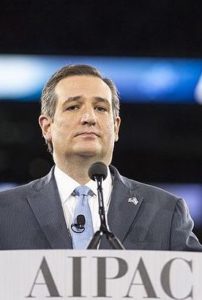
Sen. Ted Cruz at AIPAC
The American Israel Public Affairs Committee (AIPAC) is an influential advocacy group whose mission is to “ensure that both America and Israel remain strong and that they collaborate closely together.” AIPAC is regarded as a driving force of “America’s pro-Israel lobby.”
Although it states that it “receives no financial assistance from Israel,” the American Israel Public Affairs Committee generally promotes the policy objectives of the government in power in Israel. This has led critics to bemoan its undue influence on Washington, arguing that what is best for Israel is not necessarily what is best for the United States.
Both liberal and conservative politicians actively court the group. Boasting about the group’s clout, former AIPAC lobbyist Steven J. Rosen reportedly once slipped a napkin to “pro-Israel” journalist Jeffrey Goldberg and quipped, “You see this napkin? In twenty-four hours, we could have the signatures of seventy senators on this napkin.”[1]
Although AIPAC suffered some setbacks during the Obama presidency, the election of Donald Trump led right-wing “pro-Israel” factions to expect it to deliver “messianic outcomes for Israel,” as one observer noted.[2] AIPAC has at times had strained relations with the former real estate mogul. During the 2016 presidential campaign, Trump stirred controversy at AIPAC’s annual conference when he got a huge ovation after arguing that President Barack Obama “may be the worst thing to ever happen to Israel, believe me, believe me.” The incident prompted AIPAC to issue an unprecedented apology the following day.[3]
Observers have noted the American Israel Public Affairs Committee’s financial connections with hard-right neoconservative groups like the Center for Security Policy that have been key backers of controversial Trump policies, like his executive orders banning travel from several Muslim-majority countries. Wrote one journalist: “AIPAC’s willingness to partner with an organization whose president, Frank Gaffney, was denounced by the Anti-Defamation League, the Southern Poverty Law Center and the American Conservative Union … raises serious questions about AIPAC’s commitment to fighting bigotry, discrimination, and, in particular, Islamophobia.”[4]
AIPAC in the Age of Trump
Donald Trump’s presidency presented the American Israel Public Affairs Committee (AIPAC) with a quandary. The organization had taken the unusual step of apologizing not only for Trump’s words attacking President Barack Obama at its 2016 policy conference, but also for the reaction of a large part of the audience. Trump was decidedly unpopular among the clear majority of Jews in the United States but found a great deal of support in Israel after an initial period of uncertainty about him. The orthodox Jewish community in the United States—which leaned Republican more than any other sector of U.S. Jews—largely supported Trump’s policies toward Israel. More liberal pro-Israel Jews who found many of his policies and actions distasteful were pleased by his lax attitude toward settlements, his hostility to the Iran nuclear deal, and his intention and eventual decision to move the U.S. embassy in Israel from Tel Aviv to Jerusalem, thus formally recognizing Jerusalem as Israel’s capital.
As former American Israel Public Affairs Committee staff member MJ Rosenberg—who had long since become one of the organization’s most prominent critics—pointed out, “Republicans, who come to their militant support for Israeli policies instinctively, don’t warrant AIPAC arm-twisting but Democrats, invariably dovish on all foreign policy issues except Israel, certainly do.” But Rosenberg also noted that “AIPAC’s grip on Democrats is loosening as younger and more progressive activists flex their political muscles.”[5]
Efforts by the Republicans—which were enthusiastically aided by the right-wing Israeli government of Benjamin Netanyahu—to turn Israel away from its long-held bipartisan status into a wedge issue that could be used against Democrats pre-dated Trump’s election, but observers believed that Trump was the final straw in the “cementing of a more acrimonious relationship between Israel and Democrats.”[6]
This increased partisanship affected AIPAC. At its 2017 policy conference, there was little talk of a two-state solution, or any resolution to the ongoing occupation of the Palestinians. In reviewing the conference, journalist Mitchell Plitnick wrote, “On a policy level, AIPAC is drifting and appears unsure of itself. The scene outside the conference was one where the Jewish alt-right extremists of the Jewish Defense League were clearly closer to AIPAC’s side than the much more moderate protesters who are urging an end to the occupation but are not advocating any anti-Israel measures. The two-state solution is still in the air, and while the Republicans have withdrawn support for it, no one has actually come out against it, as many in the current Israeli government have done. …AIPAC moves on from its 2017 conference with its influence on Congress still strong, but clearly slipping, as it is torn between pushing a bipartisan agenda and working with the new President.”[7]
AIPAC was thrust into the spotlight in February 2019 when freshman congresswoman Ilhan Omar (D-MN)—one of the first two Muslim women to be elected to Congress—suggested first that congressional support for Israeli policies was due to campaign contributions labeling AIPAC as the source of those contribution; and then just a few days later when she spoke of pressure to show allegiance to a foreign country, referring to Israel.
Rosenberg noted that Omar’s campaign financing statement should have been uncontroversial. “Somehow, I don’t think the reaction would have been the same if she had tweeted that Congress still supports the ethanol subsidy because the American Farm Bureau and other components of the corn/ethanol lobby spend millions to keep this agribusiness bonanza going (which they do),” he opined. “Or that if she had opposed the ethanol subsidy, she would have been accused of hating farmers.”[8]
Nonetheless, Omar faced a storm of accusations of anti-Semitism for suggesting that campaign contributions influenced congressional policy regarding Israel. Politicians on both sides of the aisle denounced Omar’s statement as an echo of anti-Semitic stereotypes involving Jewish money and power. Leading House Democrats pressured her to apologize and she did so. Then President Donald Trump called on Omar to resign. Even her sharpest Democratic critics, including House Foreign Relations Committee Chairman Eliot Engel (D-NY) rebuffed the president on this.[9]
Just days later, Omar made an appearance at a Washington, DC restaurant where one sentence she said out of a nine-minute speech reignited the controversy. She said, “I want to talk about the political influence in this country that says it is okay to push for allegiance to a foreign country.” Critics jumped at the statement, saying Omar was accusing Jews of dual loyalty, an accusation which had historically led to severe violence against Jewish communities.[10]
Journalist Mitchell Plitnick—pointing out the broader context of her words and quoting her more extensively—argued that “Omar is clearly referring to the many forces that influence U.S. policy toward Israel and Palestine, which includes Jewish and Christian communities, weapons and tech manufacturers, and geopolitical strategic hawks. It’s obvious she was not referring to Jews or any other specific sector of the multi-faceted pro-Israel influence.”[11]
This time, when House Democratic leadership moved to rebuke Omar with a resolution that would not name her but would condemn anti-Semitism and only imply criticism of the new congresswoman, they faced strong pushback from pro-peace and pro-Palestinian organizations as well as from progressive Democrats in Congress.[12] The intra-party fighting ended with a resolution that condemned anti-Semitism and Islamophobia and noted many other forms of bigotry the House was standing against. Most saw the modified language as a victory for Omar and progressives.[13]
This came shortly after an AIPAC-sponsored amendment on the first bill the Senate passed in 2019 split the Democratic vote, an unusual occurrence for AIPAC-sponsored legislation and a further blow to the organization’s coveted bipartisan reach. With only one exception, every Democrat in the Senate who had joined the race for the 2020 presidential nomination voted against the measure, which allowed states to require that anyone doing business with state government agree not to support a boycott of Israel.[14]
“This split between Republicans and Democrats on Israel is real, and is mirrored in a split between the government of Israel and the American Jewish community,” said Martin Indyk, who once worked for Aipac and was later ambassador to Israel under Bill Clinton and a special envoy for the peace process under Barack Obama. “And since the American Jewish community is a pillar of the Democratic Party and is AIPAC’s base, you’ve got kind of a perfect storm.”[15]
Friction With Obama
In 2013 and 2014, the American Israel Public Affairs Committee suffered a series of high-profile defeats that led some observers to question whether the group would retain its influence in coming years. Notably, after failing to marshal sufficient support for a U.S. military strike on Syria or to head off renewed nuclear negotiations between Iran and the P5+1 powers, AIPAC had to back down from its 2013-2014 bid to pass new Iran sanctions legislation while talks were underway after failing to persuade enough Democrats. Critics in and outside of government accused the bill’s supporters of trying to sink the negotiations and foment a war. “AIPAC and other hard-line groups remain a potent force in guaranteeing generous U.S. aid to Israel and hamstringing U.S. efforts to achieve a two-state solution,” said Harvard Professor Stephen Walt, “but their clout declines when they advocate a course of action that could lead to another Middle East war.”[16]
AIPAC faced another setback in mid-2014, when their efforts to amend a bill in Congress that would allow Israelis to enter the United States without a visa—while not requiring the same of Israel for U.S. citizens—faced a critical response and ultimately failed. One observer noted that the proposed AIPAC provision “raised a lot of hackles on Capitol Hill, even in some offices that are very AIPAC-friendly.”[17]
Support for the group seemed to be slipping among many of the otherwise liberal-leaning Jewish voters who had traditionally provided the backbone of its support. “Today, a growing number of American Jews, though still devoted to Israel, struggle with the lack of progress toward peace with the Palestinians. Many feel that AIPAC does not speak for them,” reported The New Yorker in a lengthy 2014 profile.[18]
Noting AIPAC’s increasing alienation from important constituencies and increasing reliance on evangelical Christians and Republicans, journalist Jim Lobe wrote in August 2014: “Liberal Zionists—who undoubtedly constitute a majority of American Jews (who in turn constitute a major source of political campaign funding for Democrats)—face a choice between their Zionism, as defined by Netanyahu and AIPAC, on the one hand and their liberal values on the other. The two appear to have become mutually exclusive.”[19]
Iran
Iran has long been a key target of AIPAC’s lobbying efforts, which it calls “the world’s leading state sponsor of terror.”[20]
AIPAC has been a leader in efforts to thwart diplomatic progress over Iran’s nuclear program, instead promoting ever-tighter sanctions on the country. In a June 2012 “Issue Memo” titled “While the World Talks, Iran Enriches; More Pressure Needed,” AIPAC argued that the then on-going talks between Iran and the U.N. Security Council and Germany (P5+1) were failing to produce results and that “crippling economic sanctions must be accelerated to prevent Tehran from achieving a nuclear weapons capability.” The memo also dismissed any consideration of “containing” Iran and added that “the United States must make clear that it will prevent Iran from developing or acquiring nuclear weapons and that Iran will not be allowed to acquire the capability to quickly produce a nuclear weapon at a time of its choosing.”[21]
In the months leading up to the successful conclusion of a comprehensive deal between Iran and the P5+1, AIPAC spent a record amount of money lobbying Congress to pass legislation giving members of Congress the ability to review any final agreement. A July 2015 Washington Post article stated: “The $1.67 million that AIPAC spent so far this year is more than the group has ever spent on direct lobbying during a six-month period—at least in the last 16 years.”[22]
After the announcement that the parties had reached an agreement, AIPAC released a statement denouncing the deal and vowing to fight to overturn it in Congress: “After more than 20 months of negotiations, the United States and its negotiating partners announced a nuclear agreement with Iran. Throughout the negotiations, AIPAC outlined five critical criteria for a good deal. Unfortunately, the proposed agreement is fundamentally flawed in each of these vital areas. Urge your senators and representative to oppose the agreement.”[23]
Even as the nuclear agreement became international law in late July 2015 by way of a U.N. Security Council resolution, AIPAC declared it would launch an all-out effort to lobby Congress to pass veto-proof legislation scuttling the deal. “In the coming weeks, AIPAC will mobilize the entirety of our institutional resources in order to articulate our concerns about the agreement and secure a broad bipartisan vote in Congress to oppose the deal,” read an email AIPAC sent to its top members and donors after the closing of the deal.[24]
In July 2015, AIPAC created a new tax-exempt lobbying group, Citizens for a Nuclear Free Iran (CNFI), to bolster its efforts to lobby against the nuclear deal. According to the new group’s spokesperson, Patrick Dorton, CNFI’s purpose was to educate the public “about the dangers of the proposed Iran deal.” Reported the New York Times: “A person who had been briefed on the plan said the group planned to spend upward of $20 million on the effort. Another person familiar with the campaign said advertising was planned in 30 to 40 states.”[25]
CNFI’s advisory committee consists of a number of former hawkish Democratic members of Congress, including former Sens. Evan Bayh (IN), Mark Begich (AK), Mary Landrieu (LA) and Joseph Lieberman (CT), and former Rep. Shelley Berkley (NV).[26]Commented The Nation’s Ali Gharib: “It’s sort of a remarkable list when you look at it. I mean, it’s obvious why AIPAC picked them, they’re the most stalwart-like traditionally pro-Israel figures that have come off the Hill in recent years.”[27]
A July 2015 Nelson Report newsletter quoted a “former AIPAC official” about the reasons the heavy investment the lobby was making in persuading Congress to reject the Iran deal. Among the reasons were that “Iran has been an enormously lucrative fundraiser for AIPAC” and that “without this cause AIPAC and this Israeli government” may have to “focus on more critical issue [sic], like peace with the Palestinians.”[28] The former AIPAC official further proclaimed: “Iran has been the group’s raison d’être for two decades, and it doesn’t know what else to do; its troops are trained to attack Iran and the lobby can’t afford to admit failure lest it lose supporters.”[29]
An AIPAC executive stated that AIPAC’s opposition to the Iran deal is “good for business” and that the group is “terrified they’re going to lose their major fund-raising appeal” if the Iran issue gets resolved. This led one reporter to write that it “appears that AIPAC, which, after calling for careful study of the JCPOA, urged Congress to reject it just over 24 hours later, may see the deal’s survival as an ‘existential threat’ to … itself, more than anything else.”[30]
AIPAC supported imposing additional sanctions on Iran even as the negotiations were making headway in late 2013, when the P5+1 powers—including the United States—reached an interim agreement that would see Iran restrict its enrichment activities in exchange for minor sanctions relief while the parties negotiated a final agreement.
While a November 2013 AIPAC memo acknowledged that the agreement did limit Iran’s abilities to enrich, the lobby was dissatisfied with Iran being allowed to enrich uranium at all and called for Congress to preemptively pass new sanctions in the event the agreement failed.[31] That same month, the hawkish “pro-Israel” Sen. Mark Kirk (R-IL) revealed that he was working with AIPAC and Sen. Robert Menendez (D-NJ). to push new sanctions even as talks were underway, defying calls from the Obama administration to give the talks a chance.[32] The Kirk-Menendez sanctions package ultimately floundered after AIPAC failed to muster enough Democrats to secure a veto-proof majority and Majority Leader Harry Reid refused to bring the bill to the floor.[33]
In March 2014, as the annual AIPAC policy conference was underway in Washington, Reps. Eric Cantor (R-VA) and Steny Hoyer (D-MD)—both reliable AIPAC allies—circulated a letter among their colleagues saying that while they “do not seek to deny Iran a peaceful nuclear energy program,” they were concerned that “Iran will use prolonged negotiations as a tool to secure an economic lifeline while it continues to make progress towards a nuclear weapon.” Expressing concern about “Iran’s state sponsorship of terrorism, its horrendous human rights record, its efforts to destabilize its neighbors, its pursuit of intercontinental ballistic missiles, and its threats against our ally, Israel, as well as the fates of American citizens detained by Iran,” they concluded with the typical hawkish refrain, “we must keep all options on the table to prevent this dangerous regime from acquiring nuclear weapons.”[34]
Describing the letter as “AIPAC-approved,” the Inter Press Service (noted that while the letter was “a bit more congenial than” the Kirk-Menendez approach in that it did not propose specific new sanctions, its not-too-subtle nod to military action “naturally raises hackles and strengthens hardliners in Tehran.”[35]
In the lead up to the November 2014 deadline for an agreement to be reached in negotiations between Iran and the P5+1, AIPAC voiced support for a letter sent by Reps. Ed Royce(R-CA) and Eliot Engel (D-NY) to Secretary of State John Kerry. LobeLog contributor Peter Jenkins wrote that the Royce-Engel letter contained “many distortions of the truth.” Regarding the letter’s claim that “it’s not a hard proposition” for Iran to prove its nuclear program is peaceful, Jenkins opined: “Actually it’s a very hard proposition to prove. How can a state ’prove’ that it does not have some small secret fissile material production facility somewhere on its territory? That is why the IAEA is never ready to offer more than ‘credible assurances’ that a given nuclear program is truly peaceful.”[36]
Among the key sanctions AIPAC has promoted in recent years was the 2009 House-passed Iran Refined Petroleum Sanctions Act, which according the Congressional Research Service could prevent the United States “from providing credit, insurance, or guarantees to any project controlled by any energy producers or refiners that contribute significantly to Iran’s refined petroleum resources.”[37]
According to AIPAC, the bill represented “landmark sanctions legislation that would reinforce American diplomatic efforts with Iran with the threat of tougher sanctions if Iran rejects U.S. overtures and continues to enrich uranium.”[38] However, other observers countered that the bill would “hurt the Iranian people while having little effect on the leadership [the] sanctions are supposed to put pressure on; undermine the Obama administration’s attempts at engagement with Iran under a multilateral negotiating framework; and isolate the U.S. by antagonizing crucial allies in the UN Security Council.”[39]
Syria Another key AIPAC target has been Syria, which the lobby views as a threat to Israel, in part because of Syrian support for the Lebanese militant group Hezbollah. After the start of the opposition uprising in 2011, AIPAC released several issue memos lambasting the Syrian regime for committing human rights abuses and supporting terrorism. Although it avoided calling for direct U.S. military engagement, the lobby pressed for increased sanctions on the country.
A July 2011 issue memo called for tightening sanctions and international pressure. “The United States must hold Syria accountable for its destructive behavior and fully implement sanctions on Damascus as authorized under the Syria Accountability Act,” it said. “The Treasury Department should sanction Syrian banks and businesses facilitating Damascus’ illicit activities.”[40]
By September 2013, AIPAC was unabashedly supporting a U.S. strike on the country, launching a lobbying blitz on Capitol Hill aimed at convincing U.S. lawmakers to authorize an attack and warning that any failure to act would embolden Iran.[41] Connecting AIPAC’s interest in the Syrian civil war to its position on Iran, AIPAC critic MJ Rosenberg argued that “AIPAC joined the battle to win Congressional approval because resolving the Syria crisis through any means other than war would set a terrible precedent for Iran: resolving the Iran nuclear issue diplomatically.” But with U.S. popular opinion deeply opposed to U.S. involvement in the war, Rosenberg noted that “AIPAC’s big lobbying day for war with Syria changed no votes. Not one.”[42]
AIPAC had stepped up its campaign against Syria many years before the uprising began. Shortly after President George W. Bush declared “mission accomplished” in Iraq in May 2003, AIPAC began pushing for passage of the Syria Accountability and Lebanese Sovereignty Restoration Act, which allowed for U.S. sanctions against Syria.
The move stirred rumors that the Bush administration was contemplating “regime change” in Syria following its invasion of Iraq. Reported the Deutsche Presse-Agentur in November 2003, “In his speech this month about the need for the Middle Eastern countries to move toward democracy, U.S. President George W. Bush won some praise, but his words were also met with apprehension among Arab countries in the region. The basis for such worries was that Bush’s speech was preceded by suggestions from the so-called neoconservatives. They were the spearhead of the drive that led to the invasion of Iraq. For example, one of them, Richard Perle , chairman of the Defense Policy Board, talked (while in Israel) about the Syrian government’s failure to stop infiltration of guerrillas into Iraq. He coupled that with the observation that Syria’s military strength was feeble. This occurred at the same time that the Israeli lobby in Washington, the American Israel Public Affairs Committee, was using its muscle on the U.S. Congress to pass the Syria Accountability Act. This would impose U.S. sanctions on Syria unless Syria ended its occupation of parts of Lebanon, cut its ties to Palestinian groups the United States regards as terrorists, and stopped its alleged development of chemical and biological weapons.”[43]
In an October 2009 policy brief, AIPAC argued that despite the imposition of sanctions since passage of the Syria Accountability Act, little had changed. It also criticized the Obama administration’s efforts at negotiation, stating: “While the Obama administration has renewed sanctions imposed under the Syria Accountability Act, it also has sought to improve relations between Washington and Damascus through a series of high-level visits to Syria that have largely focused on persuading Syria to clamp down on the influx into Iraq of foreign fighters who have directly contributed to the instability of the new Iraqi government and the deaths of American soldiers.”[44]
AIPAC and Iraq
AIPAC was in the thick of things during the lead up to the 2003 U.S. invasion of Iraq. According to press reports, AIPAC membership jumped nearly 50 percent, to some 70,000, in the wake of the 9/11 attacks, in part through ties the group had made with the Christian Right, which reflected a key strategy promoted by many neoconservatives and foreign policy hardliners during the 1990s. In late 2002, as talk about war heated up in Washington, AIPAC held a “national summit” in Atlanta to discuss the possible war and to strategize with supporters. Among the conference speakers were Wolfowitz, Tom Ridge, and Ralph Reed, the former head of the Christian Coalition.[45]
AIPAC’s efforts to persuade U.S. lawmakers to go after Iraq date back to the first Gulf War. In an interview shortly after the 1991 Gulf War began, Thomas Dine, then president of AIPAC, told the Wall Street Journal that his organization had been busy behind the scenes building support for the war. “Yes, we were active,” said Dine. “These are the great issues of our time. If you sit on the sidelines, you have no voice.”[46]
According to press reports, in 1990 alone pro-Israel groups gave nearly $8 million in campaign contributions. Of those on the Democratic side of the aisle who received PAC cash and later supported the decision to go to war was Sen. Harry Reid, who had received $150,000 from pro-Israel PACs during his Senate election bid. A dozen years later, in 2002, Reid again supported the use of force against Iraq. Other Democrats who voted for the 1991 Gulf War resolution and received lobby cash included Sen. Richard Bryan of Nevada and Sen. Howard Heflin of Alabama. According to the Wall Street Journal, the entire Alabama delegations in both the House and Senate voted for the resolution. Although at first glance “this can be ascribed to the conservative, pro-military character of the state,” opined the Journal, it is clear that “pro-Israel PACs have also cultivated Democrats [in the state] in recent years.”[47]
A key AIPAC supporter at the time who actively worked to get congressmen on board the Gulf War resolution was Rep. Stephen Solarz (D-NY). Solarz, who later became a supporter of various Project for the New American Century (PNAC) initiatives (he signed the notorious September 20, 2001 PNAC letter calling for war against Iraq “even if evidence does not link Iraq directly to the [9/11] attack”), personally lobbied Sen. Al Gore, who voted for the resolution, as well as several other fence-sitters among the Democrats, whom Solarz accused of being “tragically shortsighted” in their view of the Israeli-American relationship. Solarz also pushed AIPAC to play a more public role in supporting the use of force, as well as several other pro-Israel lobbies, including the Reform Jewish Movement.[48]
Once the first Gulf War was under way, AIPAC set about capitalizing on the growing U.S. public support for Israel in the wake of Saddam Hussein’s Scud missile attacks on Israel. According to the Washington Report on Middle East Affairs (WRMEA), by the end of January 1991, AIPAC had rushed off a letter to its supporters outlining a post-war campaign. Reported WRMEA: “Counting on the American public’s newfound understanding of Israel’s vulnerability, AIPAC will press for a new package of security aid for Israel far larger than any previous package. Second, the lobby will encourage the United States to strengthen its friendship with Israel and avoid ‘pandering toward Arab states hostile to the West and Israel.’ Third, it will request millions of dollars more in housing loan guarantees to settle Soviet Jews. And finally, it will work to ensure that any diplomatic efforts to resolve the Arab-Israeli conflict will be based on ‘close cooperation and trust between the United States and Israel.'”[49]
Arming Israel
AIPAC’s most fundamental function has been pressing for military aid for Israel in a variety of forms. This includes direct annual aid, occasional supplemental requests, and a variety of partnership arrangements with U.S. business and government projects. For example, the U.S. heavily subsidized Israel’s Arrow missile defense system, which AIPAC has described as “among the world’s most sophisticated missile shields.”[50]
After the Senate voted in 2002 to include money for the Arrow system and other Israeli military priorities in a defense spending bill, AIPAC proudly reported, “In a vote of 95-3, the Senate last week passed the fiscal year 2003 Defense Appropriations bill, which provides substantial funding for U.S.-Israel strategic cooperation. The Arrow Missile Defense Program received $80 million above the administration’s request for a total of $146 million. Additional funding includes the following: $23.5 million for the Mobile Tactical High Energy Laser; $64.9 million for the Litening II Targeting Pod; $35 million for Bradley Reactive Armor Tiles; $22 million for the Hunter Unmanned Aerial Vehicle; and $20 million for the Improved Tactical Air-Launched Decoy.”[51]
Several high-profile Bush administration officials have had financial interests in many of the weapons systems pushed by AIPAC, including Jay Garner, the former “mayor of Baghdad.” Garner is a past president of SY Coleman Technology, which produced parts for the Arrow missile system. Garner also has strong ties to the neoconservative Jewish Institute for National Security Affairs.
Stephen Walt and John Mearsheimer highlighted U.S. support for Israel’s weapons procurement as one of the many signs of the many “special deals” the pro-Israel lobby has helped the country seal. “The United States has provided Israel with nearly $3 billion to develop weapons systems like the Lavi aircraft that the Pentagon did not want or need, while giving Israel access to top-drawer U.S. weaponry like Blackhawk helicopters and F-16 jets. Finally, the United States gives Israel access to intelligence that it denies its NATO allies and has turned a blind eye toward Israel’s acquisition of nuclear weapons.”[52]
More recently, AIPAC has been a leading proponent of U.S. funding for Israel’s “Iron Dome” missile defense system, a joint U.S.-Israeli project putatively designed to shield Israel from rocket attacks launched from the Palestinian territories. Although many have questioned the effectiveness of the expensive program, AIPAC has credited it with “saving countless civilian lives.”[53] As Congress contemplated budget cuts to defense and foreign aid programs in early 2013, AIPAC mobilized to protect Israel’s line items, including the Iron Dome system. “During a period of mounting threats to American interests in the region and to our critical ally, Israel, this is no time to reduce critical assistance which would only result in greater and graver costs,” said an AIPAC spokesperson quoted by the Jerusalem Post.[54]
The following year, during Israel’s 2014 war on Gaza, AIPAC lobbied intensively for an emergency $225-miillion supplement in U.S. funds for Iron Dome. “The worst part was having to vote for this at a time we are all so upset by the killing in Gaza,” said a Republican Senate aide. “It’s as if AIPAC knows how angry we are so the whole Senate has to take their test. They will make us cast a totally symbolic vote, just to show who’s in charge. It’s so telling that the only issue we come together with Democrats is on an AIPAC vote. We don’t even come together on our wars, when our soldiers are in the field. The senator was sick about it.”[55]
History
In 1951 I.L. “Si” Kenen formed the American Zionist Committee for Public Affairs (AZCPA) as a lobbying division in the American Zionist Committee. Kenen’s focus was on U.S. financial aid to the fledgling country. The AZCPA had by far its best connections in Washington with liberal, democratic members of Congress, while it had the most trouble with conservative Republicans.
In late 1953, Kenen saw the need for a nimble, independent U.S. advocacy group that could respond to crises in U.S. support for Israel at a time when fundamental policy toward the new Jewish state was still very much a matter of debate. In October 1953, news of a massacre committed by an Israeli army unit in the West Bank town of Qibya reached the United States. The mass killing of civilians tarnished Israel’s image and gave impetus to those in the U.S. government who preferred a policy of even-handedness in the region. Many in the Eisenhower administration—including secretary of state John Foster Dulles—were concerned about relationships with the Arab world. They worried about increasing Soviet influence in the region as well as growing Arab nationalism and questioned whether Israel—with its largely socialist economy at that time—was a sufficiently reliable ally. Eisenhower was sympathetic to these arguments, although he was also mindful of Israel’s popularity and the sympathy the Jewish state had among Americans.[56]
While Eisenhower did suspend aid to Israel for a while,—over an earlier incident where Israel had tried to divert the water of the Jordan River, an incident the U.S. had kept quiet until the Qibya massacre—Kenen and AZCPA played a key factor in restoring Israel’s image in Washington. In the wake of the clash with the Eisenhower administration and the Qibyamassacre, the AZCPA became independent.
Renamed the American-Israel Public Affairs Committee in 1959 and incorporated in 1964, the organization worked to maintain its strong contacts among liberal politicians and to keep a narrow focus to maintain widespread Jewish support. Financial and military aid to Israel—which was far lower prior to the Camp David agreement brokered by President Jimmy Carter in 1978—remained the primary focus of the organization through the years until Kenen retired in 1974.
Over the next fifteen years, AIPAC moved rightward and became a much stronger force in U.S. politics. A new executive director, Thomas Dine, worked to establish a nationwide grassroots network, and put a stronger emphasis on fundraising and campaign financing. Although AIPAC, as a non-profit organization, cannot legally contribute to campaigns, the organization used its growing network to encourage the formation of pro-Israel political action committees.[57]
During the Ronald Reagan and George H.W. Bush years, several political incidents established and cemented AIPAC’s reputation as one of the most important lobbying groups in Washington. Before Reagan, the Republican party—at the time characterized by its often unsentimental and Realist view of foreign policy and its relatively meager Jewish representation—was known to be a tough place for pro-Israel messaging. But after Israel—under its first right wing government—cast President Jimmy Carter in a negative light for pressuring their prime minister, Menachem Begin, into the Camp David agreement with Egypt, Reagan came in singing love songs to Israel and got a much larger than usual percentage of the Jewish vote in 1980.
Meanwhile, the Religious Right was on the rise and with it came the revival of Dispensationalist Protestant support for Israel which had been a significant factor in the early days of the Zionist movement but had largely lain dormant since. These political factors helped Reagan sustain a pro-Israel image despite often running afoul of the Jewish community.[58]
In 1981, the Reagan administration agreed to sell airborne early warning and control systems aircraft (AWACS) to Saudi Arabia. Israel strongly opposed the sale, but Reagan was insistent, famously saying that ”it is not the business of other nations to make American foreign policy.”[59] The president prevailed, but not by much. The House of Representatives voted against the sale, but the Senate passed it by a narrow margin. Yet even in defeat, AIPAC had made a strong mark. The group had gone up against a new president, one that was extremely popular at that time, and had very nearly won the fight.[60]
In 1982, now-Senator Dick Durbin (D-IL) defeated Rep. Paul Findley (D-IL), an eleven-term congressman who had described himself as Palestine Liberation Organization leader YasirArafat’s best friend in Congress. Though AIPAC could not directly involve itself, AIPAC activists, connected through AIPAC’s network, supported Durbin and helped to oust Findley. In 1984, Rep. Paul Simon (D-IL) defeated Sen. Chuck Percy (D-IL) in another primary contest that many believed AIPAC had a powerful hand in. Debate has raged ever since over the degree to which the defeats of both men were due to AIPAC’s efforts, but even the possibility that AIPAC was a primary cause of their defeat has served as a powerful tool in the organization’s kit.[61]
When Bill Clinton defeated incumbent George H.W. Bush in 1992, some believed that Bush’s public criticism of AIPAC and his rocky relationship with former Israeli prime ministerYitzhak Shamir was a significant factor. Bush had put a hold on $10 million in loan guarantees—loans that were meant to help with relocating Jewish refugees from the crumbling Soviet Union—unless Israel could guarantee that it would not use the money for new West Bank settlements. Jewish votes swung away from his re-election bid, although it is unclear what effect this had on the election’s outcome, particularly since the race was not close and other major factors—an economic recession and a conservative third-party candidate—may have been more decisive.[62] Still, Bush described himself during the loan guarantee fight as “one lonely little guy” facing “a thousand lobbyists.” The image, as one journalist noted, “has become a staple of the narrative that Israel backers wield excessive power in the American political system.”[63]
The Influence of the “Israel Lobby”
The apparent ability of the “Israel Lobby” to influence the direction of U.S. policy has been hotly debated for years, particularly since the 2003 invasion of Iraq, as many key champions of the war in the Bush administration—including Paul Wolfowitz and Douglas Feith—seemed to be motivated by their views on Israeli security. However, many elements of the lobby—including inside AIPAC—were not immediately supportive of the neoconservative desire to go to war with Iraq.
In their hotly contested 2006 paper and 2007 book on the lobby, John Mearsheimer and Stephen Walt emphasized the influence of neoconservatives within it. They wrote: “Although neoconservatives and other Lobby leaders were eager to invade Iraq, the broader American Jewish community was not. In fact, Samuel Freedman reported just after the war started that ‘a compilation of nationwide opinion polls by the Pew Research Center shows that Jews are less supportive of the Iraq War than the population at large, 52% to 62%.’ Thus, it would be wrong to blame the war in Iraq on ‘Jewish influence.’ Rather, the war was due in large part to the Lobby’s influence, especially the neoconservatives within it.”[64]
But as the Washington Post‘s Glenn Frankel reported, AIPAC “took no official position on the merits of going to war in Iraq. But, like the Israeli government, once it was clear that the Bush administration was determined to go to war, AIPAC cheered from the sidelines, bestowing sustained ovations on an array of administration officials at its April 2003 annual conference and on Bush himself when he attended the following year.”[65]
Few would dispute the influence of groups like American Israel Public Affairs Committee (AIPAC) and its spinoff, the Washington Institute for Near Policy. However, analysts who criticize this influence often face accusations of anti-Semitism, as was the case with Walt and Mearsheimer when they released their working paper. Remarks made by Alan Dershowitz, the well-known lawyer and Harvard professor, were typical of much of the criticism. Dershowitz lambasted the paper as being full of “bigoted comments” and that it had the “the smell of singling out Jews and singling out Israel.”[66]
The two authors foresaw the criticism, arguing in the paper: “No discussion of how the Lobby operates would be complete without examining one of its most powerful weapons: the charge of anti-Semitism. Anyone who criticizes Israeli actions or says that pro-Israel groups have significant influence over U.S. Middle East policy—an influence that AIPAC celebrates—stands a good chance of getting labeled an anti-Semite. In fact, anyone who says that there is an Israel Lobby runs the risk of being charged with anti-Semitism, even though the Israeli media themselves refer to America’s ‘Jewish Lobby.’ In effect, the Lobby boasts of its own power and then attacks anyone who calls attention to it. This tactic is very effective, because anti-Semitism is loathsome, and no responsible person wants to be accused of it.” [67]
While much of the criticism of Mearsheimer and Walt’s work did indeed reflect the hysterical backlash they anticipated, there were some sober and respectful rebuttals as well. For example, writing in the Middle East Report, Mitchell Plitnick and Chris Toensing stated, “The essential flaw in the Mearsheimer-Walt argument is not, as many critics have said, the authors’ exaggeration of the pro-Israel lobby’s power, for although the authors do this in some instances, the thrust of their argument remains sound in many others. It is not even their inattention to the other factors that have historically defined the US interest in the Middle East for the bipartisan foreign policy establishment. Rather, the most serious fault lies in the professors’ conclusion—soothing in this day and age—that US Middle East policy would become “more temperate” on any number of fronts were the influence of the Israel lobby to be curtailed. This conclusion is undercut by the remarkable continuities in US Middle East policy since the Truman administration, including in times when the pro-Israel lobby was weak. Other factors—chiefly the drive for hegemony in the Persian Gulf—have embroiled the US in plenty of trouble.”[68]
According to some estimates, there are about 500 national and local organizations that collectively make up the Israel lobby. And of those,American Israel Public Affairs Committee arguably carries the most weight—Newt Gingrich once called it “the most effective general interest group over the entire planet.” As Walt and Mearsheimer reported: “In 1997, Fortune magazine asked members of Congress and their staffs to list the most powerful lobbies in Washington. AIPAC was ranked second behind the American Association of Retired People (AARP), but ahead of heavyweight lobbies like the AFL-CIO and the National Rifle Association. A National Journal study in March 2005 reached a similar conclusion, placing AIPAC in second place (tied with AARP) in the Washington ‘muscle rankings.'”[69]
The American Israel Public Affairs Committee lists “preparing the next generation of pro-Israel leaders” as one of its goals, casting its net far beyond Jewish circles. “In the last few years, the American Israel Public Affairs Committee has broadly expanded beyond its Jewish membership base reaching out to Hispanics, African-Americans, and Christian activists,” reported the Religion News Service.[70]
On AIPAC’s diverse array of supporters, Walt and Mearsheimer reported: “The Lobby also includes prominent Christian evangelicals like Gary Bauer, Jerry Falwell, Ralph Reed, and Pat Robertson, as well as Dick Armey and Tom DeLay, former majority leaders in the House of Representatives. They believe Israel’s rebirth is part of Biblical prophecy, support its expansionist agenda, and think pressuring Israel is contrary to God’s will. In addition, the Lobby’s membership includes neoconservative gentiles such as John Bolton, the late Wall Street Journal editor Robert Bartley, former Secretary of Education William Bennett, former UN Ambassador Jeanne Kirkpatrick, and columnist George Will.”[71]
Lawrence Franklin Controversy
Normally operating behind the scenes in political and lobbyist orbits, AIPAC found itself in the public spotlight over a controversy involving two of its (now former) employees that erupted in 2005.
In May 2005, the FBI arrested Lawrence Franklin, a Pentagon analyst, for disclosing government secrets. According to an FBI affidavit, Franklin shared information about possible attacks on U.S. forces in Iraq with American Israel Public Affairs Committee (AIPAC) staffers Steven Rosen and Keith Weissman during an FBI-monitored lunch in June 2003. Franklin was allegedly upset that his hardline stance on Iran was not getting the notice he thought it deserved, and he hoped AIPAC would be able to attract attention to his views. According to the New York Times, supporters of an “influential circle in the Pentagon” (whose members have long-standing ties to AIPAC and were leading advocates for war in Iraq) blame the FBI’s investigation on “the continuing struggle inside the administration over intelligence.”[72]
Several months after Franklin’s arrest, the Department of Justice issued an indictment against Rosen and Weissman. According to the indictment, the pair passed the information Franklin gave them to a journalist and an Israeli diplomat, leading to charges that they had conspired to violate the 1917 Espionage Act.
Although Franklin pleaded guilty to his charges and received a sentence of 12.5 years in prison, Rosen and Weissman escaped prosecution. In May 2009, the Justice Department asked the court to drop the charges against the two, citing court decisions that would have forced disclosure of classified information and reduced the likelihood of successful prosecution.[73]
SOURCES
[1] Jeffrey Goldberg, “Real Insiders,” New Yorker, July 4, 2005, http://www.newyorker.com/magazine/2005/07/04/real-insiders.
[2] Eric H. Yoffie, “Will Trump Cause a Crisis for AIPAC?” Haaretz, January 13, 2017, https://www.haaretz.com/opinion/.premium-will-trump-cause-a-crisis-for-aipac-1.5485233
[3] Mitchell Plitnick, “How Donald Trump Exposed AIPAC,” New Republic, March 24, 2016, https://newrepublic.com/article/131994/donald-trump-exposed-aipac
[4] Eli Clifton, “AIPAC Gave $60K To Architect Of Trump’s Muslim Ban,” Lobelog, March 15, 2017, https://lobelog.com/aipac-gave-60k-to-architect-of-trumps-muslim-ban/
[5] MJ Rosenberg, “Sorry, Democrats: Your NRA Is Spelled AIPAC,” Lobelog, October 9, 2017, https://lobelog.com/sorry-democrats-your-nra-is-spelled-aipac/
[6] Michael Koplow, “Democrats Are Turning From Israel – Because It’s Tainted By Trump,” The Forward, January 23, 2018, https://forward.com/opinion/392688/democrats-are-turning-from-israel-because-its-tainted-by-trump/
[7] Mitchell Plitnick, “AIPAC 2017: Haley Shines, But Whither The Two-State Solution?” Lobelog, March 30, 2017, https://lobelog.com/aipac-2017-haley-shines-but-whither-the-two-state-solution/
[8] MJ Rosenberg, “Sorry, Democrats: Your NRA Is Spelled AIPAC,” Lobelog, October 9, 2017, https://lobelog.com/sorry-democrats-your-nra-is-spelled-aipac/
[9] Ben Sales, “Ilhan Omar — and her opponents — are raising money off her AIPAC tweet scandal,” Jewish telegraphic Agency, February 14, 2019, https://www.jta.org/2019/02/14/united-states/ilhan-omar-and-her-opponents-are-raising-money-off-her-aipac-tweet-scandal
[10] Jonathan Chait, “Ilhan Omar Accuses Israel Hawks of ‘Allegiance to a Foreign Country,’” The New Yorker, February 28, 2019, http://nymag.com/intelligencer/2019/02/omar-israel-hawks-allegiance-foreign-country-anti-semitism.html
[11] Mitchell Plitnick, “Ilhan Omar: Anatomy Of A Smear,” Lobelog, March 5, 2019, https://lobelog.com/ilhan-omar-anatomy-of-a-smear/
[12] Sherly Gay Stolberg, “House’s Anti-Semitism Resolution Exposes Generational Fight Over Ilhan Omar,” New York Times, March 5, 2019, https://www.nytimes.com/2019/03/05/us/politics/ilhan-omar-israel.html
[13] Emma Green, “ The Fight Over Ilhan Omar Is a Fight Over the Identity of the Democratic Party,” The Atlantic, March 7, 2019, https://www.theatlantic.com/politics/archive/2019/03/ilhan-omar-house-resolution-muslims-democratic-party/584374/
[14] Amir Tibon, “Senate Bill Against BDS Advances After Democrats Split Their Votes,” Haaretz, January 29, 2019, https://www.haaretz.com/us-news/.premium-senate-bill-against-bds-advances-after-democrats-split-their-votes-1.6883741
[15] Sheryl Gay Stolberg, “Ilhan Omar’s Criticism Raises the Question: Is Aipac Too Powerful?” New York Times, March 4, 2019, https://www.nytimes.com/2019/03/04/us/politics/aipac-congress-democrats.html
[16] Jim Lobe, “Top Israel Lobby Group Loses Battle on Iran, But War Not Over,” Inter Press Service, January 24, 2014, http://rightweb.irc-online.org/articles/display/top_israel_lobby_group_loses_battle_on_iran_but_war_not_over.
[17] Mitchell Plitnick, “A Poison Pill for AIPAC,” Lobelog, September 15, 2014, http://www.lobelog.com/a-poison-pill-for-aipac/.
[18] Connie Bruck, “Friends of Israel,” New Yorker, September 1, 2014, http://www.newyorker.com/magazine/2014/09/01/friends-israel.
[19] Jim Lobe, “AIPAC’s Problems,” LobeLog, August 29, 2014, http://www.lobelog.com/aipacs-problems/.
[20] AIPAC, “Issues: Iran,” https://www.aipac.org/learn/issues/issue-display/iran See also: https://web.archive.org/web/20120424200313/http://www.aipac.org/en/issues/issue-display?issueid=%7B1A989C8D-72FF-41B7-9A4B-02067A73CAD3%7D.
[21] AIPAC, “While the World Talks, Iran Enriches; More Pressure Needed,” June 1, 2012, http://www.aipac.org/~/media/Publications/Policy%20and%20Politics/AIPAC%20Analyses/Issue%20Memos/2012/06/AIPAC%20Memo%20While%20the%20World%20Talks%20Iran%20Enriches.pdf.
[22] Catherine Ho, “AIPAC spent record $1.7 million as it lobbied Congress to review Iran deal,” The Washington Post, July 20, 2015, http://www.washingtonpost.com/news/powerpost/wp/2015/07/20/aipacs-lobbying-spending-spikes-as-group-pushes-hard-to-oppose-iran-deal/.
[23] Jessica Schulberg, “AIPAC Drops Pretense of Supporting Iran Deal, Urges Congress to Vote it Down,” The Huffington Post, July 15, 2015, http://www.huffingtonpost.com/2015/07/15/aipac-reject-iran-deal_n_7804820.html.
[24] Jewish Press, “AIPAC Mulling ‘Nuclear Option’ in Lobbying Against Iran Deal,” July 20, 2015, http://www.jewishpress.com/news/breaking-news/aipac-mulling-nuclear-option-in-lobbying-against-iran-deal/2015/07/20/2/.
[25] Julie Hirschfeld Davis, “Pro-Israel Aipac Creates Group to Lobby Against the Iran Deal,” The New York Times, July 17, 2015, http://www.nytimes.com/politics/first-draft/2015/07/17/pro-israel-aipac-creates-group-to-lobby-against-the-iran-deal/.
[26] Julie Hirschfeld Davis, “Pro-Israel Aipac Creates Group to Lobby Against the Iran Deal,” The New York Times, July 17, 2015, http://www.nytimes.com/politics/first-draft/2015/07/17/pro-israel-aipac-creates-group-to-lobby-against-the-iran-deal/.
[27] All In with Chris Hayes, “Iraq War proponents campaign against Iran Deal,” MSNBC, July 21, 2015, http://www.msnbc.com/all-in/watch/iraq-war-proponents-against-iran-deal-488888387631.
[28] Jim Lobe, “Former AIPAC Official on Iran’s Importance to AIPAC,” LobeLog, July 25, 2015, http://www.lobelog.com/former-aipac-official-on-irans-importance-to-aipac/.
[29] Jim Lobe, “Former AIPAC Official on Iran’s Importance to AIPAC,” LobeLog, July 25, 2015, http://www.lobelog.com/former-aipac-official-on-irans-importance-to-aipac/.
[30] Jim Lobe, “Follow-up on AIPAC and Iran Deal,” LobeLog, July 26, 2015, http://www.lobelog.com/follow-up-on-aipac-and-iran-deal/.
[31] Josh Gerstein, ” AIPAC urges new Iran sanctions,” Politico, November 25, 2013, http://www.politico.com/politico44/2013/11/aipac-urges-new-iran-sanctions-178352.html.
[32] Eli Clifton and Ali Gharib, “GOP senator unloads in private call,” Salon, November 21, 2013, http://www.salon.com/2013/11/21/exclusive_gop_senator_unloads_in_private_call/.
[33] Jim Lobe, “Top Israel Lobby Group Loses Battle on Iran, But War Not Over,” Inter Press Service, January 24, 2014, http://rightweb.irc-online.org/articles/display/top_israel_lobby_group_loses_battle_on_iran_but_war_not_over.
[34] Jim Lobe, “Here’s the AIPAC-Approved House Version of Iran Letter to Obama,” LobeLog, March 3, 2014, http://www.lobelog.com/heres-the-aipac-approved-house-version-of-letter-to-obama/.
[35] Jim Lobe, “Here’s the AIPAC-Approved House Version of Iran Letter to Obama,” LobeLog, March 3, 2014, http://www.lobelog.com/heres-the-aipac-approved-house-version-of-letter-to-obama/.
[36] Peter Jenkins, “Royce/Engel Iran Letter: The Devil Lies in the Detail,” LobeLog, September 18th, 2014, http://www.lobelog.com/royce-engel-iran-letter-the-devil-lies-in-the-detail/.
[37] Eli Clifton, “US: One Step Closer to Unilateral Sanctions Against Iran,” Inter Press Service, December 9, 2009, http://www.ipsnews.net/2009/12/us-one-step-closer-to-unilateral-sanctions-against-iran/.
[38] AIPAC, “Take Action: Pass Tougher Iran Sanctions,” https://web.archive.org/web/20100210064406/http://www.aipac.org/694.asp.
[39] Eli Clifton, “US: One Step Closer to Unilateral Sanctions Against Iran,” Inter Press Service, December 9, 2009, http://www.ipsnews.net/2009/12/us-one-step-closer-to-unilateral-sanctions-against-iran/.
[40] AIPAC, “Toughen Syrian Sanctions Now,” July 20, 2011, http://www.aipac.org/~/media/Publications/Policy%20and%20Politics/AIPAC%20Analyses/Issue%20Memos/2011/07/AIPAC%20Memo%20-%20Toughen%20Syria%20Sanctions%20Now.pdf.
[41] Manu Raju, ” AIPAC to go all-out on Syria,” Politico, September 5, 2013, http://www.politico.com/story/2013/09/aipac-syria-96344.html.
[42] MJ Rosenberg, “The AIPAC Collapse,” Washington Spectator, September 13, 2013, https://
[43] “Was Syria Next on the U.S. List?” Deutsche Presse-Agentur, November 14, 2003.
[44] AIPAC, “Is Syria Ready for Peace?” October 6, 2009, http://www.aipac.org/Publications/AIPACAnalysesIssueBriefs/Syria.pdf
[45] Chicago Independent Media Center, “Shut Down AIPAC’s National Summit!” October 2002, http://chicago.indymedia.org/archive/newswire/display/12866/index.php.
[46] “Pro-Israel Lobbyists Quietly Backed Resolution Allowing Bush to Commit U.S. Troops to Combat,” Wall Street Journal, January 28, 1991.
[47] “Pro-Israel Lobbyists Quietly Backed Resolution Allowing Bush to Commit U.S. Troops to Combat,” Wall Street Journal, January 28, 1991.
[48] “Pro-Israel Lobbyists Quietly Backed Resolution Allowing Bush to Commit U.S. Troops to Combat,” Wall Street Journal, January 28, 1991.
[49] Andrea Barron, “AIPAC Not Taking Improved US Israel Relations For Granted,” Washington Report on Middle East Affairs,” March 1991, http://www.wrmea.org/1991-march/jews-and-israel.html.
[50] AIPAC, “Issue: Missile Defense,” http://www.aipac.org/learn/us-and-israel/military-partnership/missile-defense.
[51] Quoted by Anthony Gancarski, “AIPAC, Congress and Iraq,” Counterpunch, August 8, 2002, http://www.counterpunch.org/2002/08/08/aipac-congress-and-iraq/.
[52] John Mearsheimer and Stephen Walt, “The Israel Lobby and U.S. Foreign Policy,” Harvard Kennedy School of Government, March 2006, http://mearsheimer.uchicago.edu/pdfs/IsraelLobby.pdf.
[53] AIPAC, “Issue: Missile Defense,” http://www.aipac.org/learn/us-and-israel/military-partnership/missile-defense.
[54] Niv Elis, “Steinitz: Israel is worried by US sequester,” Jerusalem Post, March 3, 2013, http://www.jpost.com/Business/Business-Features/Steinitz-Israel-is-worried-by-US-sequester.
[55] M.J. Rosenberg, “AIPAC’s Phony Iron Dome Vote,” Media With Conscience, August 6, 2014, http://mwcnews.net/focus/politics/44356-iron-dome-vote.html.
[56] Doug Rossinow, “The dark roots of AIPAC, ‘America’s Pro-Israel Lobby,’” Washington Post, March 6, 2018, https://www.washingtonpost.com/news/made-by-history/wp/2018/03/06/the-dark-roots-of-aipac-americas-pro-israel-lobby/?utm_term=.07999d838c2c
[57] Connie Bruck, “Friends of Israel,” The New Yorker, September 1, 2014, https://www.newyorker.com/magazine/2014/09/01/friends-israel
[58] Ron Kampeas, “Presidents and their ties to Israel: Reagan to Trump,” Texas Jewish Post, July 26, 2018, http://tjpnews.com/presidents-and-their-ties-to-israel-reagan-to-trump/
[59] Bernard Gwertzman, “AWACS Sale Putting Unusual Strain on U.S.-Israel Ties,” New York Times, October 6, 1981, https://www.nytimes.com/1981/10/06/world/awacs-sale-putting-unusual-strain-on-us-israeli-ties-news-analysis.html
[60] Douglas M. Bloomfield, “Secret Saudi-Israel Arms Deals,” Times of Israel, June 28, 2017, https://blogs.timesofisrael.com/secret-saudi-israel-arms-deals/
[61] Connie Bruck, “Friends of Israel,” The New Yorker, September 1, 2014, https://www.newyorker.com/magazine/2014/09/01/friends-israel
[62] “Did the First President Bush Lose His Job to the Israel Lobby?” Observer, July 17, 2006, https://observer.com/2006/07/did-the-first-president-bush-lose-his-job-to-the-israel-lobby/
[63] Eric Cortellessa, “How ‘lonely little’ George H.W. Bush changed the US-Israel relationship,” Times of Israel, December 2, 2018, https://www.timesofisrael.com/how-lonely-little-george-h-w-bush-changed-the-us-israel-relationship/
[64] John Mearsheimer and Stephen Walt, “The Israel Lobby and U.S. Foreign Policy,” Harvard Kennedy School of Government, March 2006, http://mearsheimer.uchicago.edu/pdfs/IsraelLobby.pdf.
[65] Glenn Frankel, “A Beautiful Friendship?” Washington Post, July 16, 2006, http://www.washingtonpost.com/wp-dyn/content/article/2006/07/12/AR2006071201627.html.
[66] Glenn Frankel, “A Beautiful Friendship?” Washington Post, July 16, 2006, http://www.washingtonpost.com/wp-dyn/content/article/2006/07/12/AR2006071201627.html.
[67] Glenn Frankel, “A Beautiful Friendship?” Washington Post, July 16, 2006, http://www.washingtonpost.com/wp-dyn/content/article/2006/07/12/AR2006071201627.html.
[68] Mitchell Plitnick, Chris Toensing, “’The Israel Lobby’ In Perspective,” ReThinking Foreign Policy, May 22, 2011, https://mitchellplitnick.com/2011/05/22/the-israel-lobby-in-perspective/
[69] John Mearsheimer and Stephen Walt, “The Israel Lobby and U.S. Foreign Policy,” Harvard Kennedy School of Government, March 2006, http://mearsheimer.uchicago.edu/pdfs/IsraelLobby.pdf.
[70] Rachel Pomerance, “Pro-Israel Lobby Seeks Christian, Campus Allies to Broaden its Base,” Religion News Service, March 10, 2006, http://www.religionnews.com/2006/03/11/pro-israel-lobby-seeks-christian-campus-allies-to-broaden-its-base/.
[71] John Mearsheimer and Stephen Walt, “The Israel Lobby and U.S. Foreign Policy,” Harvard Kennedy School of Government, March 2006, http://mearsheimer.uchicago.edu/pdfs/IsraelLobby.pdf.
[72] David Johnston and Eric Lichtblau, “Analyst Charged with Disclosing Military Secrets,” New York Times, May 5, 2005, https://www.nytimes.com/2005/05/05/politics/pentagon-analyst-charged-with-disclosing-military-secrets.html
[73] Neil A. Lewis and David Johnston, “U.S. to Drop Spy Case Against Pro-Israel Lobbyists,” New York Times, May 1, 2009, http://www.nytimes.com/2009/05/02/us/politics/02aipac.html?_r=0.