
Stephen Cambone
last updated: February 18, 2013
Please note: The Militarist Monitor neither represents nor endorses any of the individuals or groups profiled on this site.
Affilations
- Villanova University: Matthew J. Ryan Center Thomas W. Smith Senior Fellow, 2012- 2013
- Aspen Security Forum: speaker
- National Defense University, Institute for National Strategic Studies: Former Director of Research
- Center for Strategic and International Studies: Senior Fellow for Political-Military Studies, 1993-1998
- National Institute for Public Policy: Former Study Participant
- Project for the New American Century: Former Project Participant
Government
- Department of Defense: Undersecretary of Defense for Intelligence, 2003-2006; Director for Program Analysis & Evaluation, 2002-2003; Principal Deputy Secretary for Policy, 2001-2002; Special Assistant to the Secretary and Deputy Secretary, 2001; Director of the Strategic Defense Policy Office, Bush Sr. Administration
- Commission to Assess U.S. National Security Space Management and Organization: Staff Director, 2000
- Commission to Assess the Ballistic Missile Threat to the United States: Staff Director, 1998
- Los Alamos National Laboratory: Former Staff Member (1982-1986)
Business
- QinetiQ North America: Vice President for Strategy, 2007-2012
- SRS Technologies: Deputy Director of Strategic Analysis, 1986-1990
Education
- Catholic University: B.A., Political Science
- Claremount University Graduate School: M.A. and PhD, Political Science
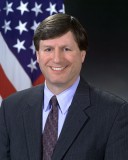
Stephen Cambone is a controversial former Pentagon official who has been closely affiliated with hawkish foreign policy factions in U.S. politics. The first-ever undersecretary of defense for intelligence—the “defense intelligence czar”—Cambone worked under Secretary of Defense Donald Rumsfeld to dramatically expand the military’s intelligence-gathering capabilities, including by loosening standards of detainee treatment during interrogations.[1]
After leaving the Pentagon in 2006, Cambone became vice president for strategy at QinetiQ North America, a subsidiary of the United Kingdom-based defense contractor QinetiQ. Shortly into his tenure at QinetiQ, the firm was awarded a lucrative contract by a Pentagon office Cambone himself had created.[2]
Cambone served in his post at QinetiQ North America until 2012, when he began a fellowship at Villanova University’s Matthew J. Ryan Center.[3] In July 2012, Cambone raised eyebrows at an Aspen Security Forum event when he hailed the decision to go to war in Iraq as “one of the great strategic decisions of the first half of the 21st century, if it proves not to be the greatest.” Cambone credited the deeply unpopular war with precipitating “the aftershocks that you see flowing through the region, whether it be in Libya, or in Egypt, or now in Syria,” and suggested it could precipitate further democratic uprisings in the Gulf. At the same event, Cambone admitted that the alleged intelligence suggesting that Iraq possessed weapons of mass destruction was erroneous, but nonetheless argued that it “might not have been a mistake” to conclude otherwise at the time.[4]
Noting the comparatively more circumspect attitudes toward the war among Bush administration veterans like Condoleezza Rice, Robert Gates, and Ryan Crocker, a reporter for Wired wrote that “Even among alumni of the Bush administration, [Cambone’s] unapologetic perspective is somewhat unusual.”[5]
In the Bush Administration
In 2003, Donald Rumsfeld appointed Cambone as the Pentagon’s first undersecretary of defense for intelligence, or the “defense intelligence czar.” The move sparked criticism among some analysts, who felt that the Pentagon was inappropriately expanding its range of activities. At the time, John Prados of the National Security Archive argued that the new position would "allow the Defense Department to consolidate its intelligence programs in a way that could undermine CIA head George Tenet's role."[6]
In his first three years as undersecretary, the New York Times reported that “Cambone and his deputy, Lt. Gen. William G. Boykin, a former commander of the Army's elite Delta Force, have carried out a wide-ranging restructuring of the Pentagon's sprawling intelligence bureaucracy.… In one of the boldest new missions, the Pentagon has sharply increased the number of clandestine teams of Defense Intelligence Agency personnel and Special Operations forces conducting secret counterterrorism missions in Iraq, Afghanistan and other foreign countries. Using a broad definition of its current authority to conduct ‘traditional military activities’ and ‘prepare the battlefield,’ the Pentagon has dispatched teams to gather information about potential foes well before any shooting starts.” Indicating Cambone’s role in revising interrogation guidelines, the paper also reported on Cambone’s advocacy of “a Pentagon proposal to have one set of interrogation techniques for enemy prisoners of war and another, presumably more coercive, set for the suspected terrorists imprisoned at Guantánamo Bay.”[7]
The effort led to Cambone’s implication in detainee abuse scandals that followed. In early 2004, Cambone was the subject of a congressional inquiry into the Abu Ghraib prison abuse scandal. Under sharp questioning from senators in May 2004, he defended the Bush administration’s efforts to loosen interrogation guidelines. While acknowledging that he was responsible for instituting some changes in questioning techniques used in Iraqi prisons, Cambone said that the changes did not lead to abuses.[8]
Shortly after Cambone’s testimony, however, journalist Seymour Hersh reported on several intelligence agents who seemed to contest Cambone’s claim about the impact of the changes. Wrote Hersh: “According to interviews with several past and present American intelligence officials, the Pentagon's operation, known inside the intelligence community by several code words, including Copper Green, encouraged physical coercion and sexual humiliation of Iraqi prisoners in an effort to generate more intelligence about the growing insurgency in Iraq.” Asked about Cambone’s and Rumsfeld’s defense of their interrogation policies during the Senate testimony, one unnamed senior CIA officer told Hersh: “Some people think you can bullshit anyone.”[9]
Even before his involvement in the prison abuse scandal, Cambone had become a target of criticism, in part because of his close relationship with Rumsfeld. Tom Donnelly, a writer based at the American Enterprise Institute, wrote in the Weekly Standard that, "fairly or not, Cambone has long been viewed as Rumsfeld's henchman, almost universally loathed—but more important, feared—by the services."[10] The Washington Monthly reported in late 2001: "It would be hard to exaggerate how much Secretary of Defense Donald Rumsfeld and his top aide Stephen Cambone were hated within the Pentagon prior to September 11. Among other mistakes, Rumsfeld and Cambone foolishly excluded top civilian and military leaders when planning an overhaul of the military to meet new threats, thereby ensuring even greater bureaucratic resistance.” According to the magazine, “an Army general joked to a Hill staffer that 'if he had one round left in his revolver, he would take out Steve Cambone.' Cambone's reputation in the building hasn't improved much since Sept. 11, but Rumsfeld's has been transformed."[11]
Private Sector
Cambone served under Rumsfeld until December 2006, when he resigned shortly after his boss stepped down. In November 2007, he became vice president for strategy of QinetiQ North America, a subsidiary of the United Kingdom-based defense contractor QinetiQ.[12]
QinetiQ was created in 2001, having evolved out of a research arm of the British Ministry of Defense (MOD) called the Defense Evaluation Research Agency. After the MOD partially privatized the agency in 2001, the U.S.-based Carlyle Group purchased a large stake in the new company.[13]
In early 2008, two months after Cambone took the position at QinetiQ North America, it was awarded a lucrative contract by the Pentagon’s Counter-Intelligence Field Activity office (CIFA)—an office that Cambone had created while in the Bush administration. In a widely cited article for CorpWatch, investigative journalist Tim Shorrock reported that as part of the five-year, $30 million contract, QinetiQ’s Mission Solutions Group is to provide unspecified “security services.” Wrote Shorrock: “The new CIFA contract comes on the heels of a series of QinetiQ deals inked with the Pentagon in the booming new business of ‘network centric warfare’—the space-age, technology-driven intelligence and warfighting policies established by Rumsfeld and Cambone during their six-year tenures at the Pentagon. Other Cambone-pioneered programs that QinetiQ has won (before he went to work at their Crystal City offices that lie just two miles from the Pentagon) include military drones and robots, low-flying satellites and jamming technologies.”[14]
Steven Aftergood of the Federation of American Scientists’ Project on Government Secrecy told Shorrock that the deal reflected the “incestuous” relationships between government agencies and contractors. “It's unseemly,” said Aftergood, “and what's worse is that it has become normal.”
Policy Work and Advocacy
Before joining the George W. Bush administration in 2001, Cambone collaborated with a number of hardline and neoconservative groups including the National Institute for Public Policy (NIPP) and the Project for the New American Century (PNAC), shaping policies that would later be championed by the administration after the 9/11 terrorist attacks.
A longtime proponent of missile defense programs, Cambone began his career as a policy expert at Los Alamos National Laboratory in the early 1980s. In 1986, he became the deputy director of strategic analysis for SRS Technologies, a defense contractor that regularly received lucrative contracts for a number of defense programs, including missile defense.[15]
After the election of George H.W. Bush, Cambone was appointed director of strategic defense policy, working under then-Defense Secretary Dick Cheney.[16] According to one biography, Cambone’s position included promoting a host of strategic defense initiatives: "As Director of Strategic Defense Policy, [Cambone] was a major contributor to President [George H.W.] Bush's decision to refocus the SDI [Strategic Defense Initiative] program in 1991 and develop the concept for a global protection system. He was a member of the high-level group appointed by the president to discuss the global protection system with Russia, U.S. allies, and other states. In addition, he was responsible for addressing and resolving policy issues that arose in the compliance review group (DOD [Department of Defense] organization to oversee compliance with the ABM [Anti-Ballistic Missile] Treaty) and the strategic systems committee of the Defense Acquisition Board, which is responsible for approving DOD weapon system acquisition."[17]
During the Clinton presidency, Cambone worked as staff director on two commissions chaired by Rumsfeld, on missile defense and space weapons, both of which sparked criticism because of their controversial conclusions on U.S. strategic vulnerability to ballistic missiles and on space-based defense capabilities. (Also serving on the Rumsfeld commissions were Paul Wolfowitz, Malcolm Wallop, William Schneider Jr., and James Woolsey.) In the tradition of Team B, the unstated agenda of these commissions appeared to be turning up pressure on the Clinton administration to support new weapons programs and substantially increase military spending.[18] Both commissions received funding from defense spending bills—in effect using taxpayer revenues to subsidize them. But given the backgrounds and connections of the individuals charged with overseeing the commissions, many observers at the time believed that their conclusions were preordained (for more information, see the Right Web Profiles: Rumsfeld Space Commissionand Rumsfeld Missile Commission).
While working for the commissions, Cambone participated in two study groups sponsored by PNAC and NIPP. NIPP's 2001 report, “Rationale and Requirements for Nuclear Forces and Arms Control,” and PNAC's “Rebuilding America's Defenses,” seem to have guided the defense policies of the George W. Bush administration with respect to nuclear policy, national security strategy, and military transformation.[19]