
Reuel-Marc Gerecht
last updated: March 2, 2018
Please note: The Militarist Monitor neither represents nor endorses any of the individuals or groups profiled on this site.

Affiliations
- Foundation for Defense of Democracies: Senior Fellow
- American Enterprise Institute: Former Resident Fellow
- Project for the New American Century: Senior Fellow, Middle East Initiative Director, 2001-05
- CBS News: Consultant on Afghanistan, 1999-2000
- Weekly Standard: Contributing Editor
Government
- CIA: Middle East Specialist in Directorate of Operations, 1985-1994
- Department of State: Political and Consular Officer, 1985-1994
Business
- Walsingham, Inc.: Risk Assessment Consultant on the Middle East, Central Asia, and the Former Soviet Union, 1999-2001
Education
- Johns Hopkins University: B.A. in History
- Princeton University: M.A. in Islamic History
Reuel Marc Gerecht is a senior fellow at the Foundation for Defense of Democracies (FDD), a neoconservative advocacy organization based in Washington, D.C.[1] A former Middle East specialist at the CIA’s directorate of operations, Gerecht is a vocal advocate of bombing Iran. Gerecht has also pushed U.S. military intervention in other parts of the Middle East, including most recently in Syria. Before joining FDD, Gerecht was a fellow at the American Enterprise Institute and a leading figure in the Project for the New American Century‘s “Middle East Initiative.”
Gerecht, like many of his neoconservative fellows, has voiced mixed opinions of President Donald Trump. During the presidential campaign, he expressed reservations about Trump, telling the Christian Science Monitor that “If you judge by intervention and a willingness to use it as a tool of American foreign policy, it would appear that Donald Trump is to the left of Hillary Clinton—and conceivably to the left of Barack Obama.”[2] Gerecht was one of dozens of foreign policy hawks who issued a public letter denouncing Trump’s foreign policy as “wildly inconsistent and unmoored in principle.” Referring to that letter, Gerecht said that “Most of these folks [who signed the letter] view Donald trump as a giant wrecking ball in that he’s a danger to American interests overseas.”[3]
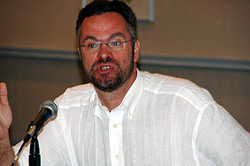
After Trump took office, Gerecht criticized his policy of barring Iranians from the United States. In his view, the United States should be pursuing a strategy that promotes Iranian dissent, because “The mullahs dread America’s insidious appeal.” He said that the Trump approach to this issue was not “sensible.”[4] On the other hand, Gerecht has praised Trump’s policies toward the Israel-Palestine conflict as “realistic,” and applauded Trump’s support for Iranian protesters.
Gerecht has urged the Trump administration to impose crippling sanctions on Iran, which would threaten the viability of the nuclear agreement between Iran and the P5+1.[5] He has been supportive of Trump’s rhetoric on Iran, but critical of his actions and policies. In October 2017, he wrote, “Trump is right about Iran and the nuclear deal. For him and all those who so strenuously opposed Obama’s nuclear diplomacy, being right, though, isn’t enough.”[6]
In that same month, Gerecht criticized the U.S. approach to confronting Iran in Syria even more sharply. “The administration’s announcement of its new Iran grand strategy appears to be, at least in Syria, just a continuation of the status quo, which is a slightly more muscular version of Obama’s approach to fighting the Islamic State,” he wrote. “In Iraq, the White House and the Pentagon may even be planning to draw down troops, which would inevitably lead to a weakening of the Iranian-averse Shia, the sole hope we have of convulsing the Persians in Mesopotamia. In Saudi Arabia, Bahrain, and Yemen, the Trump administration’s outreach to traditional Sunni allies could easily end up encouraging the Sunni side to thump harder the native Shia, which will inevitably further radicalize these communities. The potential for Iranian subversion will go up, not down.”[7]
Syria
Gerecht has aggressively supported U.S. intervention in Syria, as a way to counter Iranian influence, for several years, advocating in particular the overthrow of Bashar al-Assad.[8] Setting aside concerns about the influence of Islamic militants in the Syrian opposition, Gerecht argued in August 2013 that “America’s credibility in the region—which is overwhelmingly built on Washington’s willingness to use force—will be zero unless Obama militarily intercedes now to knock down the Assad regime.”[9] He went on to say that, “Washington’s response to Assad’s challenge must be devastating. … The choice now is either war or headlong retreat.”[10]
After the dramatic success of the so-called Islamic State (IS or ISIS) in Iraq and Syria in 2014, Gerecht rejected the idea of working with Iran to combat the group. “Some Westerners are again hoping that Iranians can be helpful against Sunni holy warriors in the Middle East. … None of this makes sense,” he wrote.[11]
In late 2015, after ISIS-connected terrorist attacks in Paris and a mass-shooting in San Bernardino, California, by a husband and wife sympathetic to the group, Gerecht argued in a piece for the Hoover Institution for the mass-deployment of U.S. troops to combat both ISIS and the Assad government in Syria. “The Islamic State and the Assad regime are two sides of the same coin—for the former to die, the latter must perish,” he opined. “But to do so would require a substantial American commitment of troops within the country, a deployment that would likely increase after the fall of the Alawite regime since maintaining order in a post-Assad Syria … will be demanding.”[12] He added: “It’s by no means clear that the Pentagon, after the drastic reductions in defense spending that Mr. Obama sought and Republicans accepted, actually could deploy to Syria and Iraq 75,000 troops—a plausible necessary number—without severely stressing the diminished capacity of the US Army and Marines.”[13]
Gerecht has continued to press for U.S. military intervention in Syria to counter Iran’s growing influence there. In December 2017, he wrote, “The president’s rhetoric against Iranian militancy has been tougher than Ronald Reagan’s or George W. Bush’s hardest orations. But Trump’s accomplishments on the ground have been few. The administration really has two options: to punish Iran economically or to roll back the mullahs militarily through the use of US forces.”[14]
Advocating Regime Change In Iran
The main focus of Gerecht’s work has long been Iran, his former charge at the CIA. He has consistently promoted overthrowing the Iranian clerical regime militarily and cast doubt on any diplomatic rapprochement between Washington and Tehran.
After the 2013 election of Iranian President Hassan Rouhani, a relative moderate who campaigned on seeking an accord with the West over Iran’s nuclear enrichment program, Gerecht dismissed the vote as irrelevant to prospects for peace. “Rouhani’s triumph in the recent presidential election wasn’t a victory for ‘moderation’ and ‘rationality’ in Iranian politics,” Gerecht wrote . “It was the triumph of class, of revolutionary clerics of good taste and slightly better economics, over the hoi polloi who’d rallied to [former Iranian President Ahmed] Ahmadinejad.”[15] Gerecht has derided what he has claimed was President Barack Obama’s “obsession” with getting a nuclear deal with Iran. He has stated that the next U.S. president will “probably” have to revoke the July 2015 nuclear deal between Iran and world powers “within the first year in office or the inertia of the accord will guarantee Mr. Obama’s policies become the new standard for the United States.”[16]
However, in an op-ed co-written with FDD executive director Mark Dubowitz shortly after the Iran nuclear agreement was reached, Gerecht framed the deal as a means by which the United States could eventually launch military strikes against Iran. Arguing that an Iranian violation of the deal would be inevitable and could serve as a pretext for launching an attack, Gerecht wrote: “No American president would destroy Iranian nuclear sites without first exhausting diplomacy … hawks who believe that airstrikes are the only possible option for stopping an Iranian nuke should welcome a deal perhaps more than anyone.”[17]
One observer said in response: “In other words, the point of supporting a diplomatic solution was so that it would pave the way for a military strike.”[18]
Still, Gerecht opposed the ultimately-successful diplomatic efforts that produced the Iran nuclear deal from the beginning. “Iranian leaders,” he wrote in an October 2013 op-ed co-authored with FDD executive director Mark Dubowitz, “probably are entering these negotiations for one reason: to test Barack Obama’s mettle. They want to see whether Tehran can have the bomb and sanctions relief.”[19] They added: “The United States shouldn’t be fooled by false divisions within the regime. Abandoning the long quest for atomic weapons would be an extraordinary humiliation for Iran’s ruling class. That isn’t going to happen unless Iran’s supreme leader and his guards know with certainty that the Islamic order is finished if they don’t abandon the bomb.”[20] In a separate article, from May 2013, Gerecht and Dubowitz argued that “The principal question is whether the West can bring sufficient non-military pressure upon Ayatollah Khamenei and his guards to make them relent in their atomic quest. We are skeptical.”[21]In a Wall Street Journal op-ed, Gerecht and Dubowitz argued that in the event the negotiations fell apart, sanctions would fail to curb Iran’s purported ambitions “without other forms of coercion.” They added that “Ayatollah Khamenei, if he isn’t otherwise deterred, may well respond to new, economy-crushing sanctions by accelerating the nuclear program, presenting Mr. Obama with the choice he most dreads: launch militarily strikes or accept Iran as a nuclear state.”[22]
They also argued that “only one target” would leave a “lasting impression” on Iran, Syria’s Bashar al-Assad. “Taking Mr. Assad down would let Tehran know that America’s withdrawal from the Middle East and President Obama’s dreams of an entente with Iran are over.”[23]After Donald Trump took office in January 2017. Gerecht renewed his advocacy for regime change. In an op-ed co-authored with his FDD colleague Ray Takeyh, Gerecht wrote, “The regime’s survival is now dependent on unsteady security services and the power of patronage, which ebbs and flows with the price of oil. Iran’s continuing stage-managed elections and colorless apparatchiks, including President Hassan Rouhani, a founding father of the feared intelligence ministry who mimics reformist slogans, have failed to convince much less inspire. Today, the Islamist regime resembles the Soviet Union of the 1970s — an exhausted entity incapable of reforming itself while drowning in corruption and bent on costly imperialism. If Washington were serious about doing to Iran what it helped to do to the U.S.S.R, it would seek to weaken the theocracy by pressing it on all fronts. A crippling sanctions regime that punishes the regime for its human-rights abuses is a necessity. Such a move would not just impose penalties on Tehran for violating international norms but send a signal to the Iranian people that the United States stands behind their aspirations.”[24]
As one observer later pointed out, “Gerecht’s concern for the Iranian people was not so obvious in 2006 when he proposed[25] that ‘we should make every effort, including repeated military strikes, to thwart the clerics’ quest for [a nuclear weapon].’”[26]
By October 2017, Gerecht was being much more direct in his call for regime change. Writing again with Ray Takeyh, Gerecht outlined his idea for regime change. “There is no substitute for presidential declaration, and Mr. Trump should embrace Reagan’s model of speaking directly to the Iranian people while castigating their illegitimate regime. Washington should again impose crippling sanctions to deny the mullahs their patronage networks, the key to their power. A formula that led to the collapse of the mighty Soviet empire can surely down Mr. Khamenei’s and the Revolutionary Guard’s kleptocracy.”[27]
Gerecht’s views on Iran largely reflect those of the entire FDD institution, including its funders. In a controversial 2013 speech, major FDD donor and casino magnate Sheldon Adelson called on the United States to drop a nuclear bomb somewhere in the Iranian desert. “Then,” Adelson said, “you say, ‘See! The next one is in the middle of Tehran. So, we mean business. You want to be wiped out? Go ahead and take a tough position and continue with your nuclear development.’”[28] When asked by a reporter for his reaction to this outburst, Gerecht said that dropping a nuclear weapon on Iran “wouldn ’ t be my first suggestion .”[29]
Compared to his pessimism about diplomacy with Iran, Gerecht is relatively optimistic about the prospects for democracy in the Arab Middle East. In his 2011 book The Wave: Man, God, and the Ballot Box in the Middle East, published by the Hoover Institution, he argued that “America must reassess democracy’s supposed lack of a future in the region.”[30]
In particular, Gerecht has been more sanguine than many of his fellow travellers about the prospects for elected Islamist rule in a democratic Middle East, especially Egypt. “What is poorly understood in the West,” he wrote in 2012, “is how critical fundamentalists are to the moral and political rejuvenation of [Muslim] countries. As counterintuitive as it seems, they are the key to more democratic, liberal politics in the region. … Dictatorship nostalgia, on the other hand, will take us right back to the cul-de-sac where Osama bin Laden was born.”[31] Gerecht reprised these sentiments after a military coup, which was cheered on by many hawks in the United States, toppled Egypt’s elected Muslim Brotherhood government in 2013. “Only the deluded, the naïve and the politically deceitful—Western fans of the coup come in all three categories—can believe that Islamism’s ‘moment’ in Egypt has passed,” he wrote. “More likely, it’s just having an interlude.”[32]
Previous Track Record on Iran
Even before 9/11 and the presidency of George W. Bush, Gerecht was pushing for regime change in Iran, most notably in a chapter he contributed to the volume Present Dangers: Crisis and Opportunity in American Foreign and Defense Policy, edited by Robert Kagan and William Kristol and published by PNAC in 2000 to serve as a neoconservative foreign policy agenda-setter for the next administration. In his essay, “Iran: Fundamentalism and Reform,” Gerecht wrote: “If Washington catches the Iranians in a terrorist act, then the U.S. Navy should retaliate with fury…If we attack, U.S. armed forces must strike with truly devastating effect against the ruling mullahs and the repressive institutions that maintain them. That is, no cruise missiles at midnight to minimize the body count. The clerics will almost certainly strike back unless Washington uses overwhelming, paralyzing force.” He added that if the Israelis “believe they’ve got the goods on the Iranians—for example, finding evidence linking them to anti-Israel/anti-Jewish bombings abroad—then they should by all means retaliate as directly as possible.”[33]
In September 2005, Gerecht gave testimony to the U.S. House Armed Services Committee during which he argued that diplomacy with Tehran was a dead end. Pointing to the Clinton administration’s efforts to “give peace a chance,” which Gerecht said had included apologizing for “the supposedly bad behavior of the entire Western world toward Iran for the last 150 years,” Gerecht argued: “American apologies in revolutionary clerical eyes mean only one thing—weakness. And showing weakness to power-politic-loving Iranian clerics is not astute. This is 101 in Iranian political culture. Yet I’m willing to bet that most analysts dealing with Iran at the State Department and the CIA probably thought American soul-searching was a good thing, that the political elite in Tehran would respect us more.”[34]
Two years later, in a widely quoted September 3, 2007 issue of Newsweek, Gerecht remained on message, writing: “Fears [in Europe about U.S. intentions to designate Iran’s Revolutionary Guard as a terrorist organization] are unfounded … and rest on several basic misunderstandings. For one thing, the terrorist label is nothing new, and thus will do little to change the current state of play. For another, Iran represents a much greater threat than Europe typically recognizes. It is not a status quo state that favors stability, as most pundits and governments portray it. Iran is, instead, a radical revolutionary force determined to sow chaos beyond its borders. Assuming that normal negotiations can bring it around is, therefore, a grave mistake. The mullahs don’t want peace in Iraq—just the opposite. War may come, but not because negotiations break down. The likely trigger is an Iranian provocation.”[35]
In March 2007, Gerecht shared his arguments with a European audience during a “U.S.-European Traveling Debate” cosponsored by AEI and the German Marshall Fund, which included stops in Berlin, Brussels, and Paris. Titled “Iran and the Bomb: Will It Get It and What Will It Mean?”, the series included Gerecht, the Washington Post‘s David Ignatius, and several policy figures from European countries. It was aimed at discussing “what courses of action the United States and its allies can take against Iran” in light of Tehran’s refusal to halt uranium enrichment activities despite considerable diplomatic pressure.[36]
By early 2008, however, Gerecht, like many other neoconservatives, was pushing a seemingly more nuanced stance toward Iran—likely in response to the November 2007 National Intelligence Estimate, which argued that Tehran halted its efforts to build a nuclear weapon in 2003.[37] Perhaps recognizing that U.S. military intervention in Iran was unlikely to occur during Bush’s short remaining time in office, Gerecht argued in a February 20, 2008 New York Times op-ed that the United States must begin “direct, unconditional talks” with the country.[38]
But what might have been mistaken as an argument for diplomacy was revealed as little more than an effort to push for military intervention. “Foreign-policy hawks ought to see such discussions as essential preparation for possible military strikes against clerical Iran’s nuclear facilities,” Gerecht wrote. He furthered his advocacy of diplomacy-as-prelude to military intervention later in the op-ed, writing, “If the mullahs don’t want to negotiate, fine: making the offer is something that must be checked off before the next president could unleash the Air Force and the Navy.”[39]
And by 2009, Gerecht’s overt cynicism had returned. In a January 2009 Wall Street Journal op-ed, he wrote, “Ultimately, it’s doubtful that Tehran will find President-elect Barack Obama’s offer of more diplomacy, or the threat of more European sanctions, to be compelling.”[40]
Gerecht also engaged in sabre-rattling about Iran after an alleged plot by an Iranian-American used car salesman to assassinate the Saudi ambassador in Washington was foiled in 2011. Accusing the Iranian regime of orchestrating the plot, Gerecht declared that “The White House needs to respond militarily to this outrage. If we don’t, we are asking for it.”[41]
Iraq
Gerecht was also a supporter of the U.S. invasion of Iraq, often couching it as a prelude to regime change in Iran. In February 2002, he wrote in the Weekly Standard that “[I]f President Bush follows his own logic and compels his administration to follow him against Iraq and Iran, then he will sow the seeds for a new, safer, more liberal order in the Middle East. If America can hold its ground, two Muslim peoples who were badly burned by the 20th century just might lead the way for their religious brethren to a more civil society, where the basic human decency their countries knew a century ago could return.”[42]
Gerecht argued that a U.S.-led invasion of Iraq would stir a democratic revolution in Iran. In a 2002 AEI policy brief, he wrote, “An American invasion [of Iraq] could possibly provoke riots in Iran—simultaneous uprisings in major cities that would simply be beyond the scope of regime-loyal, specialized riot-control units. The army or the Revolutionary Guard Corps would have to be pulled into service in large numbers, and that’s when things could get interesting. … And if an American invasion doesn’t provoke urban unrest, the creation of a democratic Iraq probably will. Iraq’s majority Shiite population, who will inevitably lead their country in a democratic state, will start to talk to their Shiite brethren over the Iran-Iraq border.”[43]
On September 18, 2007, Gerecht participated in the University of Virginia’s “National Discussion and Debate Series,” in which he and Frederick Kagan argued in favor of keeping troops in Iraq. “You cannot hope to deflate Islamic extremism by losing,” Gerecht argued. “The presence of the United States [in Iraq], though aggravating to many a Muslim fundamentalist, is certainly, I would argue, less of a problem than in fact the United States fleeing the country and allowing that country to go tailspin into massive internecine violence.” Gerecht argued further that a U.S. withdrawal from Iraq would strengthen Iran’s regional position: “Also, what is important to remember, you cannot deal with that country unless you are willing to actually deal with the Iranian threat. Now, what the Iranians are doing inside of Iraq is radicalizing it. … [T]hey’re trying to fuel internecine conflict. If we leave, it is bound to happen.“[44]
Despite the spiraling violence in Iraq in the wake of the U.S. invasion, as well as little evidence pointing to a weakening of the regime in Tehran, Gerecht remained convinced of the possibility that the Iraq War would help bring regime change to Iran. According to writer Gareth Porter, by late 2007 Gerecht was one of the most aggressive proponents of the argument “that Iraq’s Shiites, liberated by U.S. military power, would help subvert the Iranian regime”.[45]
Israel and Palestine
In contrast to his voluminous writing on Iran, Gerecht has largely left the issue of Israel and its occupation of the West Bank and Gaza Strip to his FDD colleagues. But he has contributed some statements. In 2014, while the fighting and Israeli bombing in Gaza was at its height, Gerecht urged new parliamentary elections among the Palestinians. “The 2006 legislative elections—strongly backed by President George W. Bush and Palestinian President Mahmoud Abbas —produced a narrow victory by Hamas, an Islamist terrorist organization, setting off a long slide for the more secular Fatah. Fatah is the muscle behind the Palestinian Authority, the government on the West Bank. In the vote’s aftermath, Fatah’s security apparatus cracked in Gaza and might have fallen in the West Bank if it hadn’t been for Israeli support. The conflict between Israel and Hamas in Gaza over the past month—the third major outbreak of violence since Hamas took control in 2007—springs in part, some would argue, from this electoral mistake. Muslim fundamentalists do too well at the polls; among Palestinians, democracy allowed terrorists to triumph.”[46]
In fact, Palestinian President Abbas was quite reluctant to hold elections, as he feared his party was ill prepared and doubted the outcome would be a victory for Fatah, something President Bush was apparently quite confident of.[47] Also, Fatah’s security apparatus did not simply “crack,” it was decimated in Gaza in an attempt to forcibly remove Hamas from its seat of power, a move backed strongly by the Bush administration.[48]
Gerecht saw new elections as a way to test the true intentions of the Palestinian people. “If another Palestinian election were held—legislative elections were due in 2010 but have been put off indefinitely—the world would have a far better idea of whether Palestinians, especially those in Gaza, support terrorism against Israelis. If Hamas won the legislative or presidential elections after three wars with Israel, and launched a fourth, then the Palestinian people would bear far greater responsibility for such hostility than they do now. If Fatah won, it would be on the spot to prove its commitment to end the struggle against Israelis.”[49]
Gerecht differed from the view of many observers[50] and polling[51] that indicated Fatah’s disorganization and corruption led many to look at Hamas as an alternative and that clear majorities of Palestinians still supported peace with Israel and wanted Hamas to pursue it, and that much of the pro-Hamas vote was understood to be a vote of no-confidence in the Fatah-led Palestinian Authority.
Gerecht also defended the legitimacy and even the necessity for Palestinians of the Israel occupation. In 2017, he wrote, “The truth about Fatah’s security weaknesses is symptomatic of the truth about the Palestinians: They can exist as a non-Islamist polity only if Israel protects their attenuated nation-state. If the Jews pull back, then the militant Muslim faithful will probably recast the Palestinian identity, wiping away the secular Palestinian elite who have defined the Palestinian cause among Westerners since the Israelis and the Palestine Liberation Organization first started sparring with each other in 1964.”[52]
Gerecht’s based his view on a series of statements, typified by this one. “It may not have occurred to J-Street Americans, who are so uncomfortable with the aftermath of the ’67 war, but the only reason Fatah hasn’t created a more vicious police state—that is, created a typical Arab polity—is that Israel is right next door, checking the inclinations of the Fatah leadership, except when it comes to Hamas.”[53]
Gerecht supported Donald Trump’s widely condemned decision to recognize Jerusalem as Israel’s capital. “Most Arabs have adjusted, however reluctantly, to the permanence of Zion. They did so four decades ago when Egypt, slowly collapsing under its own military dictatorship, checked out of the war. Americans, Europeans and Israelis—not “the Arabs”—are primarily responsible for elongating the big Palestinian delusions about the “right of return” and a sovereign East Jerusalem. It’s way past time they stopped. Mr. Trump’s decision, whatever the motivation, is a step forward.”[54]
Intelligence and the CIA
Gerecht has played on his CIA experience to argue the inefficacy of the agency, a favorite topic of neoconservatives since the 1970s . In the wake of the resignation of CIA director Porter Goss, Gerecht offered a pessimistic view of the CIA in a Wall Street Journal op-ed. “Regrettably, reform at the CIA is now dead,” he wrote, arguing that the Democrats and an anti-Bush press have “put another nail into the clandestine service’s coffin by rallying around an organization that desperately needs to be radically deconstructed. However tepidly or lazily Mr. Goss approached his work, he and his abrasive minions ought to be complimented for at least firing somebody. Given the history of the CIA, this is not an insignificant achievement.”[55]
Gerecht is a contributor to a 2005 Hoover Institution book on U.S. intelligence titled The Future of American Intelligence. Its lead author was Gerecht’s then AEI colleague Gary Schmitt, who, like Gerecht, served as a principal of PNAC.[56]
Gerecht called for Donald Trump’s selection for head of the CIA, Mike Pompeo, to reinstate many of the practices ended in recent years, including torture and extraordinary rendition. “Democrats also went after the Bush administration’s use of rendition. Its application under Bill Clinton, who started transferring real or suspected Islamic terrorists into harsh allied hands, and Barack Obama received much less attention. News stories about the unpleasant practice under Democrats were inevitably thin, revealing the political preferences of the leakers. Some Democratic officials even suggested that the CIA under Clinton and Obama had exercised a virtuous version of rendition: Agency operatives overseas ensured that air-lifted radicals weren’t abused in countries where street thieves, let alone jihadists, are routinely beaten. Obama and like-minded Democrats wanted to shame the CIA publicly, to ensure its personnel would never again use severe methods. They will undoubtedly prove successful—unless another Islamic terrorist attack inside the United States results in the slaughter of thousands. If this were to occur, anger, patriotism, and a bipartisan desire to protect one’s own could well see CIA officers again on the cutting edge, doing things that most of Washington today would prefer take place, with deniability, out of sight in Egypt or Jordan.
“Unless Donald Trump is serious about pushing the CIA back into enhanced interrogation—and the odds are high that the incoming director, Republican congressman Mike Pompeo, will just do what his predecessor and the Pentagon did when confronted with the interrogation/incarceration/trial conundrum as regards Islamic terrorists (kill them with drones or put them into foreign prisons)—Pompeo will not have to deal with the agonizing morality play that Obama’s CIA director John Brennan has faced since he moved into Langley in 2013. I can sympathize with Brennan. According to two former senior CIA officers involved with detention and enhanced interrogation, Brennan, an analyst who rose through the agency often doing jobs traditionally assigned to case officers, never once expressed reservations when the program was being designed and implemented. But as director, Brennan had to keep in tune with the president, if not the Democrats of the Senate Select Committee, some of whom gave the impression they wouldn’t mind seeing CIA officers prosecuted. He also had to work with senior operatives who knew him well and didn’t esteem his quick evolution on “torture.”[57]
Gerecht, who has been a contributing editor at the Weekly Standard and a correspondent for the Atlantic Monthly, is also the author of The Islamic Paradox: Shiite Clerics, Sunni Fundamentalists, and the Coming of Arab Democracy (AEI Press, 2004) and Know Thine Enemy: A Spy’s Journey into Revolutionary Iran (1997), which he wrote using the pen name Edward G. Shirley. According to the Washington Post‘s Vernon Loeb, Gerecht describes a CIA directorate of operations that “had grown intellectually dishonest and become an institution where case officers played a cynical ‘numbers game’ to get promoted by recruiting large numbers of paid foreign agents, regardless of quality. The ‘secrets’ these agents produced were often nearly worthless [he wrote] and typical case officers either didn’t care or didn’t know better, lacking language skills and much grounding in the culture in which they operated. ‘America’s national security would not be compromised by temporarily shutting down the DO,’ Gerecht wrote. ‘A Directorate of Operations that produces mostly mediocre intelligence and egregiously stupid coup d’etat schemes against, for example, Saddam Hussein harms the United States abroad.'”[58]
SOURCES
[1] Foundation for Defense of Democracies, “Reuel Marc Gerecht,” FDD, http://www.defenddemocracy.org/index.php?option=com_content&task=view&id=11784049&Itemid=326.
[2] Howard LaFranchi, “Clinton and Trump: Foreign-policy odd couple with their parties?” Christian Science Monitor, June 10, 2016, https://www.csmonitor.com/USA/Foreign-Policy/2016/0610/Clinton-and-Trump-Foreign-policy-odd-couple-with-their-parties
[3] Howard LaFranchi, “Clinton and Trump: Foreign-policy odd couple with their parties?” Christian Science Monitor, June 10, 2016, https://www.csmonitor.com/USA/Foreign-Policy/2016/0610/Clinton-and-Trump-Foreign-policy-odd-couple-with-their-parties
[4] Reuel Marc Gerecht, “Trump doesn’t know it, but Iranians are the Norwegians he’s been looking for,” Washington Post, January 30, 2018, https://www.washingtonpost.com/news/democracy-post/wp/2018/01/30/trump-doesnt-know-it-but-iranians-are-the-norwegians-hes-been-l
[5] Reuel Marc Gerecht and Ray Takeyh, “How to Defeat the Islamic Republic,” The Wall Street Journal, October 11, 2018, www.defenddemocracy.org/media-hit/how-to-defeat-the-islamic-republic/
[6] Reuel Marc Gerecht, “No Easy Way Out,” Weekly Standard, October 6, 2017, http://www.weeklystandard.com/article/2009969/
[7] Reuel Marc Gerecht, “Trump throws a Hail Mary pass against Iran,” Washington Examiner, October 13, 2017, http://www.defenddemocracy.org/media-hit/senior-fellow-trump-throws-a-hail-mary-pass-against-iran/
[8] Reuel Marc Gerecht and Mark Dubowitz, “Obama, American Liberator?” Washington Post, September 2, 2011.
[9] Reuel Marc Gerecht, “Assad Has Called Obama’s Bluff,” New York Times “Room for Debate” blog, August 26, 2013, http://www.nytimes.com/roomfordebate/2013/08/26/is-an-attack-on-syria-justified/assad-has-called-obamas-bluff.
[10] Reuel Marc Gerecht, “Assad Has Called Obama’s Bluff,” New York Times “Room for Debate” blog, August 26, 2013, http://www.nytimes.com/roomfordebate/2013/08/26/is-an-attack-on-syria-justified/assad-has-called-obamas-bluff.
[11] Reuel Marc Gerecht, “The Enemy of My Enemy is My Enemy,” The Weekly Standard, June 30, 2014, http://www.weeklystandard.com/articles/enemy-my-enemy-my-enemy_795404.html?page=1.
[12] Reuel Marc Gerecht, “’Fighting’ The Islamic State,” December 7, 2015, http://www.defenddemocracy.org/media-hit/senior-fellow-fighting-the-islamic-state/
[13] Reuel Marc Gerecht, “’Fighting’ The Islamic State,” December 7, 2015, http://www.defenddemocracy.org/media-hit/senior-fellow-fighting-the-islamic-state/
[14] Reuel Marc Gerecht, “Countering Iran while Retreating,” The Hoover Institution, December 12, 2017, http://www.defenddemocracy.org/media-hit/senior-fellow-countering-iran-while-retreating/
[15] Reuel Marc Gerecht, “The New Rouhani,” Weekly Standard, October 7, 2013, http://www.weeklystandard.com/articles/new-rouhani_757227.html.
[16] Reuel Marc Gerecht, “The Middle East After The Iranian Nuclear Accord,” Hoover Institution, October 19, 2015, http://www.defenddemocracy.org/media-hit/senior-fellow-the-middle-east-after-the-iranian-nuclear-accord/
[17] John Judis, “The Little Think Tank That Could,” Slate, August 18, 2015,http://www.slate.com/articles/news_and_politics/foreigners/2015/08/foundation_for_the_defense_of_democracies_inside_the_small_pro_israel_think.html
[18] John Judis, “The Little Think Tank That Could,” Slate, August 18, 2015,http://www.slate.com/articles/news_and_politics/foreigners/2015/08/foundation_for_the_defense_of_democracies_inside_the_small_pro_israel_think.html
[19] Reuel Marc Gerecht and Mark Dubowitz, “Iran wants the bomb — and sanctions relief,” Washington Post, October 11, 2013, http://www.washingtonpost.com/opinions/iran-wants-the-bomb–and-sanctions-relief/2013/10/11/201f0734-31e7-11e3-9c68-1cf643210300_print.html.
[20] Reuel Marc Gerecht and Mark Dubowitz, “Iran wants the bomb — and sanctions relief,” Washington Post, October 11, 2013, http://www.washingtonpost.com/opinions/iran-wants-the-bomb–and-sanctions-relief/2013/10/11/201f0734-31e7-11e3-9c68-1cf643210300_print.html.
[21] Reuel Marc Gerecht and Mark Dubowitz. “Forget diplomacy: With Iran, pressure works,” Globe and Mail, May 31, 2013, http://www.theglobeandmail.com/commentary/forget-diplomacy-with-iran-pressure-works/article12286142/.
[22] Reuel Marc Gerecht and Mark Dubowitz, “Iran’s Diplomatic Path to the Bomb,” The Wall Street Journal, November 12, 2014, http://online.wsj.com/articles/reuel-marc-gerecht-and-mark-dubowitz-irans-diplomatic-path-to-the-bomb-1415839411.
[23] Reuel Marc Gerecht and Mark Dubowitz, “Iran’s Diplomatic Path to the Bomb,” The Wall Street Journal, November 12, 2014, http://online.wsj.com/articles/reuel-marc-gerecht-and-mark-dubowitz-irans-diplomatic-path-to-the-bomb-1415839411.
[24] Reuel Marc Gerecht and Ray Takeyh, “How Trump can help cripple the Iranian regime,” Washington Post, April 7, 2017, https://www.washingtonpost.com/news/global-opinions/wp/2017/04/07/how-trump-can-help-cripple-the-iranian-regime/?utm_term=.c891e42920e3
[25] Reuel Marc Gerecht, “Cognitive Dissonance: The State of America’s Iran Policy,” Cato Unbound, July 9, 2006, https://www.cato-unbound.org/2006/07/09/reuel-marc-gerecht/cognitive-dissonance-state-americas-iran-policy
[26] Eli Clifton, “Iran Hawks Embrace Protest Movement But Show Little Concern For Iranian Lives,” Lobelog, January 4, 2018, https://lobelog.com/iran-hawks-embrace-protest-movement-but-show-little-concern-for-iranian-lives/
[27] Reuel Marc Gerecht and Ray Takeyh, “How to Defeat the Islamic Republic,” The Wall Street Journal, October 11, 2018, www.defenddemocracy.org/media-hit/how-to-defeat-the-islamic-republic/
[28] Noah Rayman, “GOP Mega Donor Sheldon Adelson Wants To Nuke Iran,” Time Magazine “Swampland” blog, October 23, 2013, http://swampland.time.com/2013/10/23/sheldon-adelson-nuke-iran/#ixzz2j42jAioB.
[29] Quoted in Ben Armbruster, GOP Megadonor’s ‘Nuke Iran’ Comments Highlight Links To Influential Think Tank,” Think Progress, October 25, 2013, http://thinkprogress.org/security/2013/10/25/2836101/adelson-nuke-iran-fdd/.
[30] Hoover Institution Press, “The Wave: Man, God, and the Ballot Box in the Middle East,” http://www.hooverpress.org/productdetails.cfm?PC=1441.
[31] Reuel Marc Gerecht, “The Islamist Road to Democracy,” Wall Street Journal, April 23, 2013, http://online.wsj.com/news/articles/SB10001424052702304299304577350200925769444.
[32] Reuel Marc Gerecht, “Egypt’s Islamists Will Rise Again,” Wall Street Journal, July 24, 2013, http://online.wsj.com/news/articles/SB10001424127887323829104578623563681064572.
[33] Reuel Marc Gerecht, “Iran: Fundamentalism and Reform,” in Robert Kagan and William Kristol, eds., Present Dangers—Crisis and Opportunity in American Foreign and Defense Policy (San Francisco: Encounter Books, 2000).
[34] Reuel Marc Gerecht, “Clerical Iran: The Threat,” prepared testimony for the U.S. House Armed Services Committee, September 29, 2005.
[35] Reuel Marc Gerecht, “Deadly Persian Provocations,” Newsweek, September 3, 2007.
[36] “U.S.-European Traveling Debate: Iran and the Bomb: Will It Get It and What Will It Mean?” American Enterprise Institute, March 2007, http://www.aei.org/events/filter.all,eventID.1489/event_detail.asp.
[37] Khody Akhavi, “New Report Shows Tactical Neocon Switch on Iran,” Right Web, February 28, 2008 http://www.rightweb.irc-online.org/articles/display/Report_Shows_New_Neocon_Angle_on_Iran
[38] Reuel Marc Gerecht, “Attack Iran, With Words,” New York Times, February 20, 2008, http://www.nytimes.com/2008/02/20/opinion/20gerecht.html?pagewanted=all.
[39] Reuel Marc Gerecht, “Attack Iran, With Words,” New York Times, February 20, 2008, http://www.nytimes.com/2008/02/20/opinion/20gerecht.html?pagewanted=all.
[40] “Reuel Marc Gerecht, “Iran’s Hamas Strategy,” Wall Street Journal, January 7, 2009, http://online.wsj.com/news/articles/SB123128812156759281.
[41] Reuel Marc Gerecht, “Iran’s Act of War,” Wall Street Journal, October 13, 2011, http://online.wsj.com/news/articles/SB10001424052970203914304576627160079958084.
[42] Reuel Marc Gerecht, “On to Iran! Checkmating the Clerics,” Weekly Standard, February 18, 2002.
[43] Reuel Marc Gerecht, “Regime Change in Iran?” American Enterprise Institute, August 2002.
[44] Miller Center of Public Affairs, University of Virginia, National Debate and Discussion Series transcript, September 18, 2007, http://webstorage3.mcpa.virginia.edu/debates/iraq/transcript/deb_2007_0918_iraq.pdf.
[45] Gareth Porter, “The Warpath to Regime Change,” Right Web, November 6, 2007, http://www.rightweb.irc-online.org/articles/display/The_Warpath_to_Regime_Change.
[46] Reuel Marc Gerecht, ” A Ballot-Box Test for the Palestinians,” The Wall Street Journal, August 14, 2014, http://www.defenddemocracy.org/media-hit/senior-fellow-a-ballot-box-test-for-the-palestinians/
[47] David Rose, “The Gaza Bomshell,” Vanity Fair, August, 2008, https://www.vanityfair.com/news/2008/04/gaza200804
[48] David Rose, “The Gaza Bomshell,” Vanity Fair, August, 2008, https://www.vanityfair.com/news/2008/04/gaza200804
[49] Reuel Marc Gerecht, ” A Ballot-Box Test for the Palestinians,” The Wall Street Journal, August 14, 2014, http://www.defenddemocracy.org/media-hit/senior-fellow-a-ballot-box-test-for-the-palestinians/
[50] Mitchell Plitnick, “The Fall of Gaza: Can Disaster Be Avoided?” The Third Way, June 22, 2007, https://mitchellplitnick.com/2007/06/22/the-fall-of-gaza-can-disaster-be-avoided/#more-63
[51] Palestinian Center for Policy & Survey Research, “Palestinian Public Opinion Polls No 19,” Miftah, March 21, 2006, http://www.miftah.org/Display.cfm?DocId=9809&CategoryId=17
[52] Reuel Marc Gerecht, “Protecting Palestine,” The Weekly Standard, January 6, 2017, http://www.weeklystandard.com/protecting-palestine/article/2006157
[53] Reuel Marc Gerecht, “Protecting Palestine,” The Weekly Standard, January 6, 2017, http://www.weeklystandard.com/protecting-palestine/article/2006157
[54] Reuel Marc Gerecht, “In the Mideast, Trump Gives Reality a Chance,” The Wall Street Journal, December 26, 2017, http://www.defenddemocracy.org/media-hit/senior-fellow-in-the-mideast-trump-gives-reality-a-chance/
[55] Reuel Marc Gerecht, “Intelligence Deficit Disorder,” Wall Street Journal, May 9, 2006.
[56] The Future of American Intelligence. Stanford, CA: Hoover Institution Press, 2005.
[57] Reuel Marc Gerecht, “The CIA, Post-Obama,” The Weekly Standard, December 19, 2016, http://www.weeklystandard.com/the-cia-post-obama/article/2005773
[58] Vernon Loeb, “At Hush-Hush CIA Unit, Talk of a Turnaround; Reforms Recharge Espionage Service,” Washington Post, September 7, 1999, p. A8. Also see Edward G. Shirley, “Can’t Anybody Here Play This Game?” Atlantic Monthly, Vol. 281 No. 2, February 1998, pp. 45-61.