
Mark Gerson
last updated: October 21, 2013
Please note: The Militarist Monitor neither represents nor endorses any of the individuals or groups profiled on this site.
Affiliations
- Manhattan Institute: Former Member, Board of Trustees
- Project for the New American Century: Former Director
Business
- Gerson Lehrman Group: Executive Chairman
- Thuzio: Cochair
- Axial Markets: Chairman
- Chockstone, Inc.: Member, Board of Directors
- LuxResearch: Board Member/Adviser
- IMentor: Board Member
Education
- Williams College: BA
- Yale Law School: JD
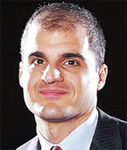
Mark Gerson is an investor and businessman with close ties to neoconservatism. He is the cofounder and chairman of the Gerson Lehrman Group (GLG), a "knowledge brokerage" consulting firm once described as the "most valuable NYC company no one outside of Wall Street has ever heard of."[1] His other ventures include the professional athlete booking agency Thuzio, the Israeli first-responder network United Hatzalah, and the entrepreneurial network Axial Markets.[2]
Gerson has supported a number of rightist political projects. He was a director of the now defunct Project for the New American Century, served as a board member of the Manhattan Institute, and has been a contributor to neoconservative outlets like Commentary and the Weekly Standard. He is perhaps best known as the author of the 1996 book The Neoconservative Vision, an oft-cited sycophantic work about the roots and trajectory of the neoconservative political faction.
A familiar theme in Gerson's work is the purported transformation of American conservatism due to the influence of early neoconservative thinkers like Irving Kristoland Norman Podhoretz. "Neoconservatism is now coming to an end, as it becomes clear that only one generation of thinkers identifies itself as such," he wrote in The Neoconservative Vision. "This is perhaps the truest testament to the success of neoconservatism in the following sense: what was once considered exclusively neoconservatism is now conservatism."[3]
In a review of another Gerson book, John McManus wrote in the New American: "Neoconservatives even proudly admit their takeover of the word 'conservative.' In his 1996 book entitled The Essential Neoconservative Reader, editor Mark Gerson jubilantly observed: 'The neoconservatives have so changed conservatism that what we now identify as conservatism is largely what was once neoconservatism. And in so doing, they have defined the way that vast numbers of Americans view their economy, their polity, and their society.'"[4]
Gerson is well connected in elite neoconservative and business circles. According to a 2003 profile in the New York Observer, "It's Mr. Gerson's place in Manhattan's burgeoning neoconservative social, political, and intellectual scene that has gotten him where he is today. He is the Friendster of the neoconservative establishment. … His congenial brilliance, amiable nature, and unsolicited offers of help to others have placed him at the center of the intellectual-political-financial complex that spans from Wall Street to 1600 Pennsylvania Avenue."[5]
Gerson also has ties to Democrats. He was a major fundraiser for Democrat Cory Booker's campaign for mayor of Newark, and subsequently donated thousands of dollars to a super PAC backing his 2013 Senate bid in New Jersey.[6] Booker is a cofounder of the Yale Chai Society, of which Gerson was a board member.
Gerson teamed up with Thomas Lehrman in 1998 to form the Gerson Lehrman Group (GLG). Describing the firm, Gerson once said in an interview: "When we started the business, we made a rule to make a new friend every day. The more people we could meet, the more we would learn. It would help the business, and it would help us."[7]
GLG soon developed into a massive network of experts available for the inquiries of investors. According to a 2005 New York Times article, "Gerson is the industry leader in connecting investors with specialists in fields ranging from Turkish cement to underwire brassieres. Gerson's 150,000 specialists include 60,000 physicians." But Gerson's business of setting up physicians with investors has raised legal questions regarding insider trading, leading to federal investigations but no formal allegations of wrongdoing.[8]
Gerson has written a number of opinion pieces for conservative outlets. In a 2007 piece for the Wall Street Journal, Gerson and Israeli ambassador Michael Oren praised George W. Bush and compared him favorably with the prophet Jonah for his decision to invade Iraq. According to Gerson and Oren, the biblical Jonah demonstrated that prophets "will be reproved for the actions they take to forestall catastrophe, but may receive no credit for averting cataclysms that never occur. … While there is no way of knowing whether terrorists would have struck America if President Bush had refrained from invading Iraq, many Americans now denounce the president for initiating an avoidable, unwinnable war. This is the tragedy of leadership. Policy makers must decide between costly actions and inaction, the price of which, though potentially higher, will ultimately remain unknown—a truly Jonah-like dilemma." The authors concluded by noting that Bush must face this same dilemma with regard to Iran's nuclear program.[9]