
Charles Krauthammer
last updated: December 23, 2018
Please note: The Militarist Monitor neither represents nor endorses any of the individuals or groups profiled on this site.
Affiliations
- Washington Post: Columnist
- Foundation for the Defense of Democracies: Member, Board of Advisers
- Fox News: Contributor
- New Republic: Contributing Editor
- Weekly Standard: Contributing Editor
- National Interest: Former Member, Editorial Board
- Project for the New American Century: Letter Signatory
Government
- President’s Council on Bioethics: Former Member
- White House: Speechwriter for Vice President Walter Mondale (1980)
- White House: Science Adviser to Carter Administration (1978-1980)
Private Sector
- Massachusetts General Hospital: Psychiatrist/Chief Resident (1975-1978)
Education
- Harvard University: M.D. (1975)
- Oxford University: Commonwealth Scholar in Politics at Balliol College (1970-1971)
- McGill University: B.A., Political Science and Economics (1970)
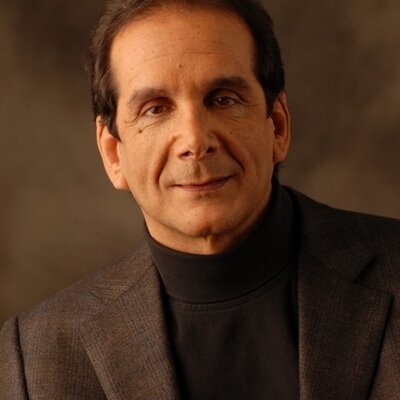
Charles Krauthammer, who died in June 2018, was an influential neoconservative columnist for the Washington Post and commentator for Fox News. A former psychiatrist, Krauthammer became a writer and pundit in the early 1980s, when he joined the New Republic. Krauthammer also wrote for Time magazine, the Weekly Standard, Commentary, Foreign Affairs, and the National Interest, among other outlets.[1]
An avid proponent of U.S. military intervention abroad and the author of the seminal neoconservative tract “The Unipolar Moment,” published in 1990, Krauthammer supported a number of neoconservative-led initiatives, including the Project for the New American Century. He has also served as an adviser to the Foundation for Defense of Democraciesand participated in the activities of the Washington Institute for Near East Policy.
Although he started his career as a Democrat, working as a science adviser to the Carter administration and later as a speechwriter for Walter Mondale, Krauthammer drifted steadily to the right during the 1980s. Ultimately, he became a mainstay of conservative punditry, praised by the right-wing National Review as “one of America’s most important opinion journalists.”[2]
Hate Trump, Love the Policies
Krauthammer was an early and harsh critic of Donald Trump. Shortly after Trump won the Republican Party’s presidential nomination in 2016, Krauthammer made clear not only his opposition to Trump but his utter disdain for the man. “I used to think Trump was an 11-year-old, an undeveloped schoolyard bully,” he wrote. “I was off by about 10 years. His needs are more primitive, an infantile hunger for approval and praise, a craving that can never be satisfied. He lives in a cocoon of solipsism where the world outside himself has value—indeed exists—only insofar as it sustains and inflates him.”
Krauthammer did not hide the fact that he, like many other observers, had not taken Trump seriously until it was too late. “A candidacy that started out as a joke, as a self-aggrandizing exercise in xenophobia, struck a chord in a certain constituency and took off. The joke was on those who believed that he was not a serious man and therefore would not be taken seriously. They—myself emphatically included—were wrong.”[3]
Krauthammer was equally opposed to Hillary Clinton and declared he would vote for neither.[4] Yet as Trump worked to enact his policies, Krauthammer made it plain that it was Trump’s temperament, not his policies, to which Krauthammer objected.
For example, after Trump was pilloried for withdrawing from the Paris agreement on climate change, Krauthammer wrote, “What the critics don’t seem to recognize is that the Paris agreement itself was a huge failure. It contained no uniform commitments and no enforcement provisions. Sure, the whole world signed. But onto what? A voluntary set of vaporous promises.”
Krauthammer alleged that Trump’s critics were overreacting to Trump’s decisions, but the real issue, in his view, was Trump’s love of sending messages over Twitter. “It’s the tweets, of course. Trump sees them as a direct, “unfiltered” conduit to the public. What he doesn’t quite understand is that for him — indeed, for anyone — they are a direct conduit from the unfiltered id. They erase whatever membrane normally exists between one’s internal disturbances and their external manifestations.”
Krauthammer apparently was pleased at the rift in the Gulf Cooperation Council that was triggered just after Trump’s visit to Saudi Arabia in the spring of 2017. His displeasure was rooted solely in Trump’s portraying the United States as a key player in the dispute. “It’s good to see our Sunni allies confront Qatar and try to bring it into line. But why make it personal — other than to feed the presidential id? Gratuitously injecting the U.S. into the crisis taints the endeavor by making it seem an American rather than an Arab initiative and turns our allies into instruments of American designs rather than defenders of their own region from a double agent in their midst,” he wrote.[5]
Krauthammer implicitly supported Trump’s decision to unilaterally violate the Iran nuclear deal. Speaking on Fox news, he said, “[W]hat the Iranians are doing. … is while the program on the fissile material is frozen, they’re working rapidly on the weaponization. … and of course on the ballistic missiles, which we can see. Yes, they are developing a nuclear weapon. It’s a violation of the ‘spirit’ of agreement, because the way they look at it, in half a decade, they’ll be able to resume the fissile material—the enriching uranium—they will have weaponized, and they will have the missiles.”[6] He offered no evidence for these claims, which were contradicted by international inspectors and the vast majority of world leaders and intelligence communities, including those in Israel and the United States.
While many conservatives and Republicans took Trump to task for his reluctance to criticize white supremacists who staged violent demonstrations in the summer of 2017, Krauthammer was perhaps the staunchest of that group. Speaking on Fox News, he said, “What Trump did today was a moral disgrace. What he did is he reverted back to where he was on Saturday and made it very clear that what he read on. … Monday, two days later, was a hostage tape, clearly reading off a prompter, saying these denunciations by name of the KKK, et cetera. That wasn’t Trump speaking. That was the aides speaking. … I’ll tell you why he didn’t [denounce white supremacy] on Saturday, because it’s not what’s in his heart.”[7]
On Obama
Krauthammer was a staunch critic of the Obama administration’s foreign policy, which he has described as a “foreign policy of retreat.”[8]
Faulting Obama in 2014 for his reluctance to intervene in a host of foreign conflicts from Eastern Europe to Syria, Krauthammer wrote, “Obama seems unaware of how far his country has fallen,” claiming that U.S. allies abroad have “watch[ed] this president undertake multiple abdications from Warsaw to Kabul.” He fiercely criticized the Obama administration for “dithering” on Syria and committing to withdraw from Afghanistan by the end of 2016—a decision that came after more than a decade of war, which Krauthammer nonetheless insisted was driven by a desire to “help Democrats electorally” and “provide a shiny new line to [Obama’s] résumé.”[9]
Krauthammer has been particularly emphatic about his dislike for the Obama administration’s advocacy of an Israeli-Palestinian peace agreement.
He was outraged by Obama’s decision, in December 2016, to abstain from a United Nations Security Council vote on a resolution calling all Israeli settlement in territories occupied in 1967 inconsistent with international law. Although this was the only resolution Obama did not veto—a number far lower than any of his predecessors, Republican and democrat alike—Krauthammer implied it was indicative of Obama’s hostility to Israel. Writing a year after the resolution passed, Krauthammer speculated, “At the very least, Obama should have insisted that any reference to East Jerusalem be dropped from the resolution or face a U.S. veto. Why did he not? It’s incomprehensible—except as a parting shot of personal revenge on Benjamin Netanyahu. Or perhaps as a revelation of a deep-seated antipathy to Israel that simply awaited a safe political interval for public expression. Another legacy moment for Barack Obama. And his most shameful.”[10]
Discussing Obama’s widely noted May 2011 speech on Mideast policy in which he reaffirmed the long-standing U.S. position that Israeli-Palestinian negotiations must begin with Israel’s 1967 borders, Krauthammer wrote, “Note how Obama has undermined Israel’s negotiating position. He is demanding that Israel go into peace talks having already forfeited its claim to the territory won in the ’67 war—its only bargaining chip. Remember: That ’67 line runs right through Jerusalem. Thus the starting point of negotiations would be that the Western Wall and even Jerusalem’s Jewish Quarter are Palestinian—alien territory for which Israel must now bargain.”[11]
Quoting Obama’s statement that the “status quo is unsustainable and Israel too must act boldly to advance a lasting peace,” Krauthammer rejoined: “Israel too? Exactly what bold steps for peace have the Palestinians taken?”[12] To which Think Progress writer Matt Duss replied, “Well, for starters, how about relinquishing claims to 78% of Palestine?. … This was, as Hussein Ibish noted recently, ‘The mother of all compromises.’ And it is a compromise that is being reaffirmed by the Palestinians seeking international recognition for a Palestinian state along the 1967 borders.”[13]
Krauthammer reiterated his complaints after the failure in 2014 of talks brokered by U.S. Secretary of State John Kerry. Although observers faulted Israeli intransigence over its illegal settlements and disputes over an agreed-upon prisoner exchange for the breakdown in talks, Krauthammer alleged, “There never was any chance of Palestinian leader Mahmoud Abbas concluding a final peace. … Abbas openly refuses to (a) recognize Israel as a Jewish state, (b) yield the so-called right of return (which would flood Israel with millions of Palestinians, destroying the state demographically) and (c) ever sign any agreement that ends the conflict once and for all.”[14] Despite Krauthammer’s claims, Abbas and the Palestinian Liberation Organization had long before recognized the government of Israel and suggested that they would relinquish their demand for a “right of return” to Israel proper.
Krauthammer has also been a staunch proponent of U.S. confrontation with Russia over its 2014 intervention in Ukraine’s civil crisis and subsequent annexation of Crimea. Advocating a revived “tripwire” strategy from the Cold War era, Krauthammer called for the United States to revive U.S. missile defense agreements with Poland and the Czech Republic (a provocative action against Russia’s nuclear deterrent seemingly unrelated to the crisis in Ukraine), to send arms shipments and military advisers to Ukraine (which observers argued could trigger a more forceful Russian response), and to impose “nuclear option” sanctions that would restrict Russia’s access to the international financial system. He also said that the United States should accelerate its natural gas exports and increase the U.S. military budget by “at least $100 billion.”[15]
On the other hand, Krauthammer has supported some of the Obama administration’s more controversial policies, including its use of armed drones to assassinate alleged terrorists overseas. “Osama bin Laden issued his fatwa declaring war on the United States in 1996; we reciprocated three days after 9/11 with Congress’s Authorization for Use of Military Force—against al-Qaeda and those who harbor and abet it,” he wrote in February 2013. “Its members are legitimate targets, day or night, awake or asleep.”[16]
Krauthammer made no exception for American citizens, whom he asserted “[forfeit] the privileges of citizenship and the protections of the Constitution” if they take up arms against the United States. In response to critics concerned about the global scope of the drone war and its humanitarian impact, Krauthammer added, “So what? It’s the jihadists who decided to make the world a battlefield and to wage war in perpetuity. Until they abandon the field, what choice do we have but to carry the fight to them?”[17]
Iran and the “War on Terror”
Among Krauthammer’s key targets has been the Iranian regime, which he has claimed is beholden to an ideology of “millenarianism” that makes Iran immune to nuclear deterrence, implying that it would be willing to sacrifice its existence to take out Israel if it acquired the bomb. In an August 2012 Post op-ed, Krauthammer lambasted “realists” for arguing that “deterrence” is an effective tool when confronting Iran because, as he put it, “It’s one thing to live in a state of mutual assured destruction with Stalin or Brezhnev, leaders of a philosophically materialist, historically grounded, deeply here-and-now regime. It’s quite another to be in a situation of mutual destruction with apocalyptic clerics who believe in the imminent advent of the Mahdi, the supremacy of the afterlife and holy war as the ultimate avenue to achieving it.”[18]
Ignoring the conclusions of the U.S. intelligence community that there was no indication that Iran had a nuclear weapons program—and that any attack on Iran would do little more than encourage Iran to build a weapon if it hadn’t decided to already—Krauthammer defended a potential preemptive strike by Israel against Iran’s nuclear installations. He wrote: “The confident belief that [Iran’s mullahs] are like the Soviets is a fantasy. That’s why Israel is contemplating a preemptive strike. Israel refuses to trust its very existence to the convenient theories of comfortable analysts living 6,000 miles from its Ground Zero.”[19]
After a 2013 breakthrough in nuclear negotiations between Iran and the “P5+1” negotiating powers, however, Krauthammer seemed to admit that Iran’s leaders made rational calculations after he hammered the Obama administration for providing a token amount of sanctions relief in exchange for cutbacks in Iran’s nuclear enrichment. “Regime survival is the only thing the mullahs value above nuclear weapons,” Krauthammer claimed after an interim agreement was reached. “And yet precisely at the point of maximum leverage, President Obama is offering relief in a deal that is absurdly asymmetric: The West would weaken sanctions in exchange for cosmetic changes that do absolutely nothing to weaken Iran’s nuclear infrastructure.”[20] Despite Krauthammer’s objections, the deal was largely praised by diplomats and other observers.
Krauthammer proved a vigorous advocate for bringing the “war on terror” to Iran even in the latter years of the Bush administration, when public frustration over Iraq was at a high point.
In a September 2006 column, for example, Krauthammer argued that it was necessary “to begin looking now with unflinching honesty at the military option” vis-à-vis Iran. He wrote: “In the region, Persian Iran will immediately become the hegemonic power in the Arab Middle East. Today it is deterred from overt aggression against its neighbors by the threat of conventional retaliation. Against a nuclear Iran, such deterrence becomes far less credible. As its weak, non-nuclear Persian Gulf neighbors accommodate to it, jihadist Iran will gain control of the most strategic region on the globe. Then there is the larger danger of permitting nuclear weapons to be acquired by religious fanatics seized with an eschatological belief in the imminent apocalypse and in their own divine duty to hasten the End of Days. The mullahs are infinitely more likely to use these weapons than anyone in the history of the nuclear age. Every city in the civilized world will live under the specter of instant annihilation delivered either by missile or by terrorist.”[21]
Earlier, during the summer 2006 military confrontation between Israel and Hezbollah, Krauthammer argued that Hezbollah was the “leading edge of an aggressive, nuclear-hungry Iran.” He concluded: “America finds itself at war with radical Islam, a two-churched monster: Sunni al-Qaida is now being challenged by Shiite Iran for primacy in its epic confrontation with the infidel West. With al-Qaida in decline, Iran is on the march. It is intervening through proxies throughout the Arab world—Hezbollah in Lebanon, Hamas in Palestine, Moqtada al-Sadr’s Mahdi Army in Iraq—to subvert modernizing, Western-oriented Arab governments and bring these territories under Iranian hegemony. Its nuclear ambitions would secure these advances, give it an overwhelming preponderance of power over the Arabs and an absolute deterrent against serious counteractions by the United States, Israel, or any other rival.”[22]
The Unipolar Moment and Its Legacy
Of all Krauthammer’s writings, his 1990 Foreign Affairs article “The Unipolar Moment” has arguably had the most lasting—and, some would argue, most damaging—impact. Written as the Cold War was winding down and the neoconservative movement was in disarray as a result of the loss of its core enemy (the Soviet Union), the article came to serve as the basis for a new neoconservative agenda in the 1990s, one that ultimately culminated in the Iraq War and the George W. Bush administration’s “war on terror.”
The article argued that the United States should seize its position as the top dog in the international order to impose its priorities on the world. Krauthammer wrote that if “America wants stability, it will have to create it.” The alternative to “such a robust and difficult interventionism,” he argued, is chaos. The main new U.S. opponents, opined Krauthammer, included “small aggressive states armed with weapons of mass destruction and possessing the means to deliver them.” Such states “will constitute the greatest single threat to world security for the rest of our lives.”[23]
Earlier, in a 1989 article for the National Interest titled “Universal Dominion: Toward a Unipolar World,” Krauthammer spelled out his vision for the larger, overarching aim of a post-Cold War agenda: To aggressively advance democracy across the globe as the “touchtone of a new ideological American foreign policy.”[24]
After the onset of the “war on terror” following 9/11, both these agenda items were heavily promoted by a formidable group of neoconservative ideologues organized around the Project for the New American Century (PNAC). Although terrorism and “Islamo-fascism” were not core elements of neoconservative rhetoric pre-9/11, the political faction quickly adapted these issues to fit Krauthammer’s larger agenda: imposing democracy globally.
This agenda was clearly spelled out in a series of open letters published by PNAC, including its September 20, 2001 letter to President George W. Bush, which Krauthammer signed along with the likes of Eliot Cohen, Francis Fukuyama, Robert Kagan, Richard Perle, William Kristol, Jeane Kirkpatrick, and a host of other neoconservative, liberal hawk, and other right-wing figures.[25]
The letter endorsed what PNAC called Bush’s “admirable commitment to ‘lead the world to victory’ in the war against terrorism.” Calling for the capture or killing of Osama bin Laden, the isolation of the Palestinian Authority, and the targeting of Hezbollah and its supporters in Syria, the PNAC letter also argued that “even if evidence does not link Iraq directly to the attack, any strategy aiming at the eradication of terrorism and its sponsors must include a determined effort to remove Saddam Hussein from power in Iraq. Failure to undertake such an effort will constitute an early and perhaps decisive surrender in the war on international terrorism.” It also emphasized the need to support democracies in the region as part of the war on terror, highlighting Israel as friend to be protected: “Israel has been and remains America’s staunchest ally against international terrorism, especially in the Middle East. The United States should fully support our fellow democracy in its fight against terrorism.”[26]
Krauthammer’s continued support for an aggressive, unilateral U.S. foreign policy despite the disastrous outcome of the invasion of Iraq helped spur a growing divide within neocon circles. Former neocon supporter Francis Fukuyama targeted Krauthammer for particular derision, arguing in 2004 that the columnist had become “strangely disconnected from reality.” In a much quoted essay called “The Neoconservative Moment”—with the title’s not-so-subtle jab at Krauthammer’s defining work—Fukuyama argued that neoconservatives like Krauthammer had lost touch with new “empirical facts” that had emerged in Iraq that demanded a dramatic change of course in U.S. foreign policy. These new facts, according to Fukuyama, included: “the failure to find weapons of mass destruction in Iraq, the virulent and steadily mounting anti-Americanism throughout the Middle East, the growing insurgency in Iraq, the fact that no strong democratic leadership had emerged there, the enormous financial and growing human cost of the war, the failure to leverage the war to make progress on the Israeli-Palestinian front, and the fact that America’s fellow democratic allies had by and large failed to fall in line and legitimate American actions ex post.”[27]
He added: “The failure to step up to these facts is dangerous precisely to the neo-neoconservative position that Krauthammer has been seeking to define and justify. As the war in Iraq turns from triumphant liberation to grinding insurgency, other voices—either traditional realists like Brent Scowcroft, nationalist-isolationists like Patrick Buchanan, or liberal internationalists like John Kerry—will step forward as authoritative voices and will have far more influence in defining American post-Iraq War foreign policy. The poorly executed nation-building strategy in Iraq will poison the well for future such exercises, undercutting domestic political support for a generous and visionary internationalism, just as Vietnam did.”[28]
Neoconservative?
Despite his long affiliation with the neoconservative brand, Krauthammer rejected the neoconservative label as an “anti-Semitic” smear. “It is an epithet. It is nothing more,” he told the National Review’s Rich Lowry in a January 2013 interview. “It once had a meaning, when Irving Kristol and Norman Podhoretz sort of changed their political ideology and made a great case for it in the ‘70s. Today it’s usually meant as a silent synonym for ‘Jewish conservative.’ … I would ask you whenever you hear the word [to] challenge the person to describe and explain to you what a neocon is. And I guarantee you they will have no answer.”[29]
At least one conservative commentator disagreed. “On brief inspection, the doctor’s tendentious tantrum borders on hilarity,” wrote Christopher Manion. “Many neocons wear the label proudly. After Obama’s illegal war on Libya (another disastrous failure, but I digress), Bill Kristol cheered, and proudly baptized Obama as a ‘born again neocon.’ Did Mr. Kristol’s use of that sly ‘epithet’ intend to brand Obama as a ‘Jewish conservative,’ I wonder?”[30]
In October 2012, prior to Krauthammer’s comments, Daily Beast blogger Ali Gharib disputed what he called “the conflation of neoconservativism and Jewishness.” Although a handful of “right-wing Jewish thinkers” helped to shape the movement, Gharib wrote, neoconservativism is not a “Jewish political movement; rather, it’s an American one” closely “identified with using military might to pursue interests.” Gharib pointed to prominent non-Jewish neoconservatives like the late Sen. Daniel Patrick Moynihan and former ambassador Jeane Kirkpatrick, as well as Jewish conservatives like Dov Zakheim who understand “the limits of U.S. power,” to illustrate his point. Gharib concluded that the association of neoconservativism with Jewishness was often invoked by right-wing hawks to blame “any careful look at neoconservatives, or even their policy positions, on anti-Semitism.”[31]
SOURCES
[1] Washington Post, “Charles Krauthammer,” http://projects.washingtonpost.com/staff/articles/charles+krauthammer/.
[2] Cited in Bradley Foundation, “Charles Krauthammer,” http://www.bradleyfdn.org/cm-window.asp?ID=1081.
[3] Charles Krauthammer, “Donald Trump and the fitness threshold,“ Washington Post, August 4, 2016, https://www.washingtonpost.com/opinions/donald-trump-and-the-fitness-threshold/2016/08/04/b06bae34-5a69-11e6-831d-0324760ca856_story.html?utm_term=.872b8933cc25
[4] Charles Krauthammer, “My vote, explained,” Washington Post, October 20, 2016, https://www.washingtonpost.com/opinions/my-vote-explained/2016/10/20/b61442a4-96f2-11e6-bc79-af1cd3d2984b_story.html?utm_term=.acc129cd7764
[5] Charles Krauthammer, “Trump Derangement Syndrome is spreading,” Mercury News, June 8, 2017, https://www.mercurynews.com/2017/06/08/krauthammer-trump-derangement-syndrome-is-spreading/
[6] “Krauthammer: Trump’s Right That Iran Is Violating the ‘Spirit’ of the Nuke Deal,” Fox News Insider, April 21, 2017, http://insider.foxnews.com/2017/04/21/krauthammer-trumps-right-iran-violating-spirit-nuke-deal
[7] Carla Herreria, “Charles Krauthammer Slams Trump’s Take On Charlottesville As ‘A Moral Disgrace,’” Huffington Post, August 16, 2017, https://www.huffingtonpost.com/entry/charles-krauthammer-trump-a-moral-disgrace-fox-news_us_5993c9f1e4b04b19336176fe
[8] Charles Krauthammer, “Emptiness at West Point,” Washington Post, May 29, 2014, http://www.washingtonpost.com/opinions/charles-krauthammer-emptiness-at-west-point/2014/05/29/bc270492-e763-11e3-afc6-a1dd9407abcf_story.html.
[9] Charles Krauthammer, “Emptiness at West Point,” Washington Post, May 29, 2014, http://www.washingtonpost.com/opinions/charles-krauthammer-emptiness-at-west-point/2014/05/29/bc270492-e763-11e3-afc6-a1dd9407abcf_story.html.
[10] Charles Krauthammer, “Charles Krauthammer: Obama’s final, most shameful, legacy moment,” Naples Daily News, December 29, 2017, https://www.naplesnews.com/story/opinion/2017/12/29/charles-krauthammer-obamas-final-shameful-legacy-moment/95967514/
[11] Charles Krauthammer, “What Obama Did to Israel,” Washington Post, May 27, 2011, http://www.washingtonpost.com/opinions/what-obama-did-to-israel/2011/05/26/AGJfYJCH_story.html.
[12] Charles Krauthammer, “What Obama Did to Israel,” Washington Post, May 27, 2011, http://www.washingtonpost.com/opinions/what-obama-did-to-israel/2011/05/26/AGJfYJCH_story.html.
[13] Matt Duss, “Krauthammer’s Complaint,” Middle East Progress, May 27, 2011, http://middleeastprogress.org/2011/05/krauthammers-complaint/.
[14] Charles Krauthammer, “Kerry’s folly, Chapter 3,” Washington Post, April 3, 2014, http://www.washingtonpost.com/opinions/charles-krauthammer-kerrys-folly-chapter-3/2014/04/03/41fae4bc-bb4a-11e3-9c3c-311301e2167d_story.html.
[15] Charles Krauthammer, “How to stop — or slow — Putin,” Washington Post, March 13, 2014, http://www.washingtonpost.com/opinions/charles-krauthammer-how-to-stop-putin/2014/03/13/9252a64a-aadb-11e3-af5f-4c56b834c4bf_story.html.
[16] Charles Krauthammer, “In Defense of Obama’s Drone War,” National Review, February 14, 2013, http://www.nationalreview.com/articles/340747/defense-obama-s-drone-war-charles-krauthammer.
[17] Charles Krauthammer, “In Defense of Obama’s Drone War,” National Review, February 14, 2013, http://www.nationalreview.com/articles/340747/defense-obama-s-drone-war-charles-krauthammer.
[18] Charles Krauthammer, “The ‘deterrence works’ fantasy,” Washington Post, http://www.washingtonpost.com/opinions/charles-krauthammer-the-deterrence-works-fantasy/2012/08/30/20c0a3ea-f2d8-11e1-892d-bc92fee603a7_story.html
[19] Charles Krauthammer, “The ‘deterrence works’ fantasy,” Washington Post, http://www.washingtonpost.com/opinions/charles-krauthammer-the-deterrence-works-fantasy/2012/08/30/20c0a3ea-f2d8-11e1-892d-bc92fee603a7_story.html
[20] Charles Krauthammer, “Sucker’s Deal,” Washington Post, November 21, 2013, http://www.washingtonpost.com/opinions/charles-krauthammer-suckers-deal/2013/11/21/9d03e966-52dc-11e3-a7f0-b790929232e1_story.html.
[21] Charles Krauthammer, “The Tehran Calculus,” Washington Post, September 15, 2006, http://www.washingtonpost.com/wp-dyn/content/article/2006/09/14/AR2006091401413.html.
[22] Charles Krauthammer, “The United States and Others Are Counting on Israel for a Decisive Victory,” Pittsburgh Post-Gazette, August 5, 2006.
[23] Charles Krauthammer, “The Unipolar Moment,” Foreign Affairs, Winter 1990/91, http://www.metu.edu.tr/~utuba/Krauthammer.pdf.
[24] Charles Krauthammer, “Universal Dominion: Toward a Unipolar World,” National Interest, Winter 1989/90.
[25] Project for the New American Century, “Letter to President Bush on the War on Terrorism,” September 20, 2001, http://web.archive.org/web/20070807153905/www.newamericancentury.org/Bushletter.htm.
[26] Project for the New American Century, “Letter to President Bush on the War on Terrorism,” September 20, 2001, http://web.archive.org/web/20070807153905/www.newamericancentury.org/Bushletter.htm
[27] Francis Fukuyama, “The Neoconservative Moment,” National Interest, January 6, 2004, http://nationalinterest.org/article/the-neoconservative-moment-811.
[28] Francis Fukuyama, “The Neoconservative Moment,” National Interest, January 6, 2004, http://nationalinterest.org/article/the-neoconservative-moment-811
[29] Jeff Poor, “Krauthammer: ‘Neoconservative’ is epithet used to disparage Jewish conservatives,” Daily Caller, January 26, 2013, http://dailycaller.com/2013/01/26/krauthammer-the-term-neoconservative-is-an-epithet-video/#ixzz2LxS7m1HV.
[30] Charles Manion, Charles Krauthammer And How the Neocons Destroyed The GOP,” From Under the Rubble, February 18, 2013, http://www.westernjournalism.com/charles-krauthammer-and-the-how-neocons-destroyed-the-gop/.
[31] Ali Gharib, “Neoconservative ≠ Jewish Conservative,” The Daily Beast “Open Zion” blog, October 30, 2012, http://www.thedailybeast.com/articles/2012/10/30/neoconservative-jewish-conservative.html.