
Rupert Murdoch
last updated: October 1, 2019
Please note: The Militarist Monitor neither represents nor endorses any of the individuals or groups profiled on this site.
BUSINESSES
- Weekly Standard: Former Owner (News Corp.)
- News Corp: Executive Chairman and Chief Executive Officer (1952-current)
- 21st Century Fox: Executive Chairman and CEO (2013-2015); Executive Co-Chairman (2015-2019)
- Fox News:Acting Chief Executive Officer ((2016-2018); Chairman (2019); Executive Co-Chairman (2019- )
EDUCATION
- Oxford University (Bachelors of Arts)
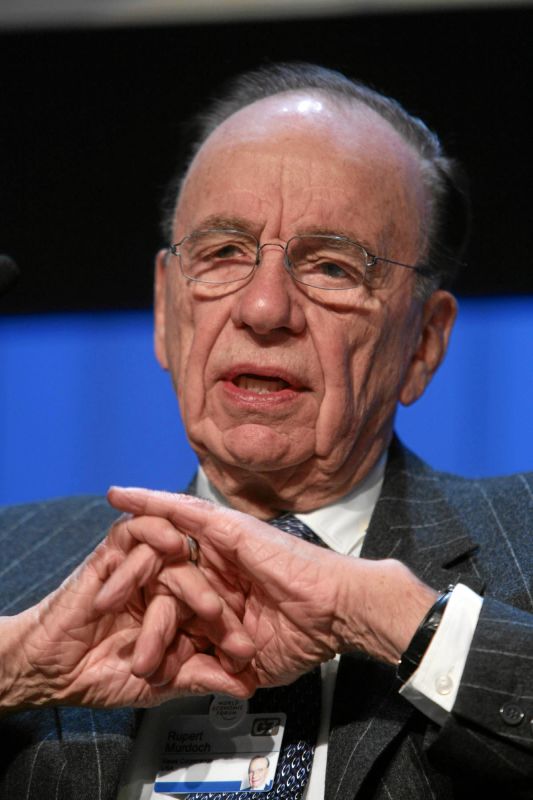
Rupert Murdoch heads one of the world’s largest media empires, the News Corporation, which during FY2018 had just over $9 billion in revenue from a diverse range of media products, including Fox News and numerous other press outlets in the United States, Australia, and the United Kingdom.[1]
In a widely noted 2019 exposé about the media mogul, the New York Times said of Murdoch and his family, “Across the English-speaking world, the family’s outlets have helped elevate marginal demagogues, mainstream ethnonationalism and politicize the very notion of truth. The results have been striking. It may not have been the family’s mission to destabilize democracies around the world, but that has been its most consequential legacy.[2]
Murdoch’s far right politics were described in stark terms by a writer for The Intercept in 2018: “Instead of a former grand wizard of the Ku Klux Klan, we have Rupert Murdoch as the founder of Fox News, which for years—starting long before Donald Trump’s presidency—injected racist, anti-Semitic and anti-liberal tropes into the American mainstream.”[3]
Murdoch is notorious for blatantly using his media holdings to try to impact policy decisions in numerous countries, including the United States and the United Kingdom. After the 9/11 attacks, for instance, many believed Murdoch had pressed many of his news outlets to promote a pro-war line that echoed efforts by both President George W. Bush and Prime Minister Tony Blair’s to push for the invasion of Iraq.[4]
More recently, the UK debate over Brexit has provided a test for Murdoch’s influence in Britain. According to the New York Times wrote, “The referendum represented the realization of a long-deferred dream for Murdoch. But it also returned him to a position of influence in British politics that seemed inconceivable just a few years earlier. Not only had The Sun played a critical role in delivering the Brexit vote, but in the ensuing political upheaval, it had swung behind Theresa May, helping ensure her election as prime minister. Once in office, she found time for a private meeting with Murdoch on one of her first foreign trips: a less-than-36-hour visit to New York to address the United Nations.”[5]
Murdoch capitalized on Fox-sponsored Republican Party presidential debates to promote specific candidates for the 2016 Republican nomination. After Fox Business Network aired a debate in November 2015, Murdoch sent out tweets promoting Marco Rubio, who Murdoch argued was the “best of all,” and lambasting Ted Cruz and Donald Trump, who “talked nonsense.”[6]
But later in the campaign, Murdoch and Trump renewed their positive relationship. One report stated that in the summer of 2016, after Trump had secured the nomination as the Republican candidate, Murdoch joined the nominee on a trip to Trump’s golf course in Scotland. The personal rapprochement proved fortuitous for Murdoch, who would find that “under Trump the government has consistently furthered Murdoch’s business interests, to the detriment of his rivals.” In 2018, the Trump administration would approve a controversial sale of a large piece of Murdoch’s 21st Century Fox holdings to the Disney Corporation, a merger which many saw as too great a consolidation of the industry in the hands of one corporation. Trump made no secret of his hand in the sale, announcing the approval before the Justice Department had signed off on it and claiming that it would create jobs, when it would actually “result in thousands of layoffs.”[7]
Fox News quickly became synonymous with Trump, alienating even many conservatives. For example, Jennifer Rubin, author of the Washington Post’s blog, Right Turn, now refuses to appear on Fox. “Fox was begun as a good-faith effort to counter bias, but it’s morphed into something that is not even news,” she said. “It’s simply a mouthpiece for the President, repeating what the President says, no matter how false or contradictory.”
Neoconservative icon and former editor of the Weekly Standard, Bill Kristol, voiced similar criticisms, stating, “It’s changed a lot. Before, it was conservative, but it wasn’t crazy. Now it’s just propaganda.”[8]
Murdoch’s relationship with Trump stretches back to the 1970s, when he was making his first forays into New York City. In 1976, Murdoch purchased the New York Post and transformed the newspaper—which had been in existence since its creation in 1801 by Alexander Hamilton—from a respected news into a sensationalistic tabloid. Trump’s penchant for creating gossipy headlines fit in perfectly with Murdoch’s style and after they met through their mutual friend, the infamous lawyer for Sen. Joseph McCarthy (R-WI) during the 1950s, Roy Cohn,[9] “Trump could attain celebrity in the pages of the Post as a playboy mogul, and Murdoch could sell papers by chronicling Trump’s exploits.”[10]
With Trump in the White House, and the massive expansion of Murdoch’s media empire, the relationship has become even more mutually beneficial, even though many observers of both men suggest that they may have some similar views but also some fundamental differences. Not the least of these is Trump’s demonization of the media, which Murdoch’s Fox News Network certainly emulates and magnifies, but which some have suggested reflects Murdoch prioritizing profit over his actual beliefs.
Wrote one such observer, “Around two-thirds of the television interviews Trump has given as president have been with Fox News and Fox Business Network (not one was given to Wallace). The barrage of prime-time poison is not just a political policy. It has built a ratings engine that helps Fox generate a billion dollars a year in advertising. …It has been said that Murdoch has a low opinion of Trump’s acumen, as well he might. And it could be that Trump’s vicious demonization of journalists is a bridge too far for Murdoch, that the monster is out of his control. But it’s too late. As the New York Times columnist Bret Stephens wrote, having himself been the recipient of menacing voice mails, ‘We are approaching a day when blood on the newsroom floor will be blood on the president’s hands.’”[11]
Relations with Neoconservatives
Considered a close ally of neoconservative activists, Murdoch has helped bankroll neoconservatism’s more important media outlets, including the William Kristol-edited Weekly Standard, the Wall Street Journal’s editorial page, and Fox News. A sign of Murdoch’s commitment to this hawkish “pro-Israel” faction’s causes was his willingness to support the Standard despite yearly losses in the millions. Many credited the magazine with playing a pivotal force in building support for the 2003 invasion of Iraq. According to a report by Fairness & Accuracy in Reporting, “With a circulation of about 65,000 and annual losses estimated from $1 million … to $5 million … the Standard represented only a tiny fraction of Murdoch’s vast media empire.”[12]
In June 2009, Murdoch sold the Standard to Clarity Media, a Denver-based company run by another conservative media mogul, Philip Anschutz. The New York Times reported that the magazine was sold for about $1 million, “according to an executive close to Mr. Murdoch who spoke anonymously because the terms of the deal were meant to be confidential.”[13] According to a News Corp. executive interviewed by the Times, Murdoch decided to sell the magazine to ”someone even more enthusiastic about perpetuating that voice.”[14]
Murdoch’s general alignment with neoconservative views and policies partly explains why he was both dismissive and disapproving of Donald Trump’s candidacy in the 2016 election, despite their friendship of decades. Murdoch—who had replaced Roger Ailes at the head of Fox News’ operations after Ailes resigned amidst sexual harassment charges—allowed different Fox hosts to promote their preferred candidates, but Murdoch himself was a backer first of Jeb Bush and later of Marco Rubio.
Yet, Fox’s broadcasting style over the years had paved the way for Trump, as one report observed. “Trump honed his political identity, railing against military intervention, free trade and immigration. They were all positions that directly contradicted Murdoch’s own, more neoconservative views. Murdoch had enthusiastically supported the Iraq War, evangelized for open immigration policies — even urging Australia to avoid the “self-defeating” anti-immigration debate in the United States — and endorsed international trade agreements like the Trans-Pacific Partnership. His attitude toward Trump’s emergent ideology was often captured on the unremittingly anti-Trump editorial page of The Wall Street Journal. …And yet Murdoch was in a sense responsible for unleashing the forces that were now propelling Trump’s rise. During the Obama years, Fox News had found ratings and profits with its wall-to-wall coverage of raucous Tea Party rallies and the opinion shows that advanced the campaign to delegitimize the country’s first African-American president.”[15]
Still, Murdoch made sure to hedge his bets. In March 2016, he tweeted, “As predicted, Trump reaching out to make peace with Republican ‘establishment.’ If he becomes inevitable party would be mad not to unify.”[16] So, when Trump became first the obvious front-runner in the Republican party, then the nominee and finally, the president of the United States, Murdoch’s media empire—especially Fox News—was steadfastly there beside him.
Media Activism
Murdoch is frequently criticized for using his media empire to advance his neoconservative-aligned political agenda. During the lead up to the U.S. invasion of Iraq, for example, the editors of Murdoch’s media holdings vociferously supported President George W. Bush and Prime Minister Tony Blair’s pro-war campaign. One British newspaper opined: “You have got to admit that Rupert Murdoch is one canny press tycoon because he has an unerring ability to choose editors across the world who think just like him. How else can we explain the extraordinary unity of thought in his newspaper empire about the need to make war on Iraq? After an exhaustive survey of the highest-selling and most influential papers across the world owned by Murdoch’s News Corporation, it is clear that all are singing from the same hymn sheet. Some are bellicose baritone soloists who relish the fight. Some prefer a less strident, if more subtle, role in the chorus. But none, whether fortissimo or pianissimo, has dared to croon the antiwar tune. Their master’s voice has never been questioned.”[17]
According to commentator David Kirkpatrick, Murdoch’s personal involvement in editorial issues helped ensure that almost all of his news outlets remained very closely aligned to “Mr. Murdoch’s own stridently hawkish political views, making his voice among the loudest in the Anglophone world in the international debate over the American-led war with Iraq.”[18]
Gene Kimmelman of the Consumers Union told the New York Times, “[Murdoch] has extended the most blatant editorializing in the entire world through his media properties, and that is exactly the example of what we need to worry about when any one entrepreneur owns and controls too many media outlets.”[19]
Fox News, which eclipsed CNN in 2002 as the top-rated cable news network in the United States, has frequently been singled out for criticism because of its blatantly one-sided coverage of political issues—from its campaign to support the invasion of Iraq to its efforts to discredit the Barack Obama White House. When CNN reporter Christiane Amanpour blamed Fox for creating “a climate of fear and self-censorship” regarding Iraq coverage, a Fox spokeswoman shot back, “Given the choice, it’s better to be viewed as a foot soldier for Bush than a spokeswoman for al-Qaida.”[20]
Similarly, when advisers to President Obama began criticizing Fox for failing to uphold high journalistic standards in its coverage of the administration, Fox senior executive Michael Clemente charged the White House with conflating the network’s commentary with its news coverage, which Clemente said was “like Fox News blaming the White House senior staff for the Washington Redskins’ losing record.”[21]
Some observers see Murdoch as more closely attracted to power and opportunism than ideology. Tim Arango of the New York Times writes, “Mr. Murdoch’s politics have often proved more malleable and less dogmatic than his critics have portrayed. He has been pragmatic in aligning himself, and his company, with power, rather than ideology. He supported Tony Blair in Britain, and in 2006, his New York Post endorsed Hillary Rodham Clinton for the Senate. Mr. Murdoch even hosted a fundraiser for Mrs. Clinton. And shortly after the election of Barack Obama as president, the Post fawned over him in its pages.”[22]
More recently, commentators have drawn comparisons between Murdoch and other pro-Israel rightwing figures like the controversial casino magnate Sheldon Adelson, who owns numerous media outlets in Israel and the United States. Adelson’s secretive purchase of a Las Vegas newspaper in 2015 and his subsequent efforts to directly impact some editorial decisions of the paper spurred MoveOn.org to circulate a petition under the title, “Don’t let Sheldon Adelson become the next Rupert Murdoch.”[23]
News Corp Scandals
Beginning in 2006 and peaking in 2011, a series of scandals erupted in which News Corp and Murdoch were embroiled in allegations that the company attempted to access voicemail records of “hundreds of celebrities and government officials,”[24] murdered British girls, and 9/11 victims.[25] British police arrested numerous top executives, including Rebekah Brooks, the former editor of News International, and the head of Scotland Yard resigned over the handling of the affair.[26] Sources also claim that News of the World journalists solicited a private detective to hack into the voicemails of 9/11 victims.[27]
Murdoch’s son James, once the heir apparent to News Corp, was accused of having given “mistaken” testimony to a British parliamentary investigation.[28] The younger Murdoch testified that he was unaware of the phone hacking allegations, but two former News Corp executives eventually came forward, saying that Murdoch had indeed knowledge of the illegal activities.[29]
The numerous scandals plaguing News Corp helped spur the splitting up of the company into two separate entities in 2013. The Economist reported in 2013: “On Friday June 28th Rupert Murdoch’s News Corporation will split in two. Most of its television and film assets will be scooped up into a new company, 21st Century Fox. Around 130 newspapers (including the Wall Street Journal and the Times of London), educational businesses and other assets will be left to form a new company with the old name of News Corp.” The Economist noted that “A break-up makes particular sense for News Corp, however, which has spent the past two years grappling with a scandal relating to allegations of phone-hacking and police bribery at the News of the World, a British newspaper that News Corp shut down in 2011. Separating the ‘good co’ (as analysts are calling 21st Century Fox) from the newspaper business (dubbed “crap co”) insulates the profitable television divisions from the repercussions of the scandal, which has cost News Corp $389m in legal and other costs so far. The split may also allow 21st Century Fox to renew its bid for the 61% of BSkyB.”[30]
SOURCES
[1] News Corp, “Quarterly Earnings Reports,” https://newscorp.com/investor-relations-2/quarterly-earnings-reports/
[2] Jonathan Mahle and Jim Rutenberg, “How Rupert Murdoch’s Empire of Influence Remade the World, Part 1, Imperial Reach,” New York Times, April 3, 2019, https://www.nytimes.com/interactive/2019/04/03/magazine/rupert-murdoch-fox-news-trump.html
[3] Peter Maass, “Fox News Is Poisoning America. Rupert Murdoch and His Heirs Should Be Shunned,” The Intercept, November 4, 2018, https://theintercept.com/2018/11/04/fox-news-is-poisoning-america-shun-rupert-murdoch/
[4] David D. Kirkpatrick, “Mr. Murdoch’s War,” New York Times, April 7, 2003, http://www.nytimes.com/2003/04/07/business/media-mr-murdoch-s-war.html.
[5] Jonathan Mahle and Jim Rutenberg, “How Rupert Murdoch’s Empire of Influence Remade the World, Part 1, Imperial Reach,” New York Times, April 3, 2019, https://www.nytimes.com/interactive/2019/04/03/magazine/rupert-murdoch-fox-news-trump.html
[6] Eliza Collins, ” Murdoch scores the 4th GOP debate for Rubio,” Politico, November 11, 2015, http://www.politico.com/story/2015/11/rupert-murdoch-gop-debate-215766.
[7] Jane Mayer, “The Making of the Fox News White House,” New Yorker, March 4, 2019, https://www.newyorker.com/magazine/2019/03/11/the-making-of-the-fox-news-white-house
[8] Jane Mayer, “The Making of the Fox News White House,” New Yorker, March 4, 2019, https://www.newyorker.com/magazine/2019/03/11/the-making-of-the-fox-news-white-house
[9] Jonathan Mahle and Jim Rutenberg, “How Rupert Murdoch’s Empire of Influence Remade the World, Part 1, Imperial Reach,” New York Times, April 3, 2019, https://www.nytimes.com/interactive/2019/04/03/magazine/rupert-murdoch-fox-news-trump.html
[10] Jane Mayer, “The Making of the Fox News White House,” New Yorker, March 4, 2019, https://www.newyorker.com/magazine/2019/03/11/the-making-of-the-fox-news-white-house
[11] Clive Irving, “Blame Rupert Murdoch for Trump Calling Journalists ‘Enemies of the People’,” Daily Beast, August 8, 2018, https://www.thedailybeast.com/blame-rupert-murdoch-for-trump-calling-journalists-enemies-of-the-people
[12] Michael Corcoran, “The Weekly Standard’s War: Murdoch sells the magazine that sold the Iraq invasion,” Extra!, September 2009, http://www.fair.org/index.php?page=3944.
[13] Tim Arango, “New Owner for a Magazine As Political Tastes Change,” New York Times, August 3, 2009, http://www.nytimes.com/2009/08/03/business/media/03standard.html.
[14] Tim Arango, “New Owner for a Magazine As Political Tastes Change,” New York Times, August 3, 2009, http://www.nytimes.com/2009/08/03/business/media/03standard.html.
[15] Jonathan Mahle and Jim Rutenberg, “How Rupert Murdoch’s Empire of Influence Remade the World, Part 1, Imperial Reach,” New York Times, April 3, 2019, https://www.nytimes.com/interactive/2019/04/03/magazine/rupert-murdoch-fox-news-trump.html
[16] Rupert Murdoch, Twitter, March 2, 2016, https://twitter.com/rupertmurdoch/status/705134886324215808
[17] Roy Greenslade, “Their Master’s Voice,” Guardian, February 17, 2003, http://www.guardian.co.uk/media/2003/feb/17/mondaymediasection.iraq.
[18] David D. Kirkpatrick, “Mr. Murdoch’s War,” New York Times, April 7, 2003, http://www.nytimes.com/2003/04/07/business/media-mr-murdoch-s-war.html.
[19] Alessandra Stanley, “It’s Reported, They Mock, You Decide,” New York Times, April 7, 2003.
[20] “Amanpour: CNN Practiced Self-Censorship,” USA Today, September 14, 2003, http://www.usatoday.com/life/columnist/mediamix/2003-09-14-media-mix_x.htm.
[21] Jim Rutenberg, “Behind the War Between White House and Fox,” New York Times, October 22, 2009, http://www.nytimes.com/2009/10/23/us/politics/23fox.html.
[22] Tim Arango, “New Owner for a Magazine As Political Tastes Change,” New York Times, August 3, 2009, http://www.nytimes.com/2009/08/03/business/media/03standard.html.
[23] MoveOn.org, “Don’t let Sheldon Adelson become the next Rupert Murdoch,” http://petitions.moveon.org/sign/dont-let-sheldon-adelson.
[24] New York Times, “Anatomy of the News International Scandal,” July 20, 2011, http://www.nytimes.com/interactive/2010/09/01/magazine/05tabloid-timeline.html?ref=europe.
[25] Reuters, “Rebekah Brooks Returning To News Corp After Phone-Hacking Scandal,” August 28, 2015, http://www.huffingtonpost.com/entry/rebekah-brooks-returning-to-news-corp-after-phone-hacking-scandal_55e0d9eee4b0c818f618064c
[26] David Carr, “Troubles That Money Can’t Dispel,” New York Times, July 17, 2011, http://www.nytimes.com/2011/07/18/business/media/for-news-corporation-troubles-that-money-cant-dispel.html?_r=3&pagewanted=all&seid=auto&smid=tw-NYTimesAd.
[27] David Collins, “Phone hacking: 9/11 victims ‘may have had mobiles tapped by News of the World reporters,’” The Daily Mirror, July 11, 2011, http://www.mirror.co.uk/news/most-popular/2011/07/11/phone-hacking-9-11-victims-may-have-had-mobiles-tapped-by-news-of-the-world-reporters-115875-23262694/.
[28] Tim Castle, “News Corp’s James Murdoch under pressure over hacking testimony,” Reuters, July 24, 2011, http://www.reuters.com/article/2011/07/25/newscorp-idUSL6E7IO0HT20110725.
[29] Graham Bowley and Jo Becker, “Pressure on Murdochs Mounts in Hacking Scandal,” New York Times, July 22, 2011, http://www.nytimes.com/2011/07/23/world/europe/23murdoch.html.
[30] Economist, « Why is News Corp splitting in two?” June 23, 2013, http://www.economist.com/blogs/economist-explains/2013/06/economist-explains-14.