
Clifford May
last updated: September 3, 2015
Please note: The Militarist Monitor neither represents nor endorses any of the individuals or groups profiled on this site.
Affiliations
- Foundation for Defense of Democracies: President (2001-present)
- Republican Jewish Coalition: Former Board Member
- Alliance for Research on National Security Issues: Deputy Director
- Project for the New American Century: Signatory, Letter on Israel, Arafat, and War on Terrorism (2002); Signatory, Letter on War on Terrorism (2001)
- Committee on the Present Danger: Policy Committee Chairman
- Henry Jackson Society: International Patron
- Republican National Committee: Director of Communications (1997-2001)
- Forgotten American Coalition: Member
- Christians United for Israel: Panelist
Government
- State Department: Former Member, Advisory Committee on Democracy Promotion
- Iraq Study Group: Former Member, Expert Working Group on Military and Security
Journalism
- Rising Tide Magazine: Former Editor
- Rocky Mountain News: Former Associate Editor
- KRMA-TV: Former Producer and Moderator
- TCI Cable: Former Host and Moderator for Race for the Presidency
- New York Times: Former Correspondent; Founder and Chief of West Africa Bureau
- New York Times Sunday Magazine: Former Editor
- Hearst Newspapers: Former Correspondent
- CBS Radio News: Former Reporter
- PBS: Former Reporter
- Geo Magazine: Former Senior Editor
- Newsweek: Former Associate Editor for International News
- Weber Shandwick: Former Senior Managing Director for Washington, DC Office
Education
- Sarah Lawrence College: B.A.
- University of Leningrad: Certificate in Russian language and literature
- Columbia University: M.A. (School of Public and International Affairs); M.A. (School of Journalism)
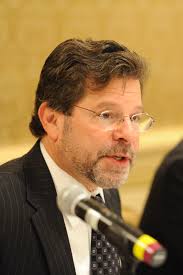
Clifford May is a neoconservative activist and writer who heads the Foundation for Defense of Democracies (FDD), an advocacy group that emerged in the wake of the 9/11 terrorist attacks to push an expansive "war on terror" focusing on the Middle East. May is also a former journalist who worked for several radio, print, and TV outlets, including PBS, CBS, Newsweek, and the New York Times.[1]
FDD claims that it is “a non-partisan institution focusing on national security and foreign policy” that was “founded by a group of former U.S. officials and visionary philanthropists shortly after the attacks of September 11, 2001 to help free nations defend themselves.”[2] Despite its non-partisan claims, the group has been closely associated with several other advocacy groups that have espoused hawkish policy agendas, typically in line with right-wing “pro-Israel” factions in the United States. FDD’s emergence also coincided with the founding of a passel of similarly oriented groups, including Americans for Victory over Terrorism, Family Security Matters, the Committee for the Liberation of Iraq, the Coalition for Democracy in Iran, and the Committee on the Present Danger.
A media account on the founding of FDD’s predecessor group, EMET, reports that in 2001 “three major pro-Israel donors incorporated an organization called EMET (Hebrew for ‘truth’). In an application to the Internal Revenue Service for tax-exempt status, May explained that the group ‘was to provide education to enhance Israel’s image in North America and the public’s understanding of issues affecting Israeli-Arab relations.’”[3]
On Iran
May’s writings often promote militarist U.S. policies on Iran and champion an Israel-centric view of Middle East. Observers have accused May of making unfounded assertions to bolster his arguments. For instance, in a January 2011 National Review Online article titled “Jihad 101,” May insinuated that Iran and al-Qaeda collaborate in terrorism campaigns. He wrote: “Iran is a predominately Shia country but its revolution inspired the rise of militant groups among the more numerous Sunni Muslims of the broader Middle East as well. Al-Qaeda is only the best known. Sunni jihadis and Shia jihadis are rivals, not enemies. They cooperate and collaborate against common enemies—us, for example.”[4]
But as writer Ali Gharib commented in response to the article, “the Islamic Republic of Iran and Al Qaeda are not the same thing, as any honest expert in either will tell you. The two actually hate each other. The connection that May peddles, meanwhile, is just as tenuous as when he made it about Iraq-Al Qaeda. … As for substantiating his argument with evidence in any of these cases, May has never really gone beyond ‘Well, they’re all jihadis!’”[5]
Since the election of President Barack Obama, May’s writings have alternately praised and condemned the Obama administration’s foreign policies, depending on the degree to which they adhere to the objective of overturning “enemy” regimes and bolstering May’s vision of Israeli security. Thus, for instance, in a March 2012 Scripps Howard op-ed, May praised President Obama for recognizing the “legitimacy” of Israeli concerns with respect to Iran’s purported effort to develop nuclear weapons, while casting doubt on the efficacy of the sanctions supported by the president and U.S. allies. “No one with a lick of sense,” wrote May, “backs sanctions because they are confident sanctions will work—with ‘work’ defined as causing Iran’s rulers to decide to forgo the most effective weapon ever invented.” Echoing a line of argument pursued by other hawkish “pro-Israel” figures like Michael Makovsky of the Jewish Institute for National Security Affairs, May argued that credible threats had to be made against Tehran: “A new round of diplomacy is scheduled to begin next month in Geneva. For there to be any small chance of success Iran’s rulers will need to feel pressured and vulnerable—they will need to take seriously the possibility that Americans and/or Israelis have rocks and are prepared to use them.”[6]
In early 2015, May issued dire warnings about the Obama administration’s diplomatic efforts aimed at peacefully resolving the Iranian nuclear dispute. In March 2015, as Iran and the P5+1 were edging closer to an agreement, he wrote: “At this point, it’s all but certain that Mr. Obama is prepared to accept a deal that will be dangerous for America and the West—and, yes, life-threatening for Israel. For Iran’s rulers, by contrast, it could be the deal of this young but already bloody century.” May then made the outlandish claim that Shia Iran could give the avowedly anti-Shia al-Qaeda a nuclear bomb: “[I]n addition to worrying that Iran’s rulers will use nuclear weapons or give them to Hezbollah, their proxy, there is now reason to believe they might provide a bomb to al Qaeda.”[7]
He pushed Congress to pass additional sanctions on Iran in the midst of the on-going negotiations, a measure President Obama promised to veto. He wrote for the Washington Times in January 2015: “Mr. Menendez, Mr. Kirk and many other members of Congress—whether there are enough of them to constitute a veto-proof majority is unclear—think that Mr. Obama’s all-carrots-and-few-sticks approach has not succeeded. They want to try a different strategy. They want to use the prospect of new, deadline-triggered sanctions to pressure Iran’s rulers to compromise sooner rather than later—because there will come a point when later is too late.”[8]
After a comprehensive nuclear deal was reached between Iran and six major world powers in July 2015, May argued that the United States should have increased sanctions to get a better deal but that instead "Mr. Obama seeks to accommodate and appease Iran's rulers." He then added: "It would be an exaggeration to say that such policies always lead to major wars and holocausts. But can you tell me when such policies have led to good outcomes?"[9]
Slate’s John Judis responded: “These kinds of considerations have led some supporters of the agreement to argue that hawks like May and [FDD Executive Director Mark] Dubowitz, in advocating renegotiation, know that this path will bear no fruit and secretly want to hasten war with Iran.”[10] He added that FDD’s opposition to the Iran deal may really derived from the potential of rapprochement between the United States and Iran, which some “pro-Israel” figures think would come at the expense of Israel. “May described sympathetically Israel’s ‘worry that Mr. Obama means to form a de facto alliance with Iran.’ Some observers have long said that this concern actually lies at the heart of the Israeli government’s opposition to a deal with Iran: Netanyahu fears that a deal would wed American foreign policy to an irredeemably revolutionary Iran at the expense of Israel. And one person familiar with the thinking of FDD experts described this scenario, involving an attempted rapprochement between the United States and Iran, as representing to them ‘the worst of all possible worlds.’”[11]
May has also claimed that “multiculturalism” is partly to blame for the Obama administration reaching a nuclear deal with Iran. He wrote in August 2015: “Why would American negotiators agree to such concessions? They apparently believe that talking softly while carrying no military or economic sticks is all that’s necessary to achieve ‘conflict resolution’ … Have multiculturalism and ‘moral equivalence’ blinded America’s leaders to that reality?”[12]
May commended New York Democratic Sen. Chuck Schumer for declaring he would vote against the deal in the lead up to Congress’s vote on the agreement, making him one of just two Democratic Senators coming out against the deal as of early September 2015. May proclaimed: “Your work is not yet done, you know. You need to educate those of your colleagues who are educable. … The stronger and more bipartisan the disapproval the better. That will provide the next administration, whether Democratic or Republican, with leverage to mend or end the deal. What’s more, the gold rush of investors heading to Tehran will slow if they think it’s not yet safe down in the mines.”[13]
On the Palestinians
May has been a vocal critic of the Obama administration’s approach to the Israeli-Palestinian conflict. In April 2010, for example, May lambasted then-Secretary of State Hillary Clinton for encouraging Israel to "continue building momentum toward a comprehensive peace” and respecting Palestinians' "legitimate aspirations.” Characterizing these statements as “cruel” toward Israel, May wrote that Clinton “has conducted Middle East diplomacy in a way that can be described, at best, as lacking coherence. At worst—borrowing a phrase from scholar Bernard Lewis—she is helping make America appear ‘harmless as an enemy and treacherous as a friend.’”[14]
May has denounced using the term “occupied Palestinian territories”—widely used by governments and international organizations including the United Nations—to refer to the West Bank and Gaza Strip. He wrote in June 2015: “Last week, I paid a couple of visits to the West Bank or, as Israel’s enemies call it, ‘the illegally occupied Palestinian territories.’ Israelis who live and work there are more likely to use the biblical name: Judea and Samaria.”[15]
According to one observer: “May himself has adhered more closely to Netanyahu’s position of giving lip service to a two-state solution while maintaining that because of Palestinian refusal to recognize the state of Israel, the conditions do not exist for realizing it.”[16]
May has expressed strong opposition to the grassroots BDS (Boycott, Divestment and Sanctions) movement, which seeks to pressure Israel to give Palestinians the right to self-determination. He wrote in August 2015: “You can be sure, however, that the campaign’s leaders understand quite well how economic warfare can facilitate kinetic warfare. Brand Israel as a pariah state (even as Iran, the world’s leading terrorism sponsor, is given renewed legitimacy and the prospect of significant foreign investment) and, over time, Israel will be rendered more vulnerable to its openly exterminationist enemies.”[17]
Other U.S. National Security Policies
May joined a chorus of right-wing figures in criticizing the Obama administration’s efforts to reform U.S. nuclear strategic policies, claiming that reductions to the nuclear arsenal established in the new START agreement negotiated with Russia will be seen by terrorists as an opportunity to be exploited[18] (despite that fact that the treaty will allow the United States to maintain 1,550 deployed strategic warheads). May also erroneously declared that the new START “may limit our ability to deploy additional missile defense,” a view that despite its popularity on the right has been repeatedly dismissed by serious arms control specialists.[19]
May criticized the Obama administration’s 2015 National Security Strategy and the comments made by National Security Advisor Susan Rice during its public unveiling ceremony at the Brookings Institution. Rice had stressed during her speech that the United States did not currently facing the sort of existential crises it faced during World War II or the Cold War. May responded, saying: “Remember that American leaders of both parties similarly minimized the threat posed by al Qaeda prior to Sept. 11, 2001.” He added: “Is the lesson of that day, as Dr. Rice implies, that we should worry only about existential threats—confident that we can absorb lesser doses of death and destruction? Or should we have learned instead to do all we can to prevent our enemies from inflicting such punishment now and in the future?”[20]
According to May, President Obama’s policy is to abandon the United States’ supposed global leadership role. “With the fall of the Berlin Wall, the US accepted the burden of global leadership. Soon, however, there were voices on both the left and the right arguing for America to relinquish that responsibility. President Obama has made that his policy. Since he’s been in office, he has been ‘leading from behind,’ deferring to the ‘international community,’” he wrote in February 2015. “The stronger America’s military and economic power, and the more credible America’s willingness to deploy that power, the less frequently that power will need to be deployed.”[21]
In an August 2015 op-ed for the Washington Times, May stated that Obama wanted to weaken the United States: “Diminishing our military capabilities is the current policy of the Obama administration, and it has the acquiescence, and in some cases the support, of many Republicans in Congress.”[22]
May was a stringent critic of the 2014 Senate report on CIA torture, writing after its release: “George Orwell, a man of the left, made clear that people sleep peacefully in their beds at night only because rough men stand ready to do violence on their behalf. Today, we are telling our rough men to stop being rough. It’s no longer necessary. It’s torture. It’s illegal and immoral. And we’re ashamed of them. To our enemies, this will appear as a kind of unilateral disarmament. All of us—Mrs. Feinstein and Mr. Stewart included—should think about that, perhaps tonight when we lie down in our beds.”
May also contributed his name to a widely noted May 2010 Washington Times editorial that called for a “renewed adherence to the national security philosophy of President Ronald Reagan: ‘Peace Through Strength.’” Offering a 10-point plan to protect America, the authors—who also included the Center for Security Policy’s Frank Gaffney and Reagan-era figure Edwin Meese—argued that “freedom,” “America’s exceptional role,” and even the country’s very existence are at stake as a result of an astounding array of alleged threats facing the country. These threats included missile attacks, Shariah law, electromagnetic pulse weapons, Islamic terrorism, undocumented immigrants, and a weak military.[23]
Track Record
A veteran journalist, May worked as a correspondent for the New York Times, a senior editor for Geo Magazine, and an associate editor for Newsweek. He writes a weekly column that is nationally distributed by Scripps Howard News Service, and he has contributed to the National Review Online, CNN's American Morning, and National Public Radio's Morning Edition, among other outlets. In the late 1990s, May edited Rising Tide, the official magazine of the Republican Party.
During George W. Bush’s second term, May served as a member of Secretary of State Condoleezza Rice's Advisory Committee on Democracy Promotion (ACPD).[24] May was appointed for a two-year stint beginning in 2006. Undersecretary of State Paula Dobriansky served as executive director of the committee. Other committee members include Carl Gershman and Vin Weber of the National Endowment for Democracy, Michael Novak of the American Enterprise Institute (AEI), and Jennifer Windsor of Freedom House.[25]
In September 2007, Media Matters criticized May for failing to disclose his government ties, and those of the FDD, during media appearances. "[May] has appeared in the media several times to defend the administration's conduct of the Iraq war,” the progressive media watchdog group published on their site. “However, in none of his columns or on-air appearances has May disclosed that FDD has received at least $1.2 million in State Department grants since 2004, or that May himself is a member of Secretary of State Condoleezza Rice's Advisory Committee on Democracy Promotion."[26]
May was also a member of the Iraq Study Group's Military and Security Working Group of Experts, which was formed in March 2006. As the Washington Post reported in December 2006: "A key recommendation of last week's Iraq Study Group report was that the Bush administration should reach out to Iran and Syria to improve the situation in Iraq. The White House has long rejected the notion, but nearly all of the 44 experts who worked on the report supported it. However, two conservative holdouts—Clifford May, a former Republican National Committee spokesman, and Reuel Marc Gerecht of the American Enterprise Institute—needed some extra convincing. In a series of e-mails, James Dobbins, a former diplomat and the chief architect of Afghan reconciliation (now at Rand Corp.) made his case. In the end, May was won over but Gerecht was not."[27]
In a September 2006 op-ed, May equated “Islamic fascists” with World War II-era fascists. Citing the work of Michael Ledeen, a scholar at AEI, May argued that "whereas the Nazis waged a war for German domination of Europe, [Ayatollah] Khomeini looked forward to a war that would spread Islamic rule throughout the Middle East and beyond." Quoting a 1942 Khomeini diatribe, in which the Iranian revolutionary claimed that "the sword is the key to paradise" and "Islam wants to conquer the whole world," May argued that "Khomeini's successors may soon have not just swords but also nuclear weapons to help them pursue their vision. Osama bin Laden's ambitions are the same though he dreams of Sunni rather than Shiite sheiks ordering infidels to convert or die." He also approvingly cited the opinions of conservative then-Sen. Rick Santorum (R-PA), who, according to May, recognized that "Islamic fascism" is the "ideological heir to the enemy America confronted in World War II—and is at least as serious a threat.”[28]
Advocacy Affiliations
Before joining the FDD, May was director of communications for the Republican National Committee. May's corporate connections have included working as the senior managing director of Weber Shandwick, which describes itself as "one of the world's leading public relations and communications management firms."[29]
May has also served as vice-chair of the Republican Jewish Coalition and was a signatory of various statements published by the Project for the New American Century (PNAC). May currently serves as chairman of the Policy Committee of the Committee on the Present Danger (CPD), which the FDD describes as a "venerable Cold War group."[30] CPD was revived by the FDD and a plank of hardline Democrats and Republicans in 2004. Sen. Jon Kyl (R-AZ) and Sen. Joseph Lieberman (I-CT) serve as CPD's honorary co-chairmen. George Shultz and James Woolsey are the co-chairs of CPD's six-member board of directors.
May was one of several right-wing figures to sign on to a September 2007 declaration sponsored by the Forgotten American Coalition condemning the idea of withdrawal from Iraq. The coalition, spearheaded by Gary Bauer, was a letterhead organization that also hyped the threat from Iran and Syria. In July 2007, May was a panelist at the Washington, DC summit of Christians United for Israel, a gathering that he described as focusing on Israeli security and "Islamic imperialists and supremacists.”[31]
May has been associated with the Henry Jackson Society, a conservative group launched in Cambridge, England in March 2005. The society was founded, in its own words, on the idea that "liberal democracy should be spread across the world; that as the world's most powerful democracies, the United States and the European Union—under British leadership—must shape the world more actively by intervention and example; that such leadership requires political will, a commitment to universal human rights, and the maintenance of a strong military with global expeditionary reach; and that too few of our leaders in Britain and the rest of Europe today are ready to play a role in the world that matches our strength and responsibilities."[32] Included among the think tank's international patrons are May and other neoconservative luminaries like Bruce Jackson, Robert Kagan, William Kristol, Richard Perle, Joshua Muravchik, and Woolsey.
May's FDD has been packed with "insiders" such as Jack Kemp, Newt Gingrich, Woolsey, Gaffney, Kristol, and Perle. An indication of the FDD's emergence as a major player in the think-tank world occurred on March 13, 2006, when President George W. Bush delivered a speech on the "Global War on Terrorism" at an FDD-sponsored event. Bush's choice of the FDD as a forum was regarded by many observers as a sign that the administration remained firmly under the thrall of neoconservative-inspired foreign policy, despite worsening problems in Iraq and elsewhere in the Middle East.
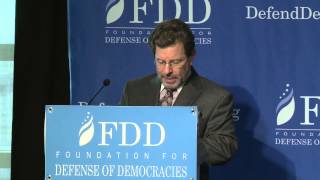
Bush's FDD speech highlighted not only the new prominence of the FDD, but also of Clifford May. May, who introduced the president, framed the administration's war on terrorism in Cold War terms and also incorporated the FDD's democracy vs. terrorism theme in his opening remarks: "From the moment he stood on the rubble of the World Trade Center, President Bush has demonstrated that he understands the nature of the threat facing our country and the entire Free World," said May. "We stand behind the president in his commitment, his determination to defend freedom and defeat the enemies of democratic societies."[33]
The president commended FDD's work during his speech: "The foundation is making a difference across the world, and I appreciate the difference you're making. You have trained Iraqi women and Iranian students in the principles and practice of democracy, you've translated 'democracy readers' into Arabic for distribution across the broader Middle East, you've helped activists across the region organize effective political movements—so they can help bring about democratic change and ensure the survival of liberty in new democracies. By promoting democratic ideals, and training a new generation of democratic leaders in the Middle East, you are helping us to bring victory in the war on terror—and I thank you for your hard work in freedom's cause."[34]