
Norman Podhoretz
last updated: December 11, 2015
Please note: The Militarist Monitor neither represents nor endorses any of the individuals or groups profiled on this site.
Affiliations
- Hudson Institute: Adjunct Fellow
- Commentary Magazine: Editor-in-Chief (1960-1995)
- Committee on the Present Danger: Cofounder
- Committee for the Free World: Cofounder
- Project for the New American Century: Founding Signatory
- Council on Foreign Relations:Member
- Columbia University: Former Pulitzer Scholar
Government
- U.S. Information Agency: Chairman of the New Directions Advisory Committee (1981-1987)
- U.S. Army: Enlisted Officer in Army Security Agency (1953-1955)
Education
- Columbia University: B.A.
- Cambridge University: B.A., M.A.
- Jewish Theological Seminary: B.A., Hebrew Literature
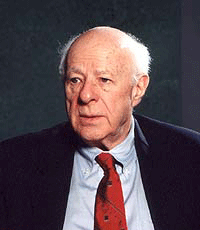
Norman Podhoretz has been a leading writer and ideologue of the neoconservative movement since the group began to emerge in the late 1960s. Along with the late Irving Kristol, Podhoretz is widely regarded as one of the group’s trailblazers. He is also a patriarch of one of the faction’s most prominent families, which includes Podhoretz’s spouse Midge Decter, son John Podhoretz, son-in-law Elliott Abrams, and late stepdaughter Rachel Abrams.
Podhoretz edited the neoconservative flagship magazine Commentary from 1960 to 1995, using it as a soapbox from which he and like-minded writers shaped the contours of what he called the neoconservative “tendency.” As he steadily drifted from the political left to the right, Podhoretz lambasted the anti-war movement, extolled the virtues of military power, attacked so-called “appeasers” like George McGovern, and condemned the supposed amorality of the counterculture from his perch at Commentary. Podhoretz also was an important member of the Committee on the Present Danger(CPD), founded in the mid-1970s to serve as a pressure group aimed at resisting the politics of détente with the Soviet Union and championing a fierce anti-communism.
In recent years, Podhoretz has been among the louder advocates of bombing Iran, deriding “appeasers” and divulging his case against Tehran in Commentary, the Wall Street Journal, and other publications. “I’ve been saying for something like seven years that nothing will stop Iran from getting nuclear capability,” Podhoretz told an interviewer in January 2013. “And neither sanctions nor diplomacy will work. If there is no military action taken within the next few months, or maybe years, then Iran will become a nuclear power.”[1]
Podhoretz vociferously opposed the historic nuclear agreement reached in July 2015 between Iran and world powers. Writing for the Wall Street Journal after the deal was struck, Podhoretz called the agreement a “calamity,” adding that the lone “upshot” was that the “only way” left to prevent an Iranian nuclear weapon would be to “bomb Iran.”[2]
He opined: “The brutal truth is that the actual alternatives before us are not Mr. Obama’s deal or war. They are conventional war now or nuclear war later. John Kerry recently declared that Israel would be making a ‘huge mistake’ to take military action against Iran. But Mr. Kerry, as usual, is spectacularly wrong. Israel would not be making a mistake at all, let alone a huge one. On the contrary, it would actually be sparing itself—and the rest of the world—a nuclear conflagration in the not too distant future.”[3]
Podhoretz also voiced support for Israel attacking Iran while the nuclear negotiations were on-going, writing in late 2013: “I remain convinced that containment is impossible, from which it follows that the two choices before us are not war vs. containment but a conventional war now or a nuclear war later.” He added: “Given how very unlikely it is that President Obama, despite his all-options-on-the-table protestations to the contrary, would ever take military action, the only hope rests with Israel. If, then, Israel fails to strike now, Iran will get the bomb.”[4]
Podhoretz has likened the U.S.-Iran standoff to Europe’s “appeasement” of Nazi Germany in the 1930s. “Mr. [George W.] Bush is right about the resemblance between 2008 and 1938,” Podhoretz wrote in 2008. “In 1938, as Winston Churchill later said, Hitler could still have been stopped at a relatively low price and many millions of lives could have been saved if England and France had not deceived themselves about the realities of their situation. Mutatis mutandis, it is the same in 2008, when Iran can still be stopped from getting the bomb and even more millions of lives can be saved—but only provided that we summon up the courage to see what is staring us in the face and then act on what we see. … If not—God help us all—the stage will have been set for the outbreak of a nuclear war that will become as inescapable then as it is avoidable now.”[5]
When a 2007 National Intelligence Estimate (NIE) concluded that there was no evidence to suggest Iran was developing a nuclear weapon, Podhoretz argued that the report was aimed at making it “politically impossible” for Bush to exercise a military option. “To me,” Podhoretz wrote, “it seemed obvious that it [the NIE] represented another ambush by an intelligence community that had consistently tried to sabotage Bush’s policies through a series of damaging leaks and was now trying to prevent him from ever taking military action against Iran.”[6]
The political behavior of American Jews has been another major theme of Podhoretz’s more recent writings, which he explored in his 2009 book Why Are Jews Liberal? Summing up his views in a Wall Street Journal op-ed, Podhoretz claimed that American Jews simply cared more about liberal politics than their faith. “Invirtually every instance of a clash between Jewish law and contemporary liberalism, it is the liberal creed that prevails for most American Jews,” Podhoretz claimed. “Which is to say that for them, liberalism has become more than a political outlook. It has for all practical purposes superseded Judaism and become a religion in its own right.”[7]
Leon Wieseltier, literary editor of the New Republic, called Why Are Jews Liberal? a “dreary book” that failed to actually answer the question posed by its title. “His perspective is so settled, so confirmed, that it is a wonder he is not too bored to write,” Wiesltier wrote of Podhoretz in the New York Times. “The veracity of everything he believes is so overwhelmingly obvious to him that he no longer troubles to argue for it.”[8]
Podhoretz has maintained his hope that “buyer’s remorse” over President Barack Obama’s alleged hostility to “the security of Israel” will eventually drive more American Jews to the conservative camp.[9] More broadly, Podhoretz has called Obama an “anti-American leftist” who aims “to turn this country into a European-style social democracy while diminishing the leading role it has played in the world since the end of World War II.”[10]
Podhoretz has also criticized President Obama’s efforts at restarting peace negotiations between Israel and the Palestinians. With the collapse of the 2013-2014 Israeli-Palestinian peace talks, Podhoretz bemoaned what he alleged was Secretary of State John Kerry blaming Israel for what Podhoretz deemed, “this latest diplomatic fiasco.” Podhoretz went on to hold the Palestinians culpable: “I for one pray that a day will come when the Palestinians finally let go of the evil intent toward Israel that keeps me from having any sympathy for them, and that they will make their own inner peace with the existence of a Jewish state in their immediate neighborhood. But until that day arrives, the “peace process” will go on being as futile as it has been so many times before and as it has just proved once again to be.”[11]
Since relinquishing his Commentary perch in 1995, Podhoretz has preached his ultra-hawkish and U.S.-centric vision of global affairs as an adjunct fellow at the right-wing Hudson Institute. He has also served as an adviser to politicians, including former New York City mayor Rudolph Giuliani, who tapped Podhoretz as a senior foreign policy adviser during his run for the 2008 Republican Party presidential nomination.
Impact on Neoconservatism
Discussing Podhoretz’s influence on U.S. political discourse, the noted international relations scholar Andrew J. Bacevich wrote in his 2005 book The New American Militarism: “Once his own fling with sixties radicalism ended, Podhoretz launched a ‘scorched-earth campaign against the New Left and counterculture.’ From his editorial command post at Commentary… Podhoretz did much to create and refine the fiercely combative neoconservative style. That style emphasized not balance (viewed as evidence of timidity) or the careful sifting of evidence (suggesting scholasticism) but the ruthless demolition of any point of view inconsistent with the neoconservative version of truth, typically portrayed as self-evident and beyond dispute.”[12]
In the 1960s, Podhoretz began explicating themes that have since become commonplace in neoconservative discourse, including the constant preoccupation with weakness and betrayal, the centrality of the Holocaust, the belief in U.S. exceptionalism, and the view that U.S. military force is a unique arbiter of good in global affairs. Before Iran became the new “Munich” to Podhoretz, there was Vietnam, which for him was “the self-evident symbol of a policy that must never be followed again.” The debacle in Vietnam had resulted in the lessening of the possibility of the United States wielding its military power, a result that Podhoretz considered potentially catastrophic. He wrote in 1982 that, “The survival not only of the United States but of free institutions everywhere in the world depends on a resurgence of American power.” Thus, he and other neocons in the 1970s, including his wife Midge Decter, struggled to overcome the post-Vietnam “malaise” in U.S. culture, which they thought was expressed in the counterculture and the “appeasement” polices of both the Nixon and Carter administrations.[13]
Perhaps Podhoretz’s most notorious work in this period was his 1963 Commentary piece, “My Negro Problem and Ours.” Discussing his reaction to the turbulent racial politics of the period, Podhoretz wrote: “The hatred I still feel for Negroes is the hardest of all the old feelings to face or admit, and it is the most hidden and the most overlarded by the conscious attitudes into which I have succeeded in willing myself. … I know it from the insane rage that can stir in me at the thought of Negro anti-Semitism; I know it from the disgusting prurience that can stir in me at the sight of a mixed couple; and I know it from the violence that can stir in me whenever I encounter that special brand of paranoid touchiness to which many Negroes are prone.”[14]
Reflecting on the piece fifty years after its publication, Podhoretz praised it as a “fully realized piece of writing” and added: “I have always been proud of it for the boldness it exhibited in grappling with what was then, and still is, the most difficult subject for any American to discuss without hiding behind the usual clichés and pieties and without taking refuge in cant.” Commenting on race relations today, Podhoretz claimed that “the problem today is not white racism,” but rather “the astounding proportion of black babies born out of wedlock who grow up without fathers, and who are doomed to do badly in school, to get into trouble on the streets, and to wind up in jail.” To critics who said that white racism exacerbated each of these tendencies, Podhoretz asserted: “if there is white racism at work here, it is precisely the perverse liberal variety.”[15]
Podhoretz also gained a reputation while at Commentary for overusing Holocaust imagery to describe contemporary events. Peter Novick, author of The Holocaust in American Life, remarked about Podhoretz’s work: “Once one starts using imagery from that most extreme of events, it becomes impossible to say anything moderate, balanced, or nuanced; the very language carries you along to hyperbole. … Anyone who scoffed at the idea that there were dangerous portents in American society had not learned ‘the lessons of the Holocaust.'”
This preoccupation also found expression in neoconservatives’ views on Israel. Decter once wrote while criticizing politicians whom she felt were not sufficiently supportive of Israel: “In a world full of ambiguities and puzzlements, one thing is absolutely easy both to define and locate: that is the Jewish interest. The continued security—and in those happy places where the term applies, well-being—of the Jews, worldwide, rests with a strong, vital, prosperous, self-confident United States.”[16]
Describing the sharp neoconservative reaction to perceived anti-Semitism in the United Nations following the 1973 Yom Kippur War, the conservative scholars Stefan Halper and Jonathan Clarke argue that a consensus gradually emerged among key neoconservatives like Daniel Patrick Moynihan, Irving Kristol, and Podhoretz that “America and Israel … shared a common ideological struggle against common enemies. The 1970s saw the vague consensus of neoconservatism … wrap itself tightly around the belief that America must have a self-assured and robust elite, which must be willing to employ U.S. power promptly and resolutely, if need be, and prepared to stand up to the USSR along with its anti-American and anti-Semitic allies at the UN and beyond.”[17]
Even as the Cold War drew near to a close, Podhoretz and his cohorts continued to raise alarm about the Soviet “threat.” In the late 1980s, as the Soviet Union began to crumble, Podhoretz’s Commentary continued to warn of impending doom from the Soviets. In 1987, after Mikhail Gorbachev introduced the Perestroika and glasnost reforms that helped open up the Soviet Union to liberal changes, Podhoretz published an article by Eugene Rostow, which argued: “The Soviet program of indefinite expansion achieved by the aggressive use of force … [is still] the central problem … of world politics and American national security.” A year later, the French writer Jean-Francois Revel wrote in Commentary that he believed glasnost was merely a new method for an old Kremlin technique of getting rid of opponents, writing that, “It is an instrument through which [Mikhail Gorbachev] can consolidate his own power by using the press to indict and, little by little, eliminate his predecessors’ men.”[18]
With the end of the Cold War, Podhoretz quickly joined forces with a second generation of neoconservatives who began championing a new U.S. interventionist policy, a notion that found preeminent expression in Charles Krauthammer‘s 1990 Foreign Affairs article, “The Unipolar Moment,” which argued that the United States should take advantage of its position as the unique global superpower to impose its priorities across the world.[19] Unlike some of his contemporaries, such as Robert Tucker and Irving Kristol, Podhoretz fully embraced this new campaign, which eventually coalesced in the Project for the New American Century(PNAC) in 1997. Podhoretz signed PNAC’s founding statement of principles, which called for a “Reaganite policy of military strength and moral clarity” that would ensure “American global leadership.” The statement added, “we need to accept responsibility for America’s unique role in preserving and extending an international order friendly to our security, our prosperity, and our principles.”[20]
“World War IV” and “Islamofascism”
After 9/11, Podhoretz became one of the most prominent supporters of the view, initially dreamed up by neoconservative academic Eliot Cohen, that the United States was fighting World War IV. In a 2004 Commentary article, Podhoretz opined that: “We are only in the very early stages of what promises to be a very long war, and Iraq is only the second front to have been opened in that war: the second scene, so to speak, of the first act of a five-act play. In World War II and then in World War III [the Cold War], we persisted in spite of impatience, discouragement, and opposition for as long as it took to win, and this is exactly what we have been called upon to do today in World War IV.”[21]
Employing standard neoconservative rhetoric equating “radical Islamism” with threats from the past, Podhoretz added, “No less than in those titanic conflicts, we are up against a truly malignant force in radical Islamism and in the states breeding, sheltering, or financing its terrorist armory. This new enemy has already attacked us on our own soil—a feat neither Nazi Germany nor Soviet Russia ever managed to pull off—and openly announces his intention to hit us again, only this time with weapons of infinitely greater and deadlier power than those used on 9/11. His objective is not merely to murder as many of us as possible and to conquer our land. Like the Nazis and Communists before him, he is dedicated to the destruction of everything good for which America stands.”[22]
In 2007, Podhoretz continued this line of thinking in his book World War IV: The Long Struggle against Islamofascism, which was released, perhaps not unintentionally, on September 11. Peter Beinart, then a liberal hawk and editor-at-large of the New Republic, roundly panned the book, noting that Podhoretz failed even to explain his titular assertion. “‘Islamofascism’ … goes largely undefined,” Beinart wrote. “Podhoretz does call it a ‘monster with two heads, one religious and the other secular.’ But if fascism involves worship of the state, how exactly does the religious ‘head’—Al Qaeda—qualify, given that Osama bin Laden sees the state as a pagan imposition threatening the unity of Islam? And if the secular ‘head’ was Saddam Hussein’s Baath Party, what made it Islamofascist? After all, Saddam’s longtime foreign minister was Christian, as was Michel Aflaq, Baathism’s ideological founder (though some claim that on his deathbed he converted to Islam).” Beinart concludes that, Podhoretz’s “assertions are bold, sweeping, and almost wholly unencumbered by evidence. …World War IV is largely an excuse to insult his old foes on the left and titillate himself with fantasies of civic violence.”[23]
In a 2002 speech at the American Enterprise Institute, Podhoretz borrowed a line from George Kennan’s famous 1947 article “The Sources of Soviet Conduct,” which argued for a policy of containing and rolling back the Soviet Union, to describe the war on terror. Replacing the words “Russian-American relations” in the original with “Islamic terrorism,” Podhoretz said, “The thoughtful observer of Islamic terrorism will … experience a certain gratitude for a Providence which, by providing the American people with this implacable challenge, has made their entire security as a nation dependent on their pulling themselves together and accepting the responsibilities of moral and political leadership that history plainly intended them to bear.”[24]
In 2004, President George W. Bush awarded Podhoretz the Presidential Medal of Freedom, the highest civilian honor. “Mr. Bush could not have found a more kindred spirit,” reported the New York Times. “Mr. Podhoretz not only subscribes to the so-called Bush Doctrine of foreign policy, which embraces the concept of pre-emptive action against those who are viewed as a threat to the United States, but he is also taking the doctrine a step further in the next book he intends to write [World War IV]. … He sounds no less assertive than Mr. Bush in stressing the urgency of the doctrine, to the point of predicting that if the next Democrat to occupy the White House does not continue the policy, ‘we will be in danger of the most horrendously imaginable attacks, something infinitely worse than 9/11.’”[25]
Other Publications
Podhoretz is the author of numerous books, including The Norman Podhoretz Reader: A Selection of his Writings from the 1950s through the 1990s (2003); The Prophets: Who They Were, What They Are (2002); My Love Affair with America (2000); Ex-Friends (1999); The Bloody Crossroads: Where Literature and Politics Meet (1986); Why We Were in Vietnam (1982); Making It (1980); The Present Danger (1980); Breaking Ranks: A Political Memoir (1979); and Doings and Undoings: The Fifties and After in American Writing (1966).