
Rick Santorum
last updated: February 4, 2016
Please note: The Militarist Monitor neither represents nor endorses any of the individuals or groups profiled on this site.
Affiliations
- Ethics and Public Policy Council: Former Fellow
- America’s Foundation: Founder and Chair
- Senate Republican Conference: Chairman, 2001-2006.
- Thomas More Law Center: Former Member, Advisory Board
Government Service
- U.S. Senate: R-PA, 1995-2006
- House of Representatives: Republican, 18th District of Pennsylvania, 1991-1994
Business
- Kirkpatrick and Lockhart: Former Attorney
Education
- Penn State: B.A. in Political Science
- University of Pittsburgh: M.B.A.
- Dickinson School of Law: J.D.
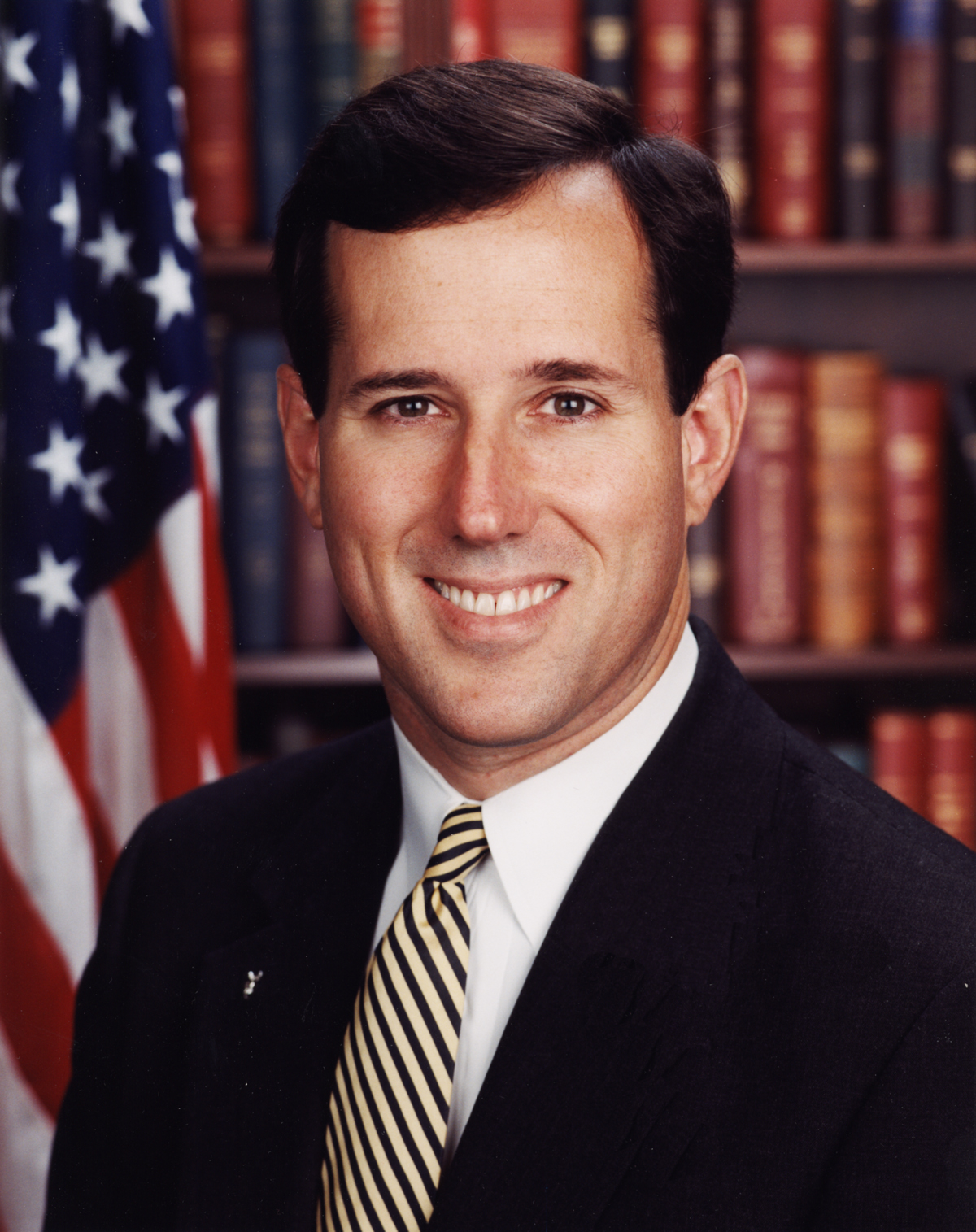
Rick Santorum is a former two-term senator from Pennsylvania and fellow at the neoconservative Ethics and Public Policy Center (EPPC). He has a reputation as being an extremely conservative Catholic, championing right-wing domestic programs as well as hawkish U.S. foreign policies. He unsuccessfully ran for the Republican Party’s presidential nomination in 2012 and 2016.
2016 Presidential Candidacy
In May 2015, Santorum declared his intent to seek the Republican Party’s 2016 presidential nomination. His run was widely expected given his performance in the 2012 presidential primaries, where he won 10 states and finished second to the eventual nominee, Mitt Romney.[1]
However, Santorum failed to gain traction in the 2016 race and after finishing eleventh during the Iowa caucuses, he suspended his campaign and endorsed Sen. Marco Rubio (R-FL).[2] Santorum, who like Rubio advocates for a staunchly hawkish foreign policy, said he supported Rubio because the Florida senator is “a candidate that espouses the values we believe in … someone who has a real understanding of the threat of ISIS.”[3]
Observers noted that Santorum’s announcement speech largely avoided social issues—which were the hallmark of his 2012 campaign—and instead relayed a populist economic message. “Working families don’t need another president tied to big government or big money,” he proclaimed in the address. In April 2015, Santorum also called for an increase in the minimum wage before an audience of evangelicals.[4]
The New York Times said of Santorum’s announcement speech: “At times, his unwillingness to emphasize the issues that worked for him in 2012—opposition to abortion and same-sex marriage—and his decision to criticize his own party for being obsessed with cutting taxes for the rich have made him seem the boldest candidate in the race.”[5]
On the other hand, Santorum decried the Supreme Court’s June 2015 decision making gay marriage legal across the United States. “[A] 5-4 decision is going to try to affect the basic foundation of America, and frankly, now, with America leading the way, potentially disrupting the foundation of the world,” he opined shortly after the ruling was made.[6]
Santorum took stringently hawkish positions on foreign policy throughout his campaign. He has called for 10,000 U.S. ground troops to be deployed to fight ISIS and rejected the “tripe from the left that it’s our fault that ISIS exists.”[7] He has instead posited that ISIS goes “back to the thousand-year history of Muslim expansionism.”[8]
Santorum was also strongly critical of the Obama administration’s nuclear negotiations with Iran that successfully concluded with an agreement in July 2015. In April 2015, he wildly claimed that Iran cares about “bringing about the end of times so it can conquer the world.” He further posited that a nuclear deal with Iran would allow the country “to move forward, and to do even more dangerous things.”[9] In March 2015, Santorum said that if he were still a senator, he would have signed the controversial letter authored by hawkish Sen. Tom Cotton (R-AR), a protégé of neoconservative pundit William Kristol, and signed by 47 Senators to Iran’s leaders that many experts argued was aimed at scuttling negotiations.[10]
After the nuclear deal was reached, Santorum claimed that “this is the greatest betrayal of American national security in our history.”[11] He also declared that the deal is “not worth the paper it’s printed on” and accused lawmakers of suffering from “Stockholm syndrome” for not opposing the Obama administration’s diplomatic efforts with Iran.[12] “They are so afraid to fight. They have now decided that the only way to survive is to go along with him,” he posited at the National Security Action Summit in New Hampshire shortly after the deal was announced.[13]
Regarding the Israeli-Palestinian conflict, Santorum “supports expanded Israeli settlements and believes the West Bank is Israeli ground, won in the 1967 Six-Day War.” He has also compared the conflict to “Texas and territory the U.S. gained in the Mexican-American War.”[14]
2012 Presidential Candidacy
Santorum announced his candidacy for the 2012 presidential election in June 2011. He suspended it nearly 10 months later, in April 2012, after a series of primary losses effectively put the GOP nomination out of reach.
That Santorum’s campaign survived as long as it did came as a surprise to most observers, in part because of his extremely right-wing social views. However, as the GOP nomination progressed and early favorite Mitt Romney failed to generate excitement among the Republican Party base, Santorum emerged as a frontrunner, winning several primaries in early 2012.[15] On the basis of these victories, Santorum argued in February that the nomination was a two-person race, between him and Romney, dismissing the other remaining candidates, Newt Gingrich and Ron Paul.[16]
Santorum endeavored to distinguish his candidacy by attacking President Barack Obama on everything from abortion and global warming—which Santorum thinks is nothing more than a leftist “scheme”[17]—to the “war on terror” and Islamic jihadists. Among his more notable tirades was his accusation, made during a speech in Oklahoma City in February 2012, that the Obama administration was willing to “throw Israel under a bus” in order to assist Iran’s efforts to develop nuclear weapons. Pointing to Obama’s opposition to the controversial “Keystone” pipeline project, Santorum alleged that the president was intentionally trying to endanger U.S. “energy security.” He said: “We’re throwing Israel under the bus because we know we’re going to be dependent upon OPEC. We’re going to say, ‘Oh, Iran, we don’t want you to get a nuclear weapon—wink, wink, nod, nod—go ahead, just give us your oil.’ Folks, the president of the United States is selling the economic security of the United States down the river right now.”[18]
Earlier, during the 2011 Conservative Political Action Conference, Santorum insinuated that Obama was a radical Islamist at heart, stating that the president “doesn’t say that Jihadism is evil. He doesn’t say that sharia law is incompatible with western civilization and the United States, which they are.”[19]
During a 2011 speech in South Carolina, Santorum argued that “leftists” had corrupted the historical understanding of the Crusades: “The idea that the Crusades and the fight of Christendom against Islam is somehow an aggression on our part is absolutely anti-historical. And that is what the perception is by the American left who hates Christendom.” Reported Politico: “After asserting that Christianity had not shown any ‘aggression’ to the Muslim world, the former Pennsylvania senator … argued that American intervention in the Middle East helps promote ‘core American values.’”[20]
Santorum also used his candidacy perch to promote going to war with Iran, calling that country’s leaders “evil” and “Islamic fascists.” Shortly after the International Atomic Energy Agency released a report in November 2011 alleging that Tehran had made progress in its nuclear program, Santorum said that if he were president he would team up with Israel to attack the country. “Option number one is to work with the Israelis and plan to implement a military strategy to stop them [Iran],” Santorum said during a speech in New Hampshire. “I would work closely with our ally and make sure that the mission was accomplished and the world knows that we are this close to Israel.”[21]
However, Santorum sometimes appeared confused on the campaign trail about what his exact policies would be if he were president. During a Republican presidential debate in October 2011, for example, when Rep. Ron Paul (R-TX) asked his fellow candidates whether they would “condemn Ronald Reagan for exchanging weapons for hostages out of Iran,” Santorum defended Reagan, saying: “Iran was a sovereign country. It was not a terrorist organization.” The next day on Fox News, Santorum changed his tune, saying that the Iranians “cannot be negotiated with. They are radical Islamists. They are theocrats. They are mullahs who believe it is their destiny to fulfill the prophet’s and the 12th Imam’s vision of having global control of the world for radical Shia Islam.”[22]
In the wake of the killing of Osama bin Laden, when several right-wing figures claimed that bin Laden’s death proved that torture works, Santorum joined the fray by arguing that Sen. John McCain, a torture victim, opposed the use of “enhanced interrogation” because he misunderstood torture. Asked by the right-wing radio broadcaster Hugh Hewitt whether McCain was correct in asserting that there was no evidence that torture led to killing of bin Laden, Santorum said: “This idea that we didn’t ask that question while Khalid Sheikh Mohammed was being waterboarded, [McCain] doesn’t understand how enhanced interrogation works. I mean, you break somebody, and after they’re broken, they become cooperative.”[23]
As Right Web contributor Peter Certo argued, the idea that Khalid Sheikh Mohammed, who was waterboarded on several occasions, was the source who led to bin Laden is inaccurate, “since it appears that it was another al-Qaeda operative, Hassan Ghul, who divulged [Abu Ahmed al-Kuwaiti’s] role as a trusted confidante and courier for bin Laden. It is unclear whether Ghul underwent any ‘enhanced techniques’ before or during his interrogation, but the CIA has said that he was not waterboarded. According to the New York Times, ‘One official recalled that Mr. Ghul was ‘quite cooperative,’ saying that rough treatment, if any, would have been brief.’[24] Moreover, detainees under duress of torture frequently made false confessions to mislead their interrogators or to stop the pain of their treatment.”[25]
Path to 2012 Candidacy
Santorum was publically contemplating a run for the 2012 Republican Party presidential nomination as early as January 2010, when he sent a letter to supporters of his America’s Foundation PAC announcing he was considering a presidential run. In the letter, he claimed that although he had no burning desire to be president, he was driven to consider doing so because of President Barack Obama’s “single-minded pursuit of a radical domestic agenda” and decision to “turn a blind eye” on threats to national security. He wrote: “Our country needs a President who will stand up for our National Security. Not someone who treats terrorism as a ‘petty crime,’ and who undermines our country’s position in the world, bows to the communist leader of China and to the crown prince of Saudi Arabia, and embraces dictators like Hugo Chavez.”[26]
By December 2010, a number of news outlets were speculating as to whether Santorum was gearing up for a presidential run. He told the Washington Post at the time, “I’m feeling like doors are opening. Things are happening that maybe give me the impression that maybe I need to look at this seriously.” He then added: “If someone gets in the race that I feel really comfortable could do the things that need to be done—both winning and governing—then maybe this is a chance to say, ‘Let this cup pass.’ At this point, given what I see out there, I’m not feeling that.”[27]
Shortly after announcing his candidacy in June 2011, Santorum was asked by right-wing radio personality Rush Limbaugh why he was running when there was such a crowded field. He responded: “We’re at risk of losing what this country has fought for for 200 years, and I believe the linchpin in losing that is Obamacare. … I just feel like we have to stop Obamacare, and I think we need a candidate who can be crystal clear on that and has a strong record on not just health care but on limited government and I believe that I can bring that to the table and someone who’s been a very strong, consistent conservative over the years.”
Ethics and Public Policy Center
From 2006 to when he started his 2012 presidential campaign, Santorum was a fellow at the Ethics and Public Policy Center.[28] He also directed the Program to Promote and Protect America’s Freedom, the objectives of which reflected right-wing anxiety about purported existential threats to civilization posed by “growing” numbers of enemies. According to EPPC, the project worked “to identify, study, and heighten awareness of the threats to America and the West from a growing array of anti-Western forces and states that increasingly cast a shadow over our future and that violate religious liberty around the world.”[29]
From his EPPC perch, Santorum also provided a running political commentary on a blog titled “The Gathering Storm,” which covered everything from same-sex marriage to the alleged perils of Iran’s nuclear program.[30] Santorum’s Program to Protect America’s Freedom also hosted numerous conferences, including a series on the purported threats posed by Shariah Law to liberal democracy.[31]
Santorum is also founder and chair of America’s Foundation, a political action committee that supports “candidates and causes who share Senator Santorum’s commitment to conservative principles.”[32]
Trajectory and Core Views
After serving two terms in the House of Representatives and then another two terms in the Senate, Santorum suffered a massive defeat in the November 2006 midterms to Democratic challenger Robert Casey Jr., winning only 41 percent of the vote.
Four days after his defeat, Santorum announced that he was joining the staff of the Ethics and Public Policy Center.
While in Congress, Santorum, a devout Roman Catholic, won national support for his socially conservative views, particularly on abortion and gay rights, and for his strong support for the Bush administration’s foreign policy, especially its “global war on terror.”
Commenting on Santorum’s decision to remain active in the public arena despite his electoral defeat, Fred Barnes wrote in the neoconservative Weekly Standard that Santorum represents a “new model” in U.S. politics. Instead of fading into the background as a lobbyist or joining a law firm, Barnes wrote, Santorum decided to “to stay in politics and fight” by raising awareness of enemies, who according to Barnes include “not only Islamists but also dictators like Hugo Chávez of Venezuela and Kim Jong Il of North Korea.”[33]
In an EPPC press release about his appointment, Santorum said: “In these perilous and uncertain times, I believe it is critical that we define the threats that confront America. Without a clear definition and precise understanding of our enemies we cannot fight effectively and our own citizens become divided. It is my hope that the America’s Enemies program [later renamed the Program to Protect America’s Freedom] at EPPC will help the American people—including our leaders—understand and communicate with clarity, honesty, and consistency the enemies we face and the complex and enormous threat that they pose to our lives and the freedoms we all enjoy.”[34]
In a May 2005 New York Times Magazine article about Santorum, titled “The Believer,” Michael Sokolove called him “the nation’s pre-eminent faith-based politician,” with the exception of President George W. Bush. According Sokolove, “[Santorum] not only pushed the Senate to intervene in the Terri Schiavo case, but he also traveled to Florida and prayed with her parents.” Also in 2005, Time magazine included Santorum on its list of the country’s “25 Most Influential Evangelicals.”[35]
One of his favorite magazines is First Things, which was edited by neoconservative theologian Richard John Neuhaus before his death on 2009 and published by the Institute for Religion and Public Life. Santorum organized a study group for Catholics in Congress, and he reportedly helped convert Sen. Sam Brownback (R-KS) to Catholicism.
Santorum supporters include both neoconservatives and traditional right-wing Republicans who vociferously reject gay marriage and support walling off the U.S.-Mexico border. One of Santorum’s promoters has been Clifford May, president of the Foundation for Defense of Democracies, who in a mid-September 2006 Scripps News editorial praised Santorum for recognizing that “Islamic fascism” is the “ideological heir to the enemy America confronted in World War II—and is at least as serious a threat.”[36]
In an April 2003 interview with the Associated Press, Santorum outraged many when he supported laws banning gay sex and appeared to place homosexuality in the same grouping as bestiality, incest, and pedophilia. In an attempt to make sure Santorum’s anti-gay positions were not forgotten by voters, in May 2003 columnist Dan Savage asked readers to name a sex act after the senator. Readers instead chose a substance, and a neologism was born: santorum, noun, “that frothy mixture of lube and fecal matter that is sometimes the byproduct of anal sex.”
2006 Midterm Election Campaign
Conservative New York Times columnist David Brooks lamented in an October 2006 op-ed that if Santorum lost the 2006 midterm election, it would be bad for “people around the world.” Citing Santorum’s support for various anti-poverty campaigns, Brooks wrote: “If serious antipoverty work is going to be done, it’s going to emerge from a coalition of liberals and religious conservatives. Without Santorum, that’s less likely to happen.” The columnist also cited a quote from singer Bono, who apparently once said of Santorum: “I would suggest that Rick Santorum has a kind of Tourette’s disease; he will always say the most unpopular thing. But on our issues, he has been a defender of the most vulnerable.”[37]
Brooks failed to mention another issue on which he sees eye-to-eye with Santorum, and which seems to have been a major sore point for Pennsylvania voters: support for a militaristic anti-terror foreign policy with a heavy emphasis on the Middle East, including outspoken support for the Iraq War. In a campaign ad posted on Santorum’s website during the lead-up to the 2006 midterm elections, Santorum berated his Democratic opponent for supposedly being weak on the many and varied threats purportedly threatening the homeland. Said the ad’s alarmist and inaccurate language: “North Korea, close to a nuclear missile to reach America, yet Casey opposes deploying a missile defense system now. Iran, also close, yet Casey opposes creating the bunker-busting bombs that may be needed to stop them. China, drilling oil just 50 miles off our coast, yet Casey opposes doing the same, putting our energy at risk. Terrorists, trying to enter our country, yet Casey comes out for amnesty for illegal aliens. We just can’t take a chance on Bob Casey.”
Reiterating such “threats” to America was a staple of Santorum’s campaign speeches, in which he argued that his opponent was “unqualified for the office that he seeks at a very critical time in our nation’s future.” Citing “a gathering storm” of threats from the “axis of evil” states and newcomer “rogues” like Venezuela, Santorum argued during a speech in late October: “We will have to face this threat because our enemies are fully committed to our destruction. They will not stop until they destroy us or we destroy them.”[38]
Santorum’s alarmist language was also evident in a column he penned marking the five-year anniversary of 9/11: “Every major Islamic fascist leader has openly identified the United States as their prime target, and repeatedly promises the creation of a new, global, ‘caliphate’ where Islamic fascism will rule mankind. This, now, is the great threat of our generation.”[39]
On his RickSantorum.com campaign website, Santorum boasted of his strident support for Israel, including his sponsorship of a passel of bills in recent years aimed at isolating Israel’s Mideast neighbors. A page with the header “Santorum U.S. Senate: Jewish,” claimed: “The Jewish community has no stronger leader in the United States Senate than Rick Santorum. In fact, when Rick was first elected to the Senate in 1995, his first action was to support moving the U.S. Embassy from Tel Aviv to Jerusalem. Since then, he has led the fight to protect Israel and promote democracy in the Middle East. His Syria Accountability Act, the Iran Freedom and Support Act, and the Iran Nuclear Trade Prohibition Act have paved the way for the Senate to foster a strong, yet diplomatic, approach to the problems Israel faces.”
Congressional Record
Santorum first entered Congress in 1990 as a representative in the House. Four years later, he won a seat in the Senate, defeating Democratic Sen. Harris Wofford, one of several Democrats who fell in 1994 to a rising tide of new Republicans whose trademark figure was Rep. Newt Gingrich (R-GA).
Although closely associated with Bush’s increasingly unpopular foreign policies, it was Santorum’s extremely socially conservative views that were the hallmark of his tenure in Congress. Fiercely anti-abortion and anti-gay marriage, Santorum frequently resorted to hyperbolic tirades in championing his view of the culture wars. As the Los Angeles Times reported: “In 2002, he blamed Boston ‘liberalism’ for the Roman Catholic Church’s sex abuse scandal. In a 2003 interview, he linked gay consensual sex with bigamy, polygamy, incest, and adultery. In a 2005 book, he found fault with two-income families and working women.”[40]
Such is his stature among social conservatives that his lagging poll numbers during the lead up to the 2006 midterms energized conservatives across the country to pour in support for his 2006 midterm campaign. The Los Angeles Times reported: “It is a four-alarm fire for conservatives, who are bringing water buckets from all corners of the political world. Across Pennsylvania, pastors are preparing to stuff voter guides into their Sunday bulletins. In Washington, DC, Paul Weyrich, a national conservative leader, hosted a conference call to give a pep talk to Republicans in Pennsylvania. In England, some Santorum fans are planning to cross the Atlantic to help campaign.” Said one member of Let Freedom Ring, a conservative group based in Pennsylvania: “If Rick Santorum were to lose, it would be cited as a turning point in the social conservative movement.”[41]
According to Project Vote Smart, in 2006 Santorum’s votes aligned with the interests of Planned Parenthood none of the time, and with the National Right to Life Committee 100% of the time. In 2006, he voted against the Teen Pregnancy Education Act, which was designed to “authorize grants to carry out programs to provide education on preventing teen pregnancies, and for other purposes.” In 2005, Santorum voted against the Unintended Pregnancy Act, which was designed “to expand access to preventive health care services that reduce unintended pregnancy (including teen pregnancy), reduce the number of abortions, and improve access to women’s health care.”[42]