
Newt Gingrich
last updated: April 16, 2018
Please note: The Militarist Monitor neither represents nor endorses any of the individuals or groups profiled on this site.
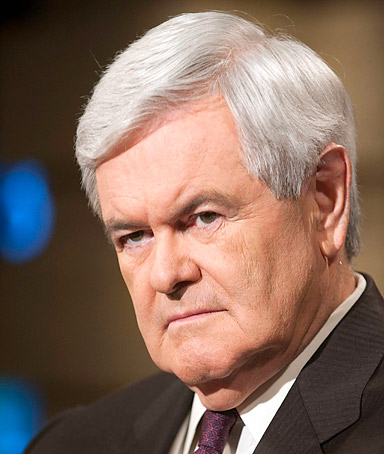
Affiliations
- American Solutions for Winning the Future: Chairman
- Renewing American Leadership: Founder
- Committee on the Present Danger: Member
- American Enterprise Institute: Former Senior Fellow
- National Defense University: Visiting Scholar
- Council on Foreign Relations: Terrorism Task Force
- Foundation for the Defense of Democracies: Member, Leadership Council
- Hoover Institution: Former Visiting Fellow
- West Georgia College: Professor of History and Environmental Studies
- Committee for the Liberation of Iraq: Advisory Board, Former Member
- Fox News: Political Analyst
- Barrick Gold Corporation: International Advisory Board member
- VitalSpring Technologies, Inc.: Member of Board of Advisors
- Golden Spike Company and Forstmann Little & Co.: Member of Board of Advisors
- H. Lee Moffitt Cancer Center & Research Institute: Member of the Advisory Board
- Pathway Genomics Corporation: Member of the Strategic Advisory Board
Government
- Defense Policy Board: Member (2001-2009)
- U.S. Commission on National Security-21st Century (“Hart-Rudman Commission”): Former Member
- U.S. House of Representatives: (R-GA) Speaker, 1995-1999; Member, 1979-1999
- Internet Policy Institute: Board Member
Business
- Gingrich Consulting: Founder
- NanoBusiness Alliance: Honorary Chairman
- Center for Health Transformation: Founder
Education
- Emory University: B.A.
- Tulane University: M.A. and Ph.D. in Modern European History
Newt Gingrich, the former Speaker of the U.S. House of Representatives and unsuccessful GOP presidential candidate, is a vocal advocate of right-wing social policies and a militarist U.S. defense posture. A former fellow at the neoconservative American Enterprise Institute (AEI), Gingrich has been an important Republican Party figure for decades. He was a key force behind the 1994 “Contract with America” and in recent years has become a vociferous proponent of the notion that the United States faces an existential threat from the Islamic terrorists he says “want to kill us because they want to kill us.”[1]
Gingrich has repeatedly run for the Republican Party’s presidential nomination, most recently in 2012, when he received the backing of major right-wing “pro-Israel” donors like Sheldon Adelson. Although he did not run for the 2016 GOP nomination contest, Gingrich was widely considered to be a potential running mate for Donald Trump, for which he reportedly “actively lobbied” the real estate mogul.[2]
Despite being passed over for a spot in the Trump administration, Gingrich has made his presence felt. For example, in March of 2018, two Democratic congressmen filed an official complaint claiming that Gingrich and other prominent conservatives—most notably, David Wurmser, a former adviser to Dick Cheney and John Bolton—conspired with White House and State Department officials to, as one journalist put it, “purge the State Department of staffers they viewed as insufficiently loyal to President Donald Trump.”[3]
Gingrich has advocated a forceful anti-terrorism campaign domestically, suggesting that the government make serious infringement on civil liberties. Speaking in November 2017, shortly after a bomb exploded in New York City, Gingrich told Fox and Friends, “This is about more than just immigrants being radicalized. There are Americans being radicalized. The Santa Barbara terrorist was, in fact, an American, although his wife was from overseas. The Orlando terrorist was an American, although his father had come and was first generation and, in many ways, anti-American. We’re going to have to be much tougher about the mosques. We’re going to have to be much tougher what’s happening in terms of the internet, and I think we’re going to have to allow the police to be more aggressive.”[4]
A Trump Critic Turned Ally
Gingrich was widely considered[5] a top prospect for a post in the Trump administration–including as Secretary of State–despite his many differences with the president-elect. During the early stages of the 2016 race, Gingrich frequently criticized many of the candidates, including both Ted Cruz and Trump. He once commented that one of Trump’s biggest achievements during the campaign had been to make Cruz look normal.[6]
After Trump locked up the nomination but failed to choose Gingrich as his running mate, the former congressman turned on Trump, calling him an “unacceptable” presidential candidate. “The current race is which of these two [Trump or Hillary Clinton]is the more unacceptable, because right now neither of them is acceptable,” Gingrich told The Washington Post.[7]
Gingrich changed his tune on Trump as the race with Clinton heated up. After the first presidential debate in September 2016, which was widely viewed as a major failure for Trump, Gingrich argued that Trump had scored an “historic victory.” “I was very proud of him,” Gingrich told Fox’s Sean Hannity. “He stuck with ‘stop-and-frisk,’ he stuck with ‘law and order.’ He didn’t allow either Lester Holt or Hillary to get him off balance.”[8]
Since Trump’s election, Gingrich has repeatedly defended the administration, which may have helped sway the president to select Gingrich’s spouse Callista to serve as US ambassador to the Vatican.[9] While pushing discredited conspiracy theories about the death of former Democratic National Committee staffer Seth Rich, Gingrich has also kept busy haranguing Congress to back Trump regardless of the various scandals he has caused. “Republicans in general — not just Trump — are in a crossroads,” Gingrich said in an interview with the Los Angeles Times. “And if they don’t get their act together, Pelosi is going to become speaker and she’s going to impeach Trump. That’s how big the stakes are.”[10]
Gingrich has also pushed conspiracy theories aimed at discrediting special counsel Robert Mueller’s Russia probe, which Gingrich argues is a “deadly” threat to President Trump’s agenda.[11] In an August 2017 interview with Fox’s Sean Hannity, Gingrich characterized the investigations into Russian meddling as a conspiracy against Trump: “The administrative deep state, its lobbying allies, its news media allies are all determined to try to destroy Donald J. Trump. It’s a very straightforward fight.”[12]
Gingrich strongly supported Trump when the president publicly praised the protesters in Iran in January 2018. Many world leaders saw Trump as intentionally antagonizing Iran. French President Emmanuel Macron accused Trump of setting the United States on a path of war with Iran. But Gingrich defended Trump, saying, “(Former President Barack) Obama’s policy was a fantasy based on a belief that there was a good dictatorship if only we paid them enough money and Trump’s policies are a much more realistic assessment that this is a bad dictatorship that does bad things and that we have to be in favor of changing it.”[13]
Gingrich expressed his support for the People’s Mujahedin of Iran—often known as the MEK, the abbreviation of their name in Persian—a cultish group which was once on the U.S. list of terror organizations and remains exiled extremely unpopular in Iran and in Iraq. The MEK is, however, widely embraced by neoconservatives.[14]
After speaking at a conference organized by the MEK, Gingrich said of them, “The MEK/PMOI is clearly the largest resistance organization and deserves respect and I think the fact Khamenei (Iran’s supreme leader) appealed to President Macron to curtail Mrs Rajavi (the cult’s charismatic leader), by itself is pretty good evidence that the dictatorship thinks they’re effective.”[15]
Gingrich has also supported Trump’s hostility to multilateralism. “I think someone who cuts through all the globalism and reasserts the legitimacy of national sovereignty is a very important step for the UN. Second, the UN has to reform itself. There are too many ways in which it is incompetent, inefficient, in some ways dishonest,” Gingrich said on “Fox and Friends.” “And third, the planet has to come together on North Korea. North Korea is the greatest danger of a nuclear war that we have seen I think not just since the Cold War, I think it’s a greater danger than the Cuban Missile Crisis.”
Gingrich advocated the threat of war not only with North Korea, but with Russia and China as well in order to confront the North Korean nuclear threat. “The Chinese in particular have got to cut him [Kim Jong Un] off. There’s all sorts of games being played. There are a lot of ways that the North Korean economy continues to financed by Russia and China, and I think those two countries have to understand they are risking a real war on their border if they allow this to continue,” Gingrich said.[16]
Obama Opposition and Anti–Islam Rhetoric
During Barack Obama’s presidency, Gingrich’s rhetoric grew increasingly strident, as he lambasted the president on everything from health care reform to foreign policy, and made wild accusations about elites abetting Islamic terrorists.
Gingrich argued that the Obama administration’s approach to foreign policy was “weak” and “amateur,”[17] and that the former president’s foreign policy vision was a “fantasy” that “completely misunderstands reality.”[18] He also implied that Obama’s strategy is un-American, telling Fox News that the country “need[s] an American foreign policy, based on American interests.”[19]
A key target was the Obama administration’s effort to negotiate with Iran over its nuclear program. Gingrich vociferously opposed the historic July 2015 nuclear deal between Iran and six world powers including the United States. In an op-ed for the Washington Times, Gingrich wrote, “The deal is no victory for peace. It’s a surrender to a violent and dangerous regime.”[20]
He also attacked Secretary of State John Kerry for his role in negotiating the agreement: “Secretary of State John Kerry entered politics 45 years ago on a platform of opportunistic anti-Americanism and false peace with totalitarianism. Then as now mistaking dishonor for political heroism, Mr. Kerry lied to the American people to justify his preferred policy of weakness and surrender. And as he proved this week, he’s still at it, with Mr. Kerry the ‘peacemaker’ in the leading role.”[21]
His attacks often focused on Muslim cultural issues, arguing that during the Obama era there had been an “Islamist cultural-political offensive designed to undermine and destroy our civilization” but that “elites are the willing apologists for those who would destroy them.”[22] For instance, during the heated debate in 2010 over whether to allow construction of a mosque near the site of the 9/11 attacks, Gingrich argued that the construction should be prohibited “so long as there are no churches or synagogues in Saudi Arabia. The time for double standards that allow Islamists to behave aggressively toward us while they demand our weakness and submission is over.”[23]
Washington Post columnist Richard Cohen responded: “[I]t is not the government of Saudi Arabia that seeks to open a mosque in Lower Manhattan, but a private group. In addition, and just for the record, Saudi Arabia does not represent all of Islam and, also just for the record, the al-Qaeda terrorists who murdered nearly 3,000 people on Sept. 11, 2001, would gladly have added the vast Saudi royal family to the list of victims.”[24]
Gingrich’s diatribe was published on the website of the group Renewing American Leadership, which he founded in 2009 to unite the conservative base in the United States, and which is “dedicated to defending and advancing American civilization by restoring our Judeo-Christian heritage.”[25]
In December 2015, after the massacre of 14 individuals in San Bernadino, California, by two individuals sympathetic to the Islamic State (ISIS), Gingrich argued that the Obama White House was, for ideological reasons, blind to the threat of “Islamic supremacists.” Along with co-author William Forstchen, Gingrich argued in an editorial after the attacks that gun-free zones at schools were absurd and suggested that “former military or law enforcement” figures carrying concealed weapons would protect school children from ISIS.[26]
Channeling neoconservative discourse honed by Norman Podhoretz and others regarding the “existential” threats to the United States and Israel, Gingrich has repeatedly characterized “radical Islamism” as a totalitarian ideology aimed at taking over the world. In an op-ed for the right-wing Human Events, he wrote: “Radical Islamism is more than simply a religious belief. It is a comprehensive political, economic, and religious movement that seeks to impose sharia—Islamic law—upon all aspects of global society…Radical Islamists see politics and religion as inseparable in a way it is difficult for Americans to understand. Radical Islamists assert sharia’s supremacy over the freely legislated laws and values of the countries they live in and see it as their sacred duty to achieve this totalitarian supremacy in practice.”[27]
Militarist Activism
After leaving Congress in 1999, Gingrich became a fellow at both AEI and the hawkish Hoover Institution, and joined the “leadership council” of the Clifford May-run Foundation for Defense of Democracies, a neoconservative pressure group founded in the wake of 9/11 to push for an expansive “war on terror.” He also served as a member of the Committee on the Present Danger, an advisor to the Committee for the Liberation of Iraq, and a Fox News analyst.
In his 2008 AEI speech, Gingrich echoed neoconservative talking points while highlighting Iran as a primary target for a new U.S. intervention. Describing Iran as “a dictatorship dedicated to Islamic Fascism and … a mortal threat to our survival,” he called for using military force if necessary to change the country’s regime, saying, “If we do not stand up against a Holocaust-denying, genocide-proposing, publicly self-defined enemy of the United States, why should we expect anyone else to do so?”[28]
Soon after taking office, President George W. Bush invited Gingrich to serve on the Pentagon’s Defense Policy Board, an advisory body heavily influenced by its neoconservative and hardline Republican members, including Richard Perle (as chair), James Woolsey, Ken Adelman, Eliot Cohen, and Dan Quayle. When appointed in November 2001, Gingrich was one of eight Hoover Institution fellows simultaneously tapped for the thirty-one-member board.
During the immediate aftermath of the 2003 U.S. invasion of Iraq, Gingrich joined many of his AEI colleagues in blaming the State Department and then-Secretary of State Colin Powell for undermining the Bush administration’s foreign policy, and for Washington’s troubled relations with many U.S. allies.
He also called Powell’s stated plan to visit Syria “ludicrous,” despite the fact that Powell would have been doing so at Bush’s request. When asked about Gingrich’s characterization, a Pentagon spokesperson said, “Plain and simple, Gingrich speaks for Gingrich.” Paul Begala, a former aide to President Bill Clinton, remarked, “There’s nothing the Democrats would like more” than to see Gingrich reemerge in the spotlight. “He’s terribly bright, but he’s more far right than he is bright. He’s become the embodiment of what most Americans hate about right-wingers.”[29]
Gingrich has argued that the United States is confronting an existential threat in the war on terror. In a 2006 op-ed for the Wall Street Journal, Gingrich compared President Abraham Lincoln’s preparations for the Civil War to President George W. Bush’s efforts to prosecute the war on terror, arguing that where Lincoln succeeded, Bush was failing.
Bush’s strategies had three flaws, Gingrich opined: “(1) They do not define the scale of the emerging World War III, between the West and the forces of militant Islam. … (2) They do not define victory in this larger war as our goal, and so the energy, resources, and intensity needed to win cannot be mobilized. (3) They do not establish clear metrics of achievement and then replace leaders, bureaucrats, and bureaucracies as needed to achieve those goals.”[30]
In a September 14, 2006 Fox News appearance, Gingrich said: “I think we’re seeing around the world an emerging Third World War from North Korea to Pakistan to India to Afghanistan to Iraq and Iran to the increasing alliance between Venezuela and Iran to the British terrorists who are getting trained in Pakistan. But I think if we could design powerful enough strategies, as we did in the Cold War to contain the Soviets, we might be able to avoid it actually degenerating into a world war.”[31]
Gingrich went on to call for regime change in Iran and North Korea and criticize the Bush administration’s handling of the war on terror. “I don’t think that the administration has yet come to grips with how big and complex this is,” he told news anchor Greta van Susteren.[32]
Gingrich’s primary claim to fame has been the 1994 “Contract with America,” a slate of Republican legislative proposals, which liberal critics called the “Contract on America.” In promoting the so-called contract, Gingrich used existential language similar to his current war on terror rhetoric—claiming, for instance, that “what is ultimately at stake … is literally the future of American civilization as it has existed for the last several hundred years.” Such language, scholar Shadia Drury wrote, is eerily reminiscent of the “sense of crisis” in Western civilization that political philosopher Leo Strauss, an early influence on Irving Kristol and many other neoconservatives, once promulgated.[33]
Doubts about U.S. Interventionism
In August 2013, even as he maintained his emphasis on fighting “radical Islam,” Gingrich appeared to express a change of heart about the interventionist militarism he had long placed at the center of his foreign policy views. “I am a neoconservative,” he told the right-wing Washington Times. “But at some point, even if you are a neoconservative, you need to take a deep breath to ask if our strategies in the Middle East have succeeded.” He added, “I think we really need a discussion on what is an effective policy against radical Islam, since it’s hard to argue that our policies of the last 12 years have succeeded.”[34]
Though Gingrich steadfastly supported the wars in Afghanistan and Iraq, he told conservative radio host Laura Ingraham in an interview that “I have to look back and say the way that they were executed failed, and maybe we should have known better, those of us who supported them.”[35] In further comments to the Times, Gingrich also categorically ruled out supporting U.S. intervention in Syria’s civil war and added that he found it “hard to argue the chaos in Syria, Iraq, Libya and Lebanon make for a better future.”[36]
Distancing himself from the “democracy promotion” agenda of the George W. Bush years, Gingrich said that he would “look at the whole question of how we think of the governments in other countries.” He went on to suggest that a new military dictatorship in Egypt would be preferable to the country’s recently deposed Muslim Brotherhood government, which was democratically elected but later toppled by the military in the wake of anti-government demonstrations.[37]
Gingrich also expressed admiration for Republican Sens. Rand Paul and Ted Cruz, saying that they were “among the few people willing to raise the right questions.” The libertarian-leaning Rand Paul in particular, the son of Gingrich’s erstwhile GOP rival Ron Paul, has expressed concerns about U.S. interventions abroad and violations of civil liberties at home. “The establishment will grow more and more hysterical the more powerful Rand Paul and Ted Cruz become,” added.[38]
Pointing out Gingrich’s past closeness with staunchly hawkish Bush administration figures like John Bolton and David Wurmser, the Huffington Post observed that his comments marked “a reversal for the former speaker, who pressed for invasion in Iraq and Afghanistan and has frequently touted his pro-Israel views, calling Palestinians an ‘invented’ people.”[39]
Other observers, however, were less surprised. “Gingrich has long been known for his desire to fundamentally change the way the politicians view certain issues,” noted a writer for ThinkProgress, “so his decision to throw his support behind the Pauls and Cruzes of the party shouldn’t come as too far out of left-field. And he’s been known to quickly change his foreign policy views when it appears it would be politically beneficial to do so.” The writer noted, however, that Gingrich’s apparent about-face does “mark a shift from the 2012 campaign for the GOP Presidential nod, in which Newt was for a time the front-runner. Unlike Paul, Gingrich said during the campaign that he would support an Israeli strike against Iran, if ‘only as a last recourse and only as step toward replacing the regime.'”[40]
Presidential Campaigns
Gingrich announced his 2012 presidential candidacy on Fox News, saying: “I am a candidate for president of the United States … because I think if you apply the right principles to achieve the right results, that we can win the future together. And I don’t think that having a president who applies the wrong principles and gets the wrong results is going to lead to winning the future.”[41]
Gingrich’s presidential ambitions were met with considerable skepticism from both the left and the right. However, his campaign was buoyed by massive injections of cash from Sheldon Adelson, a controversial casino magnate and key financial backer of right-wing “pro-Israel” groups in the United States. In early 2012, Adelson contributed $5 million to a super-PAC supporting Gingrich, Winning Our Future, that spent lavishly on negative TV ads against rival presidential candidate Mitt Romney, which were widely believed to have helped Gingrich win the South Carolina primary.[42] Adelson’s spouse, Miriam, followed up with an additional $5-million donation to the PAC aimed at influencing the 2012 Florida primary.[43]
The Adelsons’ support for Gingrich drew criticism from many rightwing figures because it financed attack ads against Romney’s business record, putting rapacious capitalism in a negative light. The support also underscored the impact that the controversial 2010 Supreme Court ruling on Citizens United, which allowed unregulated donations in election campaigns, was having on politics. Reported the New York Times: “Those attacks, which focused on Mr. Romney’s wealth and private equity career, also drew condemnation from many conservatives, who said Mr. Gingrich’s allies were undercutting free-market capitalism and amplifying class-warfare arguments being made by Democrats and Occupy Wall Street demonstrators. In making the couple’s second $5 million contribution, Dr. Adelson expressed a wish to Winning Our Future officials that the money be used ‘to continue the pro-Newt message,’ one of the people familiar with the contribution said, rather than attack Mr. Romney. The Adelsons’ contributions on Mr. Gingrich’s behalf illustrate how rapidly a new era of unlimited political money is reshaping the rules of presidential politics and empowering individual donors to a degree unseen since before the Watergate scandals.”[44]
For his part, when queried about why Adelson supported his campaign, Gingrich said in an interview on NBC: “He knows I’m very pro-Israel. That’s the central value of his life. I mean, he’s very worried that Israel is going to not survive.”[45]
On the campaign trail, Gingrich’s foreign policy views at times seemed confused and misleading. For example, when President Barack Obama announced that he would enforce a no-fly zone in Libya in late March 2011, Gingrich lambasted the president for displaying “amateur opportunism.” A few weeks earlier, however, Gingrich had said that if it were up to him he would “exercise a no-fly zone this evening.” He told Fox News’ Greta van Susteren: “The United States doesn’t need anybody’s permission. All we have to say is that we think that slaughtering your own citizens is unacceptable and that we’re intervening.”[46]
After Gaddafi was killed, Gingrich joined a chorus of voices questioning the new Libyan government. “We do not know,” he told the Orlando Sentinel, “whether the new Libyan government will be a modernizing, pro-Western government, or a religious fanatic, anti-Western government.”[47]
Gingrich also contradicted himself with respect to the Obama administration’s withdrawal of U.S. troops from Iraq. In October 2011, Gingrich declared the occupation of Iraq “lost,” but attributed the failure to the mission itself. “This is not about Obama,” he said. “This is about the general effort that far transcends Iraq. That we have to really reassess our strategies in the region and what we think we [can] accomplish. The president is right. You can’t just leave 3,000 or 5,000 troops there. They would simply become targets. If you’re not going to occupy the country, you have to withdraw.” And yet, only two days later he told a group in Iowa, “The president has announced what will be seen by historians as a decisive defeat for the U.S. in Iraq.”[48]
With regard to Iran, Gingrich was rather more explicit. Arguing that Tehran has been “waging war against us since 1979,” he has explicitly espoused an emphatic regime-change line, telling CNN in October 2011, “Our goal should be the replacement of the Iranian dictatorship.”[49]
Double Standards
Gingrich’s numerous personal scandals, which appear to contrast sharply with his vociferous promotion of “family values,” have also spurred skepticism. Several rightist commentators, like Peter Wehner, a contributor to the neoconservative flagship Commentary, highlighted Gingrich’s past marital infidelities as a significant hurdle for his nomination prospects.[50]
Others, like David Frum, a former fellow at the American Enterprise Institute, argued that the infidelity pointed to deeper problems. Questions about the context of Gingrich’s marital affairs are “fair and interesting points,” wrote Frum in the National Post, “but they do not address the reason that Gingrich’s personal life has been—and will be—so politically lethal. It’s not the infidelity. It’s the arrogance, hypocrisy, and—most horrifying to women voters—the cruelty. Anyone can dump one sick wife. Gingrich dumped two. And that second dumped wife is talking to the media.”[51]
Despite having been hurt politically by these scandals, Gingrich continued to make controversial remarks about women long after he was out of office. Referring to former Senator Al Franken (D-MN) who was about to resign due to allegations of sexual harassment, Gingrich said, “As I understand it, that occurred two years ago when he was a comedian. Al Franken was a comedian. Comedians often do weird things. He was in the entertainment business. He was doing the kind of things people in the entertainment business do.”
Speaking about how the allegations against Franken were handled, he said, “What you saw today was a lynch mob. Let’s not have due process, let’s not ask anybody any questions, let’s not have any chance to have a hearing. Let’s just lynch him.”[52]
Gingrich defended his own marital infidelity on the basis of his passion for his work, saying in a 2011 interview with the Christian Broadcasting Network, “There’s no question at times of my life, partially driven by how passionately I felt about this country, that I worked far too hard and things happened in my life that were not appropriate.”[53]
After losing several key primary votes to his GOP rivals, Gingrich suspended his presidential campaign in May 2012. At the press conference announcing his withdrawal, Gingrich said that he would remain politically active and even revisited his oft ridiculed idea from the campaign trail that the United States should establish a moon colony, saying: “I’m not totally certain I will get to the moon colony. I am certain [my grandchildren] Maggie and Robert will have that opportunity to go and take it. I think it’s almost inevitable, on just the sheer scale of technological change.”[54]
Gingrich has long fashioned himself presidential material, based in part on his get-tough stance on national security. In mid-2006, for example, he appeared to be floating a platform for the 2008 presidential race. In a speech at AEI, he called the war on terror “World War III,” and implied he would be a better wartime leader than George W. Bush. The neoconservative mouthpiece the Weekly Standard gave Gingrich’s speech a glowing review. “His rivals should take note. The first speech of the 2008 presidential campaign was delivered on the fifth anniversary of September 11, 2001.”[55]
Gingrich eventually decided not to run that year, citing potential conflicts of interest related to his advocacy group American Solutions for Winning the Future, which claims to seek solutions to immigration, national defense, education, and other national issues.[56] According to some observers, Gingrich’s 2012 presidential campaign could have had similar conflicts of interest related to American Solutions and his numerous other private endeavors. One observer told Talking Points Memo, “Once he declares, the free charter plane rides are more or less over. They [Gingrich’s various organizations] are all corporations, so they can’t do anything that would subsidize the campaign.”[57]
Books
Gingrich has written several books on politics and history. His 2005 Winning the Future: A 21st Century Contract with America expanded his ideas from the previous decade. A description of the book on the AEI website says, “Newt is back with a plan for American greatness that includes how to win the war on terror … how to reestablish God in American public life … how to reform Social Security … [and] how to restore patriotism to American schools…”[58]
AEI’s summary of Gingrich’s Drill Here, Drill Now, Pay Less (Regnery, 2008) says the book: “[A]rgues that the pinch Americans are feeling at the pump is not a blip in the economy but a looming crisis—affecting not only the price of gas, but the price of food, the strength of our economy, and our national security. To meet this crisis, Gingrich lays out a national strategy that will … require Congress to unlock our oil reserves and remove all the impediments and disincentives that unnecessary government regulation has put in the way of American energy independence.”[59]
Rediscovering God in America (2006, Integrity Publishers) is a paean to Christian Right arguments that liberals have weakened the United States by undermining the role of religion. In the opening of the book, which was a 2007 New York Times bestseller, Gingrich argues, “There is no attack on American culture more deadly and more historically dishonest than the secular effort to drive God out of America’s public life.”
According to Publishers Weekly: “The book’s arguments are predictable: Gingrich claims that references to God are sprinkled everywhere in our nation’s founding documents; that most Americans believe in God; and our classrooms and courtrooms are the laboratories where such belief is being irrevocably eroded. He trots out quotations from founding fathers that suggest their allegiance to Christianity, or at least to theism, but conveniently ignores evidence that some of these men—particularly Benjamin Franklin and Thomas Jefferson—believed religion should have little, if any, role in the nation’s government.”[60]
His 2011 book, A Nation Like No Other: Why American Exceptionalism Matters, is described in its promotional materials thus: “American Exceptionalism is not about cheerleading for the home team. It’s about recognizing and honoring the history-making, world-changing ideals our Founding Fathers enshrined to make this a nation of the people, by the people, for the people. And, as Lincoln warned, we must rededicate ourselves to those principles, lest our truly exceptional nation perish from this earth.”[61]
Writing in The Atlantic, journalist and pundit Peter Beinart said, “When conservatives say American exceptionalism is imperiled, they’re onto something. In fundamental ways, America is becoming less exceptional. Where Gingrich and company go wrong is in claiming that the Obama presidency is the cause of this decline. It’s actually the result. Ironically, the people most responsible for eroding American exceptionalism are the very conservatives who most fear its demise.”[62]
In June 2017, Gingrich published Understanding Trump, a book devoted to praising and whipping up support for the president he once ridiculed.[63]
SOURCES
[1] Quoted in Andy Kroll, “Newt Gingrich’s Muslim Brotherhood Fearmongering,” Mother Jones, February 10, 2011, https://www.motherjones.com/politics/2011/02/newt-gingrichs-muslim-brotherhood-fearmongering/
[2] Harper Neidig, “Gingrich ‘actively lobbying’ to be Trump’s running mate: report,” The Hill, July 9, 2016, http://thehill.com/blogs/ballot-box/presidential-races/287136-gingrich-actively-lobbying-to-be-trumps-running-mate
[3] Dan Friedman, “Trump White House Worked with Newt Gingrich on Political Purge at State Department, Lawmakers Say,” Mother Jones, March 15, 2018, https://www.motherjones.com/politics/2018/03/trump-white-house-worked-with-newt-gingrich-on-political-purge-at-state-department-lawmakers-say/
[4] Ian Schwartz, “Gingrich On Terrorism: ‘How Often Donald Trump Is Right And How Often His Critics Are Just Stupid,’” Real Clear Politics, November 2, 2017, https://www.realclearpolitics.com/video/2017/11/02/gingrich_on_terrorism_how_often_donald_trump_is_right_and_how_often_his_critics_are_just_stupid.html
[5] Nancy Cook, Andrew Restuccia, “Meet Trump’s Cabinet-in-waiting,” Politico, November 9, 2016, https://www.politico.com/story/2016/11/who-is-in-president-trump-cabinet-231071
[6] Nolan D. McCaskill, “Gingrich: Trump has made Ted Cruz look normal,” Politico, April 6, 2016, https://www.politico.com/blogs/2016-gop-primary-live-updates-and-results/2016/04/newt-gingrich-ted-cruz-normal-compared-to-trump-221648
[7] Philip Rucker, Dan Balz and Matea Gold, “GOP reaches ‘new level of panic’ over Trump’s candidacy,” Washington Post, August 3, 2016, https://www.washingtonpost.com/politics/gop-reaches-new-level-of-panic-over-trumps-candidacy/2016/08/03/de461880-5988-11e6-831d-0324760ca856_story.html?noredirect=on&utm_term=.07277bd10777
[8] Hannity, “Gingrich: ‘Enormous, Historic Victory’ for Trump,” Fox News, September 27, 2016, http://insider.foxnews.com/2016/09/27/newt-gingrich-hannity-react-first-presidential-debate-donald-trump-hillary-clinton
[9] Ruth Graham, “Trump to Pope: Take Newt Gingrich’s Third Wife, Please,” Slate, May 16, 2017, http://www.slate.com/blogs/xx_factor/2017/05/16/callista_gingrich_newt_s_third_wife_is_reportedly_trump_s_pick_for_ambassador.html
[10] Noah Bierman, “Newt Gingrich tells GOP Congress to fight for Trump, or else Democrats will take power,” Los Angeles Times, May 17, 2017, http://www.latimes.com/politics/washington/la-na-essential-washington-updates-newt-gingrich-to-gop-congress-cave-1495034468-htmlstory.html
[11] Naomi Lim, “Newt Gingrich: Mueller probe ‘most deadly’ threat to Trump’s agenda,” Washington Examiner, August 3, 2017, https://www.washingtonexaminer.com/newt-gingrich-mueller-probe-most-deadly-threat-to-trumps-agenda/article/2630613
[12] Media Matters Staff, “Newt Gingrich: The “deep state,” its “lobbying allies” and “media allies” are trying to destroy Trump,” Media Matters for America, August 3, 2017, https://www.mediamatters.org/video/2017/08/03/Newt-Gingrich-The-deep-state-its-lobbying-allies-and-media-allies-are-trying-to-destroy-Tr/217519
[13] Rachel O’Donoghue, “’They’re hiding from reality’ Top US lawmaker Savages European countries over Iran protest,” Daily Star, January 20, 2018, https://www.dailystar.co.uk/news/world-news/675650/newt-gingrich-iran-protests-donald-trump-emmanuel-macron-pmoi-mek-maryam-rajavi
[14] Anne and Massoud Khodabandeh, “The Iran Protests, Regime Change, And The MEK,” Lobelog, January 17, 2018, https://lobelog.com/the-iran-protests-regime-change-and-mek/
[15] Rachel O’Donoghue, “’They’re hiding from reality’ Top US lawmaker Savages European countries over Iran protest,” Daily Star, January 20, 2018, https://www.dailystar.co.uk/news/world-news/675650/newt-gingrich-iran-protests-donald-trump-emmanuel-macron-pmoi-mek-maryam-rajavi
[16] Nick Givas, “Newt Gingrich Slams UN As ‘Incompetent’ And ‘Dishonest,’” Daily Caller, September 18, 2017, http://dailycaller.com/2017/09/18/newt-gingrich-slams-un-as-incompetent-and-dishonest/
[17] The Sean Hannity Show, February 10, 2011
http://www.youtube.com/watch?v=bXvvtbxI_dk&feature=player_embedded.
[18] Talking Points Memo, “Newt: Obama Foreign Policy Based On ‘Fantasy,’ ‘Could Get An Awful Lot Of People Killed’,” http://tpmlivewire.talkingpointsmemo.com/2010/04/newt-obama-foreign-policy-based-on-fantasy-could-get-an-awful-lot-of-people-killed-video.php.
[19] The Sean Hannity Show, May 11, 2011
[20] Newt Gingrich, “John Kerry and lies about Iran,” Washington Times, July 21, 2015, http://www.washingtontimes.com/news/2015/jul/21/newt-gingrich-john-kerry-and-lies-about-iran/.
[21] Newt Gingrich, “John Kerry and lies about Iran,” Washington Times, July 21, 2015, http://www.washingtontimes.com/news/2015/jul/21/newt-gingrich-john-kerry-and-lies-about-iran/.
[22] Newt Gingrich, “Gingrich: No Cordoba at Ground Zero,” Renewing American Leadership, July 21, 2010.
[23] Newt Gingrich, “Gingrich: No Cordoba at Ground Zero,” Renewing American Leadership, July 21, 2010.
[24] Richard Cohen, “Newt Gingrich, pushing prejudice at Ground Zero,” Washington Post, August 3, 2010.
[25] Justin Elliott, “Newt Gingrich fund-raises on anti-mosque effort,” Salon.com, The War Room, July 30, 2010, http://www.salon.com/news/politics/war_room/2010/07/30/gingrich_fundraises_on_mosque.
[26] Newt Gingrich and William Forstchen, “Will Gun Free Zones Protect Our Children From ISIS?” Washington Times, December 4, 2015, http://www.gingrichproductions.com/2015/12/will-gun-free-zones-protect-our-children-from-isis/.
[27] Newt Gingrich, “No Mosque at Ground Zero,” Human Events, July 28, 2010, http://www.humanevents.com/article.php?id=38282.
[28] Jim Lobe, “Gingrich on the Campaign Trail,” Right Web, September 18, 2006. http://www.rightweb.irc-online.org/articles/display/Gingrich_on_the_Campaign_Trail
[29] Will Lester, “Newt’s Back,” Chicago Sun-Times, April 27, 2003
[30] Newt Gingrich, “Bush and Lincoln,” American Enterprise Institute, September 7, 2006, http://www.aei.org/publication/bush-and-lincoln/
[31] “Fox on the Record with Greta van Susteren,” Fox News, September 14, 2006.
[32] “Fox on the Record with Greta van Susteren,” Fox News, September 14, 2006.
[33] Shadia Drury, Leo Strauss and the American Right (New York: St. Martin’s Press, 1997), pp. 21-22.
[34] Ralph Hallow, “Newt Gingrich sees major Mideast mistakes, rethinks his neocon views on intervention,” Washington Times, August 4, 2012, http://www.washingtontimes.com/news/2013/aug/4/newt-gingrich-rethinks-neoconservative-views/print/.
[35] RealClearPolitics, ” Gingrich: Republican Party Needs A Debate On National Security,” August 2, 2013, http://www.realclearpolitics.com/video/2013/08/02/gingrich_republican_establishment_is_growing_hysterical.html.
[36] Ralph Hallow, “Newt Gingrich sees major Mideast mistakes, rethinks his neocon views on intervention,” Washington Times, August 4, 2012, http://www.washingtontimes.com/news/2013/aug/4/newt-gingrich-rethinks-neoconservative-views/print/.
[37] Ralph Hallow, “Newt Gingrich sees major Mideast mistakes, rethinks his neocon views on intervention,” Washington Times, August 4, 2012, http://www.washingtontimes.com/news/2013/aug/4/newt-gingrich-rethinks-neoconservative-views/print/.
[38] RealClearPolitics, ” Gingrich: Republican Party Needs A Debate On National Security,” August 2, 2013, http://www.realclearpolitics.com/video/2013/08/02/gingrich_republican_establishment_is_growing_hysterical.html.
[39] Mollie Reilly, “Newt Gingrich Rethinks Stance On U.S. Military Interventions,” Huffington Post, August 4, 2013, http://www.huffingtonpost.com/2013/08/04/newt-gingrich-military-interventions_n_3705208.html.
[40] Hayes Brown, “Newt Gingrich Abandons Neocons, Joins Rand Paul In GOP Foreign Policy Civil War,” Think Progress, August 5, 2013, http://thinkprogress.org/security/2013/08/05/2410891/gingrich-neocon-flip/.
[41] Fox News, “Exclusive: Gingrich Comes Out Swinging Against Obama in First Interview as Presidential Candidate | Hannity,” May 11, 2011, http://www.foxnews.com/on-air/hannity/transcript/gingrich-comes-out-swinging-against-obama-after-announcing-presidential-bid.
[42] Nicholas Confessore, ‘Super PAC’ for Gingrich to Get $5 Million Infusion, New York Times, January 23, 2012, http://www.nytimes.com/2012/01/24/us/politics/super-pac-for-gingrich-to-get-5-million-infusion.html.
[43] Nicholas Confessore, ‘Super PAC’ for Gingrich to Get $5 Million Infusion, New York Times, January 23, 2012, http://www.nytimes.com/2012/01/24/us/politics/super-pac-for-gingrich-to-get-5-million-infusion.html.
[44] Nicholas Confessore, ‘Super PAC’ for Gingrich to Get $5 Million Infusion, New York Times, January 23, 2012, http://www.nytimes.com/2012/01/24/us/politics/super-pac-for-gingrich-to-get-5-million-infusion.html.
[45] Quoted in Mondoweiss, “Gingrich says his backer’s ‘central value’ is Israel (and NBC drops the subject),” Mondoweiss, January 18, 2012, http://mondoweiss.net/2012/01/gingrich-says-his-backers-central-value-is-israel-and-nbc-has-no-more-to-say-on-the-subject.html.
[46] Amy Bingham, “GOP Candidates Praise Gadhafi’s Death, Opposed U.S. Role,” ABC News, The Note, October 20, 2011, http://abcnews.go.com/blogs/politics/2011/10/gop-candidates-praise-gadhafis-death-opposed-us-role/.
[47] Orlando Sentinel, “Gingrich Reacts to Gaddafi’s Death, Troop Withdrawal,” http://www.orlandosentinel.com/videogallery/65573339/News/Newt-Gingrich-reacts-to-Gaddafi-troop-withdrawal.
[48] Ben Armbruster, “Gingrich Suggests Obama Is Ushering ‘Defeat’ In Iraq, Two Days After Saying He’s ‘Right’ To Withdraw,” Think Progress, October 24, 2011, http://thinkprogress.org/security/2011/10/24/351971/gingrich-suggests-obama-is-ushering-defeat-in-iraq-two-days-after-saying-hes-right-to-withdraw/.
[49] Newsmax wires, “Gingrich Charges Obama Lacks Strong Policy on Iran,” Newsmax, October 16, 2011, https://www.newsmax.com/InsideCover/Gingrich-2012-Obama-Iran/2011/10/16/id/414592/
[50] Peter Wehner, “On Infidelity and Presidents,” Commentary, Contentions, March 8, 2011 http://www.commentarymagazine.com/2011/03/08/on-infidelity-and-presidents/.
[51] David Frum, “David Frum: Family values and the Newt Gingrich question,” National Post, March 9, 2011, http://fullcomment.nationalpost.com/2011/03/09/david-frum-family-values-and-the-newt-gingrich-question/.
[52] Diana Stancy Correll, “Newt Gingrich defends Al Franken: ‘Comedians often do weird things,’” Washington Examiner, December 7, 2017, https://www.washingtonexaminer.com/newt-gingrich-defends-al-franken-comedians-often-do-weird-things
[53] The Brody File, “Newt Gingrich tells The Brody File he ‘felt compelled to seek God’s forgiveness’” Christian Broadcasting Network, March 8, 2011, http://blogs.cbn.com/thebrodyfile/archive/2011/03/08/newt-gingrich-tells-brody-file-he-felt-compelled-to-seek.aspx.
[54] Felicia Sonmez, “Gingrich ends campaign; no outright endorsement for Romney,” Washington Post, May 2, 2012.
[55] Matthew Continetti, “Eye of the Newt,” Weekly Standard, September 12, 2006.
[56] Bob Drogin, “Gingrich to sit out presidential race,” Los Angeles Times, September 30, 2007, http://articles.latimes.com/2007/sep/30/nation/na-gingrich30
[57] Ryan Reilly, ” Plane Rides Will End, But Newt Inc. Will ‘Aggressively Move Forward’ After Gingrich Announcement,” TPM, May 11, 2011, http://tpmmuckraker.talkingpointsmemo.com/2011/05/newt_inc_to_aggressively_move_forward_after_gingrich_announcement.php?ref=fpa.
[58] AEI Books, Winning the Future: A 21st Century Contract with America, http://www.aei.org/book/803.
[59] AEI Books, Drill Here, Drill Now, Pay Less, http://www.aei.org/book/964.
[60] Review of Newt Gingrich’s Rediscovering God in America, Publishers Weekly, June 26, 2006.
[61] Amazon.com, https://www.amazon.com/Nation-Like-No-Other-Exceptionalism/dp/1596982713
[62] Peter Beinart, “The End of American Exceptionalism,” The Atlantic, February 3, 2014, https://www.theatlantic.com/politics/archive/2014/02/the-end-of-american-exceptionalism/283540/
[63] Amazon.com https://www.amazon.com/Understanding-Trump-Newt-Gingrich/dp/1478923083/ref=tmm_hrd_swatch_0?_encoding=UTF8&qid=&sr=