
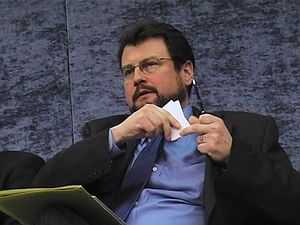
Randy Scheunemann
last updated: March 7, 2014
Please note: The Militarist Monitor neither represents nor endorses any of the individuals or groups profiled on this site.
Affiliations
- McCain 2008 Presidential Campaign: Senior Foreign Policy and National Security Advisor
- International Republican Institute: Member, Board of Directors
- Project for the New American Century: Former Member, Board of Directors
- Project on Transitional Democracies: Former Treasurer
- U.S. Committee on NATO: Former Member, Board of Directors
- Committee for the Liberation of Iraq: Former President and Executive Director
- McCain 2000 Presidential Campaign: Senior Defense and Foreign Policy Advisor
- Republican Platform Committee: Member, 1996
- Bob Dole Presidential Campaign: Senior Advisor, 1996
Government
- Office of the Secretary of Defense: Consultant on Iraq Policy, 2001
- Staff for Senate Majority Leaders Trent Lott and Bob Dole: National Security Adviser, 1993-1998
- Congressional Committee Staffs: Senate Foreign Relations Committee, House Foreign Affairs Committee, House Republican Policy Committee, 1986-1993
Business
- Orion Strategies LLC: President
- Scheunemann & Associates: Lobbyist for National Rifle Association, 1999-2002; Consultants to McCain 2008 Campaign
- Mercury Group: Former President, 1999-2000
Randy Scheunemann, founder and president of the public relations firm Orion Strategies, is a well-connected lobbyist and political insider who has advised a number of conservative political figures, supported the work of various neoconservative-led advocacy groups, and lobbied on behalf of defense industry clients and foreign governments.
Along with neoconservative figures like Robert Kagan and William Kristol, Scheunemann served as a director of the now-defunct Project for the New American Century (PNAC), a letterhead group that played an important role in building support for the Iraq War and an expansive “war on terror.”[2] He also headed the Committee for the Liberation of Iraq (CLI), a post-9/11 advocacy outfit that pushed for war in Iraq. Like PNAC, CLI played a key role forging a coalition of Beltway figures who supported a Middle East agenda that had at its core toppling Saddam Hussein.[2] Other CLI members included Sens. John McCain (R-AZ) and Joe Lieberman (I-CT).[3]
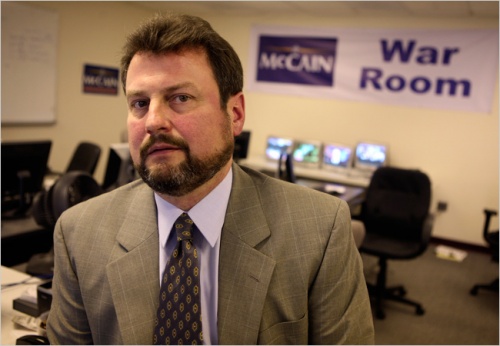
Despite his close association with right-wing factions, Scheunemann has also advised the liberal Open Society Institute, founded by billionaire financier George Soros. In November 2010, Salon.com’s Justin Elliott reported that federal disclosure forms reveal that Scheunemann’s lobbying firm, Orion Strategies, had “since 2003 been paid over $150,000 by [Open Society Policy Center] for lobbying work. … The lobbying, which has continued to the present, centers on legislation involving sanctions and democracy promotion in Burma.”[4]
During the 2008 presidential election, Scheunemann served as an adviser to Sen. John McCain’s (R-AZ) campaign. Among his roles was to advise VP candidate Sarah Palin on foreign policy. (At Palin’s suggestion, Tea Party favorite and failed Republican Senate candidate Christine O’Donnell enlisted Scheunemann and Weekly Standard online editor Michael Goldfarb to help her with debate prep during the 2010 midterm elections.)[5]
Scheunemann’s influence on Palin surfaced again in early 2014 when, following Russia’s decision to send troops to Ukraine’s Crimean peninsula after a pro-Kremlin government was ousted in Kiev, Palin took credit for having predicted the invasion. “I could see this one from Alaska,” Palin wrote on her Facebook page. “I'm usually not one to Told-Ya-So, but I did.” The quip was a reference to a remark Palin had made at a Reno, Nevada campaign stop in 2008, shortly after Russia invaded Georgia under the pretense of protecting ethnic Russians in a disputed territory. Although the attack occurred while George W. Bush was president, Palin claimed that then-Sen. Barack Obama’s “indecision and moral equivalence” would “only encourage Russia's Putin to invade Ukraine next” if he were elected.[6] Observers attributed the claim to Scheunemann rather than to the neophyte Palin. “Do you think those were actually [Palin’s] own thoughts,” wondered Robin Abcarian in a 2014 Los Angeles Times op-ed,“or ones crafted by John McCain’s top foreign policy advisor, Randy Scheunemann, a neocon who was both a paid lobbyist for Georgia and supporter of Ahmed Chalabi, the Iraqi charlatan who helped Bush and Vice President Dick Cheney gull the American people into a misbegotten war?”[7]
Scheunemann also added his voice to a neoconservative-led campaign in early 2013 to sink President Barack Obama’s nomination of former Sen. Chuck Hagel (R-NE)—a foreign policy realist who had clashed in the past with neoconservatives and members of the Israel lobby—to head the Department of Defense. Although both Scheunemann and Hagel backed John McCain’s 2000 presidential bid, David Kurtz of Talking Points Memo pointed out that “No single person might embody a foreign policy approach more diametrically opposed to Hagel’s than Scheunemann does. The Hagel nomination represents everything that Scheunemann stands against.” In a line that Kurtz dubbed “rather weak” and “petty,”[8] Scheunemann quipped that Hagel, “who is now the über-realist about not committing ground troops, had no compunction about endorsing the guy [McCain] who wanted all options on the table [in Kosovo]. His endorsement made—to put it mildly—no difference in the campaign.”[9]
As McCain Adviser
Scheunemann has long been closely associated with Senator McCain, having worked on his various presidential bids, including in 2000 and 2008.
In May 2008, the New York Times reported that Scheunemann had been working as a lobbyist for foreign governments as a “registered foreign agent” at the same time he was advising the McCain campaign.[10] "Over the past several years, Mr. Scheunemann met several times with Mr. McCain to discuss his clients’ interests. The New York Times reportedhe introduced the senator to a representative of Taiwan as it lobbied for free trade and to the foreign ministers of Albania, Croatia, and Macedonia as they tried to win admission to NATO. He also accompanied McCain to Latvia in 2001 and Georgia in 2006.”[11] In March 2008, Scheunemann ended his registrations with several countries, according to the Times. The McCain campaign policy prevented campaign workers from being paid for lobbying work. Nor were they“allowed to participate in any campaign conversations about the issues for which they lobby, which would seem to pose a conflict for someone like Mr. Scheunemann. His work as a foreign agent could overlap on any number of issues with his foreign policy advice.”[12]
Scheunemann was sharply critical of other presidential contenders during the 2008 campaign, sometimes charging them with having a “September 10 mindset” that was not suited to fighting terrorism.[13] While commenting on Mitt Romney's support for "timetables and milestones" for the Iraqi government, Scheunemann asserted that McCain "does not believe in timetables or deadlines, secret or otherwise. He has made it clear that setting a timetable or deadline is nothing more than setting a date certain for surrender."[14] In mid-2007, Scheunemann called the idea of withdrawing troops from Iraq “ludicrous. Because the idea that we will be able to better prevent sectarian violence and fight al-Qaida better from Kuwait than how we are doing it now is laughable."[15]
Scheunemann worked previously for McCain as an adviser for the senator’s failed 2000 presidential bid during a period when the candidate’s views on foreign affairs evolved dramatically.[16] John Judis writes that the candidate began "seeking to differentiate his views from those of other Republican presidential aspirants and from the growing isolationism of House Republicans … [placing] his new interventionist instincts within a larger ideological framework. That ideological framework was neoconservatism. McCain began reading the Weekly Standard and conferring with its editors, particularly Bill Kristol." Shortly after his staff consulted with Kristol, McCain hired a bevy of neoconservative-aligned operatives, including Scheunemann, Marshall Wittmann, and Daniel McKivergan.[17]
The impact of this group of advisors on the senator's thinking was revealed in early 1999, Judis reported, when McCain spoke at Kansas State University using a speech Scheunemann helped draft. In it, McCain echoed the neoconservative idea of "national greatness conservatism," arguing: "The United States is the indispensable nation because we have proven to be the greatest force for good in human history…. [W]e have every intention of continuing to use our primacy in world affairs for humanity's benefit." Judis reported about the stumping, "The centerpiece of the speech was a strategy that McCain called 'rogue-state rollback,'" a term Scheunemann claimed to have created based on rhetoric used by critics of 1950s Cold War containment strategy.[18]
Capitol Hill Experience
Scheunemann’s Capitol Hill experience dates back to the mid-1980s, when he began working for a number of congressional committees. According to his biography on the PNAC website, between 1986 and 1993 Scheunemann "served on the staffs of the Senate Foreign Relations Committee, the House Foreign Affairs Committee, and the House Republican Policy Committee."[19] He then became a senior advisor to Republican presidential candidate Sen. Bob Dole (R-KS) in 1996, served on the 1996 Republican Platform Committee, and between 1993 and 1999 was national security advisor for Dole and Sen. Trent Lott (R-MS).[20] In 1997, during the time he worked as a congressional aide for Lott, Scheunemann reportedly forgot to remove a shotgun from his car after a duck-hunting trip; when he drove up to the U.S. Capitol to report for work, he was arrested for possession of an unregistered firearm.[21]
Scheunemann's PNAC bio states that during his time working on the Hill, he "was involved in Senate deliberations concerning the use of American military power in Somalia, the Korean Peninsula, Iraq, Haiti, and Bosnia. He also served as coordinator for Senate Republican policy on UN reform, congressional-executive war powers, NATO enlargement, global climate change, economic sanctions, ballistic missile defense, and technology transfers to China."[22]
Scheunemann helped draft the 1998 Iraq Liberation Act, which made the toppling of Saddam Hussein an official U.S. policy goal and authorized $98 million for the Iraqi National Congress, a loose grouping of Iraqi dissidents led by Ahmad Chalabi that has been widely blamed for channeling false intelligence about Iraq.[23] Scheunemann also served briefly as an advisor to Defense Secretary Donald Rumsfeld early in the George W. Bush administration as a consultant on Iraq policy.[24]
Lobbying and Advocacy
According to the Lobbying Registration office of the U.S. House of Representatives and the watchdog group OpenSecrets.org, Scheunemann's former lobbying firm, Scheunemann & Associates, represented the National Rifle Association for several years.[25] In 2005, the firm also represented the Caspian Alliance, a consortium of oil- and gas-producing nations from the Caspian region. Scheunemann has also led the lobbying firms Orion Strategies (which he owns) and the Mercury Group. Clients of the Mercury Group have included Swiftships Shipbuilders, Barrett Firearms Manufacturing, BP America, Air Force Memorial Foundation, Lockheed Martin, National Shooting Sports Foundation, and Sporting Arms and Ammunitions Manufacturers.[26]
Much of Scheunemann’s work, in both the public and private spheres, has been oriented toward Europe, promoting democratic programs and expanding NATO to former Soviet-bloc countries. A board member (along with McCain) of the International Republican Institute (IRI)—a key institutional vehicle through which the National Endowment for Democracy carries out its work—Scheunemann has worked closely with Bruce Jackson, a fellow former PNAC director, on NATO expansion issues, serving as a board member of Jackson's U.S. Committee on NATO and as a registered lobbyist and/or consultant for Georgia, Latvia, Macedonia, and Romania.[27]
According to the Financial Times, while serving as "an American adviser to the Georgian government" in late 2006, Scheunemann criticize the Bush administration’s consultations with Russia in the U.N. Security Council regarding security issues in Georgia. He accused Secretary of State Condoleezza Rice of "appeasement" for acquiescing to Russia’s demand for a U.N. resolution regarding the Russia-supported republic of Abkhazia, which broke away from Georgia, in exchange for Russia's support of sanctions on North Korea in the wake of that country's nuclear test. Said Scheunemann: "What Rice approved was a weak, ambiguous resolution on North Korea. They sold out the Georgians. That was the trade."[28]