
Paul Wolfowitz
last updated: September 4, 2016
Please note: The Militarist Monitor neither represents nor endorses any of the individuals or groups profiled on this site.
Affiliations
- American Enterprise Institute: Visiting Scholar
- U.S.-Taiwan Business Council: Chairman
- World Bank: President (2005-June 2007)
- Project for the New American Century: Founding Signatory
- Heritage Foundation: Paid Speaker
- Hudson Institute: Paid Speaker
- Rand 2001 Transition Panel: Member
- Johns Hopkins School for Advanced International Studies (SAIS): Dean (1994-2001); Visiting Professor (1980-81)
- Yale University: Professor (1970-1973)
Government
- Defense Department: Deputy Secretary (2001-2005); Undersecretary of Defense for Policy (1989-1993); Deputy Assistant Secretary for Regional Programs (1977-1980)
- State Department: Chair, International Security Advisory Board, January 2008-2009; Ambassador to Indonesia (1986-1989); Assistant Secretary for East Asian and Pacific Affairs (1982-1986); Policy Planning Staff (1981-1982)
- Rumsfeld Commission on the Ballistic Missile Threat: Member (1998)
- Team B Strategic Objectives Panel: Member (1976)
- Arms Control and Disarmament Agency: Special Assistant (1973-1977)
Business
- Northrop Grumman: Former Consultant
Education
- Cornell University: B.A. in Mathematics (1965)
- University of Chicago: Ph.D. in Political Science (1972)
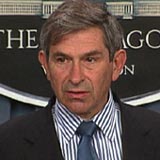
Paul Wolfowitz, a controversial former public official whose track record includes serving as a top Pentagon official and as head of the World Bank, is a visiting fellow at the American Enterprise Institute (AEI), a think tank in Washington, D.C. that is home to numerous neoconservative activists. Wolfowitz, who served as deputy secretary of defense under Donald Rumsfeld in the first George W. Bush administration, is closely associated with the decision to invade Iraq as well as with various controversies during his short tenure at the World Bank.
Wolfowitz joined AEI shortly after stepping down from his post at the World Bank in mid-2007.[1] In joining AEI, Wolfowitz followed a well-worn path to the institute, which has housed a number of other former Bush administration figures, including former U.S. ambassador to the United Nations John Bolton and former adviser to the Justice Department John Yoo. According to AEI, Wolfowitz’s research areas include development issues, Africa, public-private partnerships, and entrepreneurship.[2]
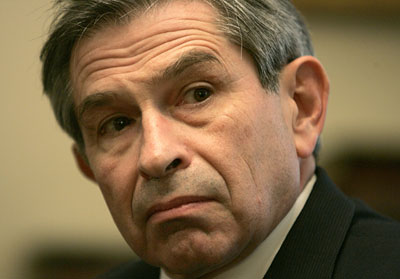
From his AEI perch, Wolfowitz has remained vocal in his support for interventionist U.S. policies, penning op-eds for major U.S. newspapers, appearing on Fox News, and speaking at numerous AEI-sponsored events.
In February 2015, Wolfowitz was named as a foreign policy advisor to 2016 GOP presidential candidate Jeb Bush. Wolfowitz joined 21 other advisors, 17 of whom were members of the George W. Bush administration.[3]
Since the demise of the Bush campaign, Wolfowitz has come out strongly against the presidential campaign of Donald Trump. In a widely noted 2016 interview with Der Speigel, Wolfowitz said that the real estate magnate was a “security risk” and that his views on foreign affairs were “disturbing.” Said Wolfowitz: “He says he admires Putin, that Saddam Hussein was killing terrorists, that the Chinese were impressive because they were tough on Tiananmen Square. That is pretty disturbing.” He added: “The only way you can be comfortable about Trump’s foreign policy, is to think he doesn’t really mean anything he says. That’s a pretty uncomfortable place to be in. Our security depends on having good relationships with our allies. Trump mainly shows contempt for them. And he seems to be unconcerned about the Russian aggression in Ukraine. By doing this he tells them that they can go ahead and do what they are doing. That is dangerous.”
Wolfowitz has also remained vocal in his support of U.S. military intervention and democracy promotion, arguing that Trump would jeopardize these policies. He told Der Speigel that come election time he “might have to vote for Hillary Clinton, even though I have big reservations about her.”
Syria
A key focus of Wolfowitz’s advocacy for U.S. intervention in recent years has been Syria. During a 2016 interview he said that “Islamic State is mainly a direct result of the failure in Syria. That’s where IS has grown. That’s where IS spread from. The Western alliance should have supported the Sunni opposition against the Assad regime from the beginning.”
He has consistently downplayed the potential ramifications if the Assad regime fell. In an an op-ed for the Sunday Times of London he and co-author Mark Palmer of Freedom House wrote: “Concerns about the aftermath of a fall of the regime should have been a reason for more active support for the opposition, rather than a justification for inaction. The failure to provide the opposition with the capability to defend liberated territory has helped preserve the regime’s military advantage and prolonged the fighting.”[4]
In September 2013, Wolfowitz likened the climate in Syria to Iraq after the first Gulf War. Syria is “not Iraq 2003,” he said. “It’s Iraq in 1991. In 1991 we had an opportunity without putting any American lives at risk to enable the Shia uprisings against Saddam to succeed. Instead we sat on our hands and watched him kill tens of thousands. We did nothing and we could have very easily enabled those rebellions to succeed. I think if we had done so we could have gotten rid of Saddam Hussein and there would not have been a second war.” Wolfowitz added that he believed the war in Syria “has more sympathy across the Arab world than even the Arab-Israeli issue,” and—using arguments reminiscent of the rosy forecasts about the Iraq War—predicted that “we would not pay a price for [supporting the Syrian opposition]; we would be rewarded for it.”[5]
Defensive on Iraq
In various interviews, Wolfowitz has conceded that the United States “may have overreached” in Iraq and Afghanistan, but has remained defensive about the decision to invade.[6] In a widely noted March 2013 interview with the Sunday Times that coincided with the tenth anniversary of the start of the U.S.-led invasion of Iraq, Wolfowitz defended the war, arguing: “We still don’t know how all this is all going to end. With the Korean War, it is amazing how different Korea looks after 60 years than it looked after 10 or even 30.” However, he admitted that the Bush administration made a number of errors, which led to a cycle of violence that “spiraled out of control.”[7]
With the rapid advance of the so-called Islamic State (or ISIS) across swathes of Iraq and Syria in 2014, Wolfowitz re-emerged in the media spotlight to defend the Iraq War, arguing that the success of ISIS proved why it was necessary to invade Iraq in the first place. Characterizing Iraq as a “haven for terror groups” before the Iraq War, Wolfowitz suggested in a July 2014 interview that the Islamic State “was basically in a different name created by Abu Musab al-Zarqawi, who was operating out of Iraq as early as January of 2002.”[8]
Asked by Der Spiegel if he was “annoyed” when people called him the “architect” of the Iraq War, he responded: “Annoyed isn’t the right word, it’s inaccurate. If I had been the architect, a lot of these things would be different. As a matter of fact, I believed after 9/11, there was reason to get much tougher about the fact that Saddam was blocking the inspections for weapons of mass destruction. He was harboring terrorists. I thought that it was time to give Saddam an ultimatum just as we did with the Taliban who were harboring Osama Bin Laden. People seem to forget that Saddam was the only leader in the world who praised the attacks of 9/11 as a good thing.
Wolfowitz’s numerous media appearances discussing the situation in Iraq in 2014 spurred widespread criticism. A reporter for Slate commented: “What’s amazing about this is the extent to which Wolfowitz is treated as a serious interlocutor. It’s as if his history never happened, and he were just another pundit with another perspective.”[9]
Ignoring the abundant evidence that Wolfowitz and other like-minded neoconservatives in the Bush administration helped drive decision-making on Iraq after the 9/11 attacks[10], Wolfowitz attacked Colin Powell for his criticism of the influence that neoconservatives had in the Bush administration. Reported the Sunday Times: “[Wolfowitz] portrayed the Bush administration as deeply divided and he was fiercely critical of Colin Powell, the then secretary of state. It was ‘outrageous’ and ‘a joke’ for General Powell—who reportedly used to speak of a ‘Gestapo office’ at the Pentagon—to have suggested the case for the Iraq War was concocted by Dr. Wolfowitz and a cabal of fellow neoconservatives within the Bush administration, he said.”[11]
On the Islamic State
Wolfowitz’s prescriptions for confronting the Islamic State have included relying on the discredited Iraqi politician Ahmed Chalabi, a former dissident who was hailed by many neoconservatives even after it was revealed that he had fed the United States fabricated intelligence about Iraq’s weapons programs and ties to Al-Qaeda. “The man is a survivor,” Wolfowitz told Bloomberg. “That’s impressive. I think he wants to succeed in what he does, he’s smart; maybe he’ll figure out a way to do it.”[12]
Wolfowitz has also contended that the United States should “at least arm” Syrian rebels who have been fighting Islamic State militants. “We may have reached a point where we need to do more than that,” arguing that is the Islamic state is allowed to “triumph in Syria and Iraq, and there’s nobody left fighting them, then it’s possible that we would actually confront that problem.”[13]
Extolling Continued U.S. Military Interventions
Wolfowitz has advocated aggressive U.S. involvement in countries impacted by the “Arab Spring” uprisings, at times splitting with some of his fellow neoconservatives who have argued against the idea of promoting democracy in countries like Egypt. In March 2011, for example, Wolfowitz appeared on an AEI panel along with Michael O’Hanlon, Thomas Donnelly, Danielle Pletka, and Ken Pollack, during which Wolfowitz extolled President Obama’s intervention in Libya.[14]
In mid-June 2009, Wolfowitz joined numerous right-wing and neoconservative writers—including Charles Krauthammer and Robert Kagan—who lambasted President Obama for his alleged “weakness” in dealing with the electoral crisis in Iran. Wolfowitz wrote in a Post op-ed that “the reform the Iranian demonstrators seek is something that we should be supporting. In such a situation, the United States does not have a ‘no comment’ option. Coming from America, silence is itself a comment—a comment in support of those holding power and against those protesting the status quo. It would be a cruel irony if, in an effort to avoid imposing democracy, the United States were to tip the scale toward dictators who impose their will on people struggling for freedom.”[15]
Commenting on the op-ed, Byard Duncan wrote on Alternet: “Wolfowitz would be wise to understand the implications of his comments: The assertion that the United States must take a firm stance on the Iran issue carries the paternalistic assumption that the demonstrators somehow ‘need’ our support—that their actions are void without Uncle Sam’s wink and thumbs-up. Wolfowitz’s position essentially robs Iranians of their agency, and its arrogance reinforces Mahmoud Ahmadinejad’s argument that the West is acting behind the scenes.”[16]
Wolfowitz was critical of the July 2015 nuclear accord reached between Iran and the P5+1 world powers. He claimed in an op-ed that the agreement “concedes so much of what the Iranian regime has been demanding” and “provides it with enormous additional resources to pursue its threatening activities.”[17]
More recently, Wolfowitz added his voice to a chorus of neoconservative and “pro-Israeli” hardliners who supported Michele Flournoy as a possible alternative to former Sen. Chuck Hagel for Pentagon chief during President Obama’s second term. In a December 2012 op-ed for the Wall Street Journal, Wolfowitz argued that Flournoy, who founded the Center for a New American Security, would be an excellent choice in part because of her experience advising the U.S. military in Afghanistan.
World Bank
Wolfowitz’s June 2007 resignation from the World Bank ended a tumultuous two-year tenure. He had been criticized by the bank’s board and staff for “ethical lapses” concerning his relationship with a bank employee, as well as for his management skills.[18] Dissension within the bank reached a boiling point in early 2007, when allegations emerged that Wolfowitz had been improperly involved in securing a promotion and raise for his girlfriend. Shortly after Wolfowitz announced his intention to resign, President George W. Bush nominated career diplomat Robert Zoellick to fill the post.[19]
After taking over as World Bank president in June 2005, Wolfowitz seemed to pressure the bank to take on a larger role in Iraq. According to the Inter Press Service, Wolfowitz’s persistent efforts to “recruit a new country manager for Iraq despite concerns over staff security there—as well as the bank’s attempts [in May 2007] to suppress reports about an incident in which a bank employee was injured in Baghdad, apparently to avoid derailing his recruitment efforts—have lent credence to critics’ charges that he has been more than eager to line up the institution and its resources behind U.S. policy there.”[20]
The New York Times reported that Wolfowitz’s decisions at the World Bank sometimes left the “impression that at critical moments [Wolfowitz] was putting American foreign policy interests first,” for example, when he decided to suspend “a program in Uzbekistan after the country denied landing rights to American military aircraft.”[21] He also “directed huge amounts of aid to the countries he once recruited to sign on to Washington’s counterterrorism agenda … [and] relied heavily on a pair of aides drawn from the Bush administration, Robin Cleveland and Kevin Kellems, who created an inner circle that the bank’s professional staff members said they had great trouble piercing.”[22]
According to journalists Emad Mekay and Jim Lobe, “Of the top five outside international appointments made by [Wolfowitz] during his nearly two-year tenure, three were senior political appointees of right-wing governments that provided strong backing for U.S. policy in Iraq.”[23] These appointments included former Jordanian Deputy Prime Minister Marwan Muasher, who was named senior vice president for external affairs in early 2007. Muasher was Jordan’s ambassador in Washington in the lead up to the Iraq War and reportedly helped ensure his country’s cooperation during the 2003 invasion. Wolfowitz also secured posts for former Salvadoran Finance Minister Juan José Daboub, who was chief of staff to former President Francisco Flores Perez at the time when El Salvador sent nearly 400 Salvadoran combat troops to Iraq (more than any other developing country), and former Spanish Foreign Minister Ana Palacio, who was an outspoken proponent of the Iraq War during the administration of former Spanish Prime Minister José María Aznar, who sent 1,500 troops to Iraq despite widespread opposition to the war in Spain.
Of these Wolfowitz appointees, Daboub proved the most controversial. Traditionally, the World Bank has pushed family planning initiatives and birth control as core agenda items in an effort to improve women’s health and economic well-being in developing countries. However, after taking over as managing director at the bank, Daboub, a conservative Catholic, allegedly cut references to such programs in bank strategy documents, echoing the Bush administration’s conservative views on family planning issues. The Los Angeles Times reported that, “In an internal e-mail, the bank’s team leader for Madagascar indicated that one of two managing directors appointed by Wolfowitz ordered the removal of all references to family planning from a document laying out strategy for the African nation. And a draft of the bank’s long-term health program strategy overseen by the same official makes almost no mention of family planning, suggesting a wider rollback may be under way.”[24]
Daboub denied he was changing World Bank policy or had altered the Madagascar report, but the Times obtained a copy of the report revealing multiple deletions to family planning references. And internal bank e-mails obtained by the Government Accountability Project also show that Daboub, referred to as “MD” (or managing director) in the e-mails, requested that all references to family planning be deleted. “It’s a blatant lie,” said one bank staffer about Daboub’s denials. Carmen Barroso of the International Planned Parenthood Federation, commenting on the affair, said, “There’s mismanagement there. Wolfowitz appointed a guy in a very high position who felt free to censor in line with his personal beliefs. I think that’s good grounds for sacking.”[25]
On the other hand, Wolfowitz promoted efforts of poor nations to push through equitable global trade agreements. In early July 2006, just before a meeting of the Group of Eight industrialized nations in St. Petersburg, the World Bank released a letter from Wolfowitz in which he argued that wealthy countries must make deep cuts in farm subsidies to help developing countries improve their export earnings. “Good intentions are in generous supply,” he wrote. “The world’s poorest people, the 1.2 billion living on less than $1 a day, are counting on your good intentions being transformed into decisive action.”[26] Weeks later, during the July 2006 World Trade Organization meeting aimed at concluding a new global trade agreement, U.S. and European leaders scuttled talks by refusing to commit to deep cuts in subsidies.[27]
Wolfowitz and Neoconservatism
After Bush announced in March 2005 that he would nominate Wolfowitz, his former deputy defense secretary, to lead the World Bank, many pundits worried that neoconservatives seemed poised to take their agenda to a new playing field. Other observers, however, seemed confused by the nomination, wondering what a political figure with little experience in banking or development could bring to the job. Political reporter Jim Lobe of the Inter Press Service asked, “If sending arch-unilateralist John Bolton to the United Nations sent a message of contempt for multilateralism, what does U.S. President George W. Bush mean by sending that ardent advocate of hard power, Paul Wolfowitz, to the planet’s single biggest purveyor of soft power, the World Bank?”[28] At the same time, Wolfowitz’s neoconservative counterparts seemed delighted by the announcement. Thomas Donnelly of AEI said, “It’s not quite like John Bolton going to the UN, but you’re going to get someone who’s really devoted to the president’s agenda. … The World Bank could be a useful tool of American statecraft, that would be great.”[29]
Part of the confusion over Wolfowitz stems from his at-times ambiguous relationship to the neoconservative agenda. Although a long-standing hawk whose connections to neoconservative advocacy efforts date back to the Cold War, Wolfowitz has expressed several contrarian views within the neoconservative camp. In particular, he has been much more flexible when it comes to Middle East peace, shying away from the extreme Likudnik line of hostility toward Palestine espoused by many neoconservatives, and opposing the Jewish settler movement. In 2002, when Bush pushed Israel to pull back from an offensive in the West Bank, the American Israel Public Affairs Committee and others organized a rally in Washington to support a congressional resolution aimed at affirming U.S. solidarity with Israel. According to the Washington Post‘s Glenn Frankel, “The crowd booed … Wolfowitz, Bush’s representative to the rally, when he told them that ‘innocent Palestinians are suffering and dying in great numbers.’”[30]
Policy and Advocacy Track Record
Wolfowitz has a long track record of producing influential and controversial policy proposals on key aspects of U.S. defense policy: In the late 1970s, he participated in the Team B Strategic Objectives Panel, a notorious effort to reinterpret CIA intelligence on the Soviet threat that helped put the country on a confrontational path with the Soviet Union and set the stage for the Reagan arms buildup; as Dick Cheney‘s undersecretary of defense for policy in the Bush Senior administration, he oversaw (along with I. Lewis Libby and Zalmay Khalilzad) the controversial 1992 Draft Defense Planning Guidance (DPG) that is widely regarded as an early blueprint for the George W. Bush administration’s preemptive defense posture and interventionist foreign policies; and he collaborated in the late 1990s with the Project for the New American Century‘s advocacy campaign calling for war in Iraq. He has also been associated, along with Douglas Feith, with the work of the Office of Special Plans, the Pentagon outfit that George Tenet and others blamed for twisting the intelligence on Iraq.
While working in the George H.W. Bush administration as undersecretary of defense for policy, in 1992 Wolfowitz was charged with producing a policy guidance report aimed at formulating a post-Cold War defense posture. Upset by Bush Senior’s decision to leave Saddam Hussein’s regime in place after the 1991 Gulf War, Wolfowitz, along with “Scooter” Libby, argued in a draft DPG that the United States should actively deter nations from “aspiring to a larger regional or global role,” use preemptive force to prevent countries from developing weapons of mass destruction, and act alone if necessary.
Although the draft guidance was quashed soon after it was leaked to the New York Times, many of its ideas—in particular, the doctrine of preemption—later found their way into President George W. Bush’s national security strategy. The document also seems to have served as a template for the founding statement of principles of the Project for the New American Century, which was signed by a who’s-who list of hawks and neoconservatives who later served in the George W. Bush administration, including Wolfowitz, Cheney, Libby, Khalilzad, Rumsfeld, Elliott Abrams, Paula Dobriansky, and Peter Rodman. (Non-administration signatories include Gary Bauer, Frank Gaffney, Norman Podhoretz, Donald Kagan, Vin Weber, George Weigel, and Midge Decter.)[31]
Wolfowitz’s role in pushing the Bush administration to target Iraq shortly after 9/11 has been widely documented. In Plan of Attack, Bob Woodward’s 2004 book recounting the decision-making that led up to the Iraq War, Wolfowitz is described as “a drum that would not stop. He and his group of neoconservatives were rubbing their hands over the ideas [for invading Iraq].” According to Woodward, in the days immediately after 9/11, Wolfowitz was the “only strong advocate for attacking Iraq. … He estimated that there was a 10-50% chance Saddam was involved in the 9/11 attacks.”[32]
In an interview with Vanity Fair‘s Sam Tannenhaus in May 2003, Wolfowitz appeared to cast doubt upon the Bush administration’s stated belief that Iraq had weapons of mass destruction, saying, “The truth is that for reasons that have a lot to do with the U.S. government bureaucracy we settled on the one issue that everyone could agree on, which was weapons of mass destruction, as the core reason.” Shortly after the interview was published, the Pentagon criticized the magazine for taking Wolfowitz’s statement out of context and released the full interview on the Department of Defense’s website. In the Pentagon version, Wolfowitz, after a short pause, continued with his argument, saying, “But there have always been three fundamental concerns. One is weapons of mass destruction, the second is support for terrorism, the third is the criminal treatment of the Iraqi people. Actually I guess you could say there’s a fourth overriding one which is the connection between the first two.”[33]
Between his stints in the administrations of Bush Senior and Junior, Wolfowitz served from 1994 to 2001 as dean of the Johns Hopkins School for Advanced International Studies, the Washington, D.C.-based graduate school that has been home to a number of key neoconservative figures, including Gary Schmitt of the Project for the New American Century and the Defense Policy Board’s Eliot Cohen. In 1998, Wolfowitz also served on the so-called Rumsfeld Missile Commission, which conducted a six-month study that concluded, in contrast to intelligence community reports, that the ballistic missile threat to the United States was much greater than previously believed.
In January 2008, Wolfowitz replaced Fred Thompson as chair of the U.S. State Department’s International Security Advisory Board (ISAB), which is tasked with providing State “with independent insight and advice on all aspects of arms control, disarmament, international security, and related aspects of public diplomacy.”[34]
Wolfowitz’s appointment to the State Department’s relatively low-profile ISAB sparked considerable criticism. Shortly after news of Wolfowitz’s ISAB position was announced, the Center for Public Integrity released a study detailing Iraq-related “false statements” made by top Bush administration officials, including Wolfowitz, in the two years after 9/11. By the center’s count, Wolfowitz alone made 85 public statements reflecting “misinformation about the threat posed by Saddam Hussein’s Iraq.”[35] Joseph Cirincione, a senior fellow at the Center for American Progress, commented on Wolfowitz’s appointment to the ISAB, telling Bloomberg News, “The advice given by Paul Wolfowitz over the past six years ranks among the worst provided by any defense official in history. I have no idea why anyone would want more.”[36]
Serving under Wolfowitz at the time of his appointment to the ISAB chairmanship were a number of foreign policy hawks, including Kathleen Bailey of the National Institute for Public Policy (NIPP); Robert Joseph, a former undersecretary of state who has worked with both NIPP and the Center for Security Policy (CSP); former CIA director James Woolsey; Keith Payne, head of NIPP; William Schneider Jr., CSP adviser and ex-head of the Defense Science Board; and William Van Cleave, a Reagan-era Pentagon official and adviser to the Ariel Center, a think tank closely aligned with Israel’s right-wing Likud Party.[37]
[1] Jim Lobe, “Wolfowitz to AEI,” Lobelog, July 2, 2007, http://www.lobelog.com/wolfowitz-to-aei/.
[2] American Enterprise Institute, Scholars and Fellows, Paul Wolfowitz biography, http://www.aei.org/scholars/scholarID.126,filter.all/scholar.asp.
[3] David Corn, “The Jeb Bush Adviser Who Should Scare You,” Mother Jones, May 13, 2015, http://www.motherjones.com/politics/2015/05/jeb-bush-adviser-paul-wolfowitz.
[4] Paul Wolfowitz and Mark Palmer, “Our dithering has played into Assad’s hands,” Sunday Times, July 23, 2012, http://www.aei.org/article/foreign-and-defense-policy/regional/middle-east-and-north-africa/our-dithering-has-played-into-assads-hands/.
[5] Eli Lake, “Syria’s Strange Bedfellows: Paul Wolfowitz’s Case for Obama’s War,” The Daily Beast, September 6, 2013, http://www.thedailybeast.com/articles/2013/09/06/syria-s-strange-bedfellows-paul-wolfowitz-s-case-for-obama-s-war.html.
[6] Eli Lake, “Syria’s Strange Bedfellows: Paul Wolfowitz’s Case for Obama’s War,” The Daily Beast, September 6, 2013, http://www.thedailybeast.com/articles/2013/09/06/syria-s-strange-bedfellows-paul-wolfowitz-s-case-for-obama-s-war.html.
[7] Toby Harnden, “Pentagon chief Wolfowitz admits US bungled in Iraq,” Sunday Times, March 17, 2013, http://www.thesundaytimes.co.uk/sto/news/world_news/Americas/article1230851.ece.
[8] Nicole Gaouette, “Wolfowitz Sees Chalabi as Viable Iraq Leader Even With Iran Ties,” Bloomberg, July 4, 2014, http://www.bloomberg.com/news/2014-07-03/wolfowitz-sees-chalabi-as-viable-iraq-leader-even-with-iran-ties.html.
[9] Jamelle Bouie, “Fool me once,” Slate, June 16, 2014, http://www.slate.com/articles/news_and_politics/politics/2014/06/paul_wolfowitz_bill_kristol_and_douglas_feith_should_be_ignored_the_neocons.html.
[10] See, for example, James Mann, The Rise of the Vulcans (New York: Viking, 2004).
[11] Toby Harnden, “Pentagon chief Wolfowitz admits US bungled in Iraq,” Sunday Times, March 17, 2013, http://www.thesundaytimes.co.uk/sto/news/world_news/Americas/article1230851.ece.
[12] Nicole Gaouette, “Wolfowitz Sees Chalabi as Viable Iraq Leader Even With Iran Ties,” Bloomberg, July 4, 2014, http://www.bloomberg.com/news/2014-07-03/wolfowitz-sees-chalabi-as-viable-iraq-leader-even-with-iran-ties.html.
[13] Nicole Gaouette, “Wolfowitz Sees Chalabi as Viable Iraq Leader Even With Iran Ties,” Bloomberg, July 4, 2014, http://www.bloomberg.com/news/2014-07-03/wolfowitz-sees-chalabi-as-viable-iraq-leader-even-with-iran-ties.html.
[14] Brian Beutler, “ Obama Makes Bedfellows With Neocon Boffins On Libya,” Talking Points Memo, March 28, 2011, http://tpmdc.talkingpointsmemo.com/2011/03/obama-makes-bedfellows-with-neocon-boffins.php#more
[15] Paul Wolfowitz, “’No Comment’ Is Not an Option,” Washington Post, June 19, 2009.
[16] Byard Duncan, “Why Did The Washington Post Axe Dan Froomkin and Give Paul Wolfowitz a Column?” Alternet, June 19, 2009, http://www.alternet.org/story/140796/why_did_the_washington_post_axe_dan_froomkin_and_give_paul_wolfowitz_a_column.
[17] Paul Wolfowitz, “Obama’s gift to Iran,” Politico, April 23, 2015, http://www.politico.eu/article/rouhani-obama-iran-gift/.
[18] World Bank, “Ethics Committee Case No. 2,” Dossier, http://newsblogs.chicagotribune.com/news_theswamp/files/EthicsCommitteeCaseNo2andPresidentsPaper.pdf; Steve Clemons, “Paul Wolfowitz Busy Neo-Conning World Bank: Staff Rebellion Brewing,” Washington Note, January 20, 2006, http://www.thewashingtonnote.com/archives/001196.php.
[19] “Bush Announces Pick for World Bank Chief,” Associated Press, May 30, 2007.
[20] Emad Mekay and Jim Lobe, “Top Wolfowitz Postings Went to Iraq War Backers,” Inter Press Service, April 13, 2007, http://www.ipsnews.net/2007/04/politics-top-wolfowitz-postings-went-to-iraq-war-backers/.
[21] David Sanger, “Wolfowitz Fight Has Subplot,” New York Times, April 13, 2007, http://www.nytimes.com/2007/04/14/washington/14assess.html?_r=0.
[22] David Sanger, “Wolfowitz Fight Has Subplot,” New York Times, April 13, 2007, http://www.nytimes.com/2007/04/14/washington/14assess.html?_r=0.
[23] Emad Mekay and Jim Lobe, “Wolfowitz’s Quid Pro Quo?” Right Web, April 17, 2007, http://www.rightweb.irc-online.org/articles/display/Wolfowitzs_Quid_Pro_Quo.
[24] Nicole Gaouette, “World Bank May Target Family Planning,” Los Angeles Times, April 19, 2007, http://articles.latimes.com/2007/apr/19/nation/na-worldbank19.
[25] Nicole Gaouette, “World Bank May Target Family Planning,” Los Angeles Times, April 19, 2007, http://articles.latimes.com/2007/apr/19/nation/na-worldbank19.
[26] Steven R. Weisman, “World Bank Chief Urges Trade Concessions,” New York Times, July 10, 2006, http://www.nytimes.com/2006/07/10/world/europe/10worldbank.html?fta=y.
[27] Steven R. Weisman, “World Bank Chief Urges Trade Concessions,” New York Times, July 10, 2006, http://www.nytimes.com/2006/07/10/world/europe/10worldbank.html?fta=y.
[28] Jim Lobe, “Wolfowitz Pick for World Bank Prompts Head-Scratching,” Inter Press Service, March 16, 2005, http://www.ipsnews.net/2005/03/finance-wolfowitz-pick-for-world-bank-prompts-head-scratching/.
[29] Jim Lobe, “Wolfowitz Pick for World Bank Prompts Head-Scratching,” Inter Press Service, March 16, 2005, http://www.ipsnews.net/2005/03/finance-wolfowitz-pick-for-world-bank-prompts-head-scratching/.
[30] Glenn Frankel, “A Beautiful Friendship?” Washington Post, July 16, 2006, http://www.washingtonpost.com/wp-dyn/content/article/2006/07/12/AR2006071201627.html.
[31] Michael Flynn, “The War Hawks,” Chicago Tribune, April 13, 2003, http://articles.chicagotribune.com/2003-04-13/news/0304130427_1_iraq-william-kristol-benevolent-hegemony.
[32] Bob Woodward, Plan of Attack (London: Simon & Schuster, 2004), pp. 20, 26.
[33] Department of Defense News Transcript, “Deputy Secretary Wolfowitz Interview with Sam Tannenhaus, Vanity Fair,” May 29, 2003, http://www.defenselink.mil/transcripts/2003/tr20030509-depsecdef0223.html.
[34] State Department, International Security Advisory Board, February 1, 2008, http://www.state.gov/t/isn/isab/; State Department International Security Advisory Board, “Current Board Members,” http://www.state.gov/t/isn/isab/c17650.htm.
[35] Charles Lewis and Mark Reading-Smith, “False Pretenses,” Center for Public Integrity, http://www.publicintegrity.org/WarCard/Default.aspx?src=project_home&context=overview&id=945.
[36] Janine Zacharia, “Wolfowitz Appointed Chairman of Arms Control Advisory Panel,” Bloomberg News, Boston Globe, January 25, 2008, http://www.boston.com/news/nation/articles/2008/01/25/wolfowitz_appointed_chairman_of_arms_control_advisory_panel/.
[37] State Department, International Security Advisory Board, “Current Board Members,” http://www.state.gov/t/isn/isab/c17650.htm.