
Peter Wehner
last updated: November 9, 2016
Please note: The Militarist Monitor neither represents nor endorses any of the individuals or groups profiled on this site.
Affiliations
- Ethics and Public Policy Center: Senior Fellow
- Commentary: Contributor
- Weekly Standard: Contributor
- National Review: Contributor
- Harry Walker Agency: Speaker/Client
- Hudson Institute:Former Research Fellow
- Empower America: Former Executive Director for Policy (1993-2001)
Government Service
- White House: Deputy Assistant to the President/Director of Strategic Initiatives (2002-2007);Deputy Director of Speechwriting (2001) George H.W. Bush Administration; Assistant to the Director of the Office of National Drug Control Policy (1989-1990)
- Department of Education: Speechwriter for William Bennett (1987-1988)
Education
- University of Washington: B.A., Political Science
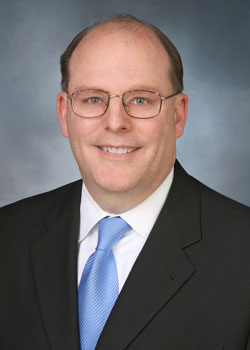
Peter Wehner is a senior fellow at the Ethics and Public Policy Center (EPPC), a neoconservative organization that promotes an increased role for Christianity in public policy, and a frequent op-ed contributor to the New York Times. A former adviser in the George W. Bush White House, Wehner’s track record also includes stints in the Reagan and George H. W. Bush administrations.[1] Wehner has worked with a number of other rightist groups, including the William Bennett-founded Empower America and the Hudson Institute, and he has been closely associated with leading neoconservative figures like William Kristol.[2]
Although his writings often focus on domestic policy and Christian ethics, Wehner is a reliable hawk on foreign affairs and he tends to view foreign policy through the prism of moralism. Wehner has frequently teamed up with foreign policy hawks to promote U.S. overseas military action,[3]often framing his views around abstract ideas like the “freedom agenda” or his loathing of foreign policy “realism,” which he has argued “leads to death.”[4]
A vocal critic of the Obama administration, Wehner has argued that the administration’s track record on foreign affairs has been an abject failure. In an op-ed for the neoconservative Weekly Standard, he argued that Obama is not interested in protecting the country and is causing the public to question the country’s morality. He wrote: “It tells us something that every previous president was instinctively inclined to defend the United States, while Obama is far more inclined to apologize for her and place himself above her. He has undermined America’s moral self-confidence.”[5]
During the 2016 Republican presidential primary contest, Wehner frequently lashed out at various candidates, in particular Donald Trump and Ben Carson, for their failures to understand U.S. foreign relations and for being “rhetorically reckless” in a way that “damages our political culture as well as conservatism, a philosophy that should be grounded in prudence, moderation, and self-restraint.”[6]
Wehner’s disillusionment during the 2016 campaign led him to join a chorus of GOP figures who argued that if Donald Trump won the GOP presidential nomination they would not vote. He wrote in a New York Times op-ed: “If Mr. Trump and Mrs. Clinton were the Republican and Democratic nominees, I would prefer to vote for a responsible third-party alternative; absent that option, I would simply not cast a ballot for president. A lot of Republicans, I suspect, would do the same.”[7]
In the George W. Bush White House
Wehner served as an adviser and speechwriter in the George W. Bush from 2002 to 2007. He gained a reputation as a vocal proponent of the Bush administration’s conservative domestic agenda and militarist “war on terror” policies, which he continued to defend after leaving the government. In May 2008, for example, Wehner characterized Bush’s Iraq plan as “working in terms of security, in terms of politics, and in terms of economics. … I don’t see any reason why you’d get away from it.”[8]
Wehner’s position as head of the Office of Strategic Initiatives, an in-house quasi-think tank created by Karl Rove, was characterized by the Washington Post as the “rarest of White House jobs.”[9] According to the Post, Wehner was “paid to read, to think, to prod, to brainstorm—all without accountability. He recalls the words of White House senior adviser Karl Rove when he interviewed for the job: ‘He said my job is to bug him.’”[10]
Bush called Wehner’s frequent proposals on both domestic and foreign policy, which were widely circulated in and out of the administration, “Wehner-grams.” Former White House colleagues highlighted the influential role Wehner played. Michael Gerson, a former Bush speechwriter, said that Wehner “developed a tremendous influence at the White House, not by being a policy implementer but by being an idea and argument generator.”[11]
From his perch at the White House, Wehner’s principal role often seemed to be the administration’s attack dog. For example, in response to a 2006 column by conservative writer George Will that lambasted Bush’s Middle East policy as the “triumph of unrealism,” Wehner wrote a widely circulated rebuttal, arguing that Will’s views on the Middle East would “lead to death and destruction on a scale that is almost unimaginable.”[12] Ignoring the violence in Iraq associated with the U.S. occupation and blowback from the push to establish Western-style democracies in the Middle East,[13] Wehner contended that Bush’s “Freedom Agenda” would “assist in the rise of liberty and civic habits in the Middle East. That will take longer to achieve than the historical blink of an eye. And one thing we know for sure: we were never going to get there under a policy that looked away from, or even promoted, tyrannical regimes in the Arab world.”[14]
Wehner also attacked Will for insisting that Iraq should not be the focus of efforts to combat terrorism, writing: “Iraq is a central front in the war on terrorism because [terrorists] have made it so. Wishing it were not the case—even writing that it is not the case—won’t change that reality.”[15]
At the Ethics and Public Policy Center
When he left the Bush administration in 2007, Wehner took a post as senior fellow at EPPC,[16] one of several institutes established by neoconservatives to promote an increased role for religion in public policy. Others include the Institute on Religion and Democracy and the Institute on Religion and Public Life. EPPC hosts a number of high-profile rightist ideologues, including George Weigel.
Wehner has used his post at EPPC to promote the same ideological positions he championed in the Bush White House. In an online article for the neoconservative flagship magazine Commentary, Wehner criticized conservative blogger Andrew Sullivan for arguing, after the Russian invasion of Georgia in August 2008, that the United States had “very little moral standing to protest an invasion of a sovereign country.”[17]Sullivan’s “moral equivalency” between Iraq and Georgia was “indefensible,” wrote Wehner.[18]
Sullivan responded: “Just imagine if the press were to discover a major jail in Gori, occupied by the Russians, where hundreds of Georgians had been dragged in off the streets and tortured and abused? What if we discovered that the orders for this emanated from the Kremlin itself? And what if we had documentary evidence of the ghastliest forms of racist, dehumanizing, abusive practices against the vulnerable as the standard operating procedure of the Russian army—because the prisoners were suspected of resisting the occupying power? Pete Wehner belonged to the administration that did this. It seems to me that, in these circumstances, the question of moral equivalence becomes a live one. When an American president has violated two centuries of civilized norms, how could it not be, for any serious person with a conscience?”[19]
In September 2011, Wehner joined a coterie of Iraq War promoters in signing an open letter to President Barack Obama that called for maintaining a large U.S. military presence in Iraq after the end of 2011. The letter, which was released by the William Kristol-founded Foreign Policy Initiative (FPI)—a successor group to the Project for the New American Century—argued that the 4,000-troop residual force the Obama administration was reportedly considering keeping in Iraq after the U.S. withdrawal was incapable of helping Iraq defend itself. The authors pointed to alleged threats from Iran, which the letter claimed “has increased its attempts to expand its influence in Iraq, including through the killing of American forces and support to Iraqi political parties.”[20]
The letter was signed by 40 policy and defense analysts, including a number of former senior George W. Bush administration officials who played key roles in the invasion and subsequent occupation of Iraq; among them, the former head of the Coalition Provisional Authority (CPA), Paul Bremer ; his former spokesman, Dan Senor ; former Undersecretary of Defense Eric Edelman ; and Vice President Dick Cheney ‘s Mideast aide, John Hannah ; as well as Wehner’s former colleagues in the Bush White House, Karl Rove and Marc Thiessen .
Additional Experience
Wehner has contributed to a number of right-wing and neoconservative media outlets, including Commentary’s “Contentions” blog, National Review’s “The Corner” blog, and the Weekly Standard. Topics of his articles have included his views of the presidential candidates, the benefits of Bush administration’s Medicare policies, the supposed successes of the “Freedom Agenda,” and fawning reviews of books penned by right-wing writers like Dinesh D’Souza.
Wehner’s track record includes serving in posts under three Republican presidents and as a director at the now-defunct Empower America, a rightist advocacy group founded by William Bennett in 1993. Wehner was also a speechwriter for Bennett (the secretary of education for Ronald Reagan), and later an assistant to Bennett in the Office of National Drug Control Policy, before joining the Bush administration.