
Dan Senor
last updated: July 9, 2014
Please note: The Militarist Monitor neither represents nor endorses any of the individuals or groups profiled on this site.
Affiliations
- Foreign Policy Initiative:Cofounder
- 2012 Mitt Romney Presidential Campaign: Adviser
- Council on Foreign Relations:Former Adjunct Senior Fellow for Middle East Studies
- Vets for Freedom:Adviser, 2006
- American Israel Public Affairs Committee:Former intern
Government
- Coalition Provisional Authority (Iraq): Chief spokesperson, 2003-2004
- Sen. Spencer Abraham (R-MI): Foreign policy aide, Press Secretary & Communications Director, 1990s
Business
- Elliott Management: Senior Adviser
- Rosemont Capital LLC: Founder
- Carlyle Group: Investment Professional, 2001-2003
Education
- University of Western Ontario: B.A.
- Harvard University: M.B.A. (2001)
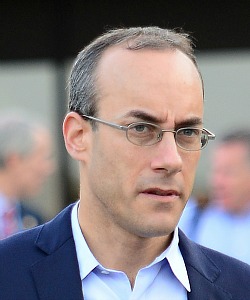
Dan Senor is an investment banker and neoconservative pundit.
Senor first came to prominence as a spokesman for the Coalition Provisional Authority in Iraq in the aftermath of the 2003 U.S.-led invasion, gaining a reputation as “the spinmeister responsible for selling the early years of the occupation … as a rosy time—even as bombs exploded daily and sectarian violence ripped apart the country.”[1]
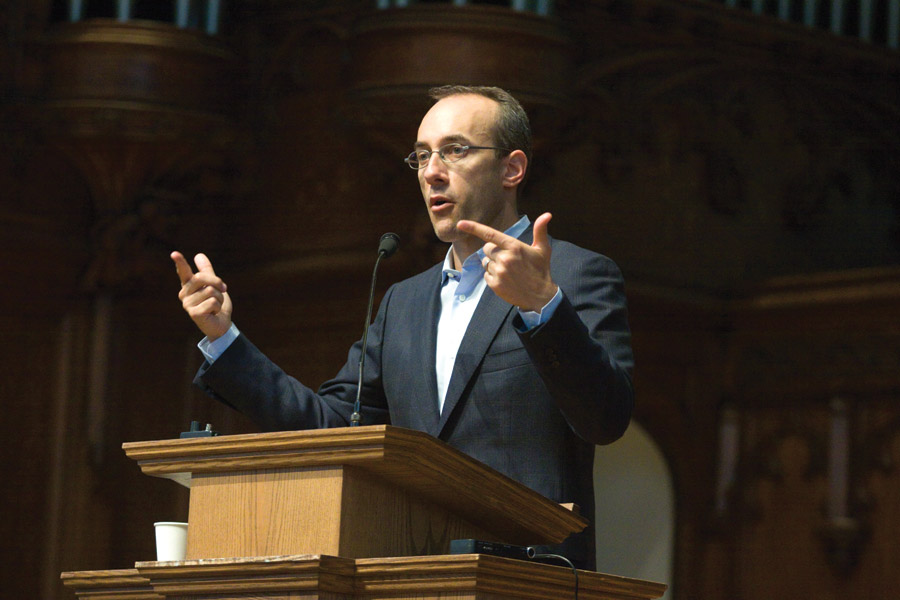
After leaving the Bush administration, Senor—who is the spouse of former CNN anchorwoman Campbell Brown—became a guest commentator on foreign policy issues for Fox News and a private equity executive. He co-founded the investment firm Rosemont Capital LLC[2] before joining Elliott Management, the hedge fund firm owned by Paul Singer, a billionaire Wall Street investor who has given millions to Republican political campaigns and neoconservative advocacy groups.[3] He also held a post as an adjunct fellow at the Council of Foreign Relations Middle Eastern studies program.[4]
In 2009, Senor cofounded—with William Kristol and Robert Kagan—the Foreign Policy Initiative (FPI), a neoconservative group viewed by some as a revival of the now-defunct Project for a New American Century (PNAC).[5]
On Iraq
In early 2003, Senor joined the Bush administration as deputy to White House Press Secretary Scott McClellan. Within a few months, he accepted a post in the Iraq “theater.” From 2003 to 2004, Senor served as a government adviser based at U.S. Central Command Forward in Qatar and later in Kuwait and Iraq.“[6]
In Iraq, Senor made his public debut as the media face of the Bush administration's Coalition Provisional Authority (CPA) under Ambassador L. Paul Bremer. Although only “in country” for 15 months, Senor was one of the longest-serving civilians in Iraq, where his tenure was marked by a pattern of what many observers characterized as misleading and deeply politicized statements about the condition of Iraq and the war effort.
In the book Reporting Iraq: An Oral History of the War by the Journalists Who Covered It, Washington Post reporter Rajiv Chandrasekaran recalled that as CPA spokesman, Senor once contrasted Baghdad with Paris, which at the time was suffering a streak of riots. “Paris is burning—but on the record, security and stability are returning to Iraq,” Senor notoriously quipped.[7]
Senor played a key role in the Bush administration's efforts to manipulate public discourse about Iraq. According to the Washington Post: “In September 2004, the White House controversially employed Senor to coach and ghostwrite the speeches of Iraq's interim prime minister Iyad Allawi during his visit to the U.S., in an effort to enhance the Bush reelection campaign. At the same time, Senor appeared on cable news programs claiming that Allawi's positive remarks (vetted by Senor) supported the Bush Administration's rosy view of the Iraq occupation.”[8]
Despite his steadfast support for the Iraq War, Senor has occasionally hinted at disagreements with some of its neoconservative architects and supporters, many of whom went on to criticize the Bush administration for mismanaging the U.S. occupation of Iraq.
In May 2009, for example, Senor participated in a Hudson Institute symposium on controversial ex-Pentagon official Douglas Feith’s book, War and Decision. During the symposium, former Deputy Secretary of Defense Paul Wolfowitz conceded that he and others “were clueless on counterinsurgency.” In his blog, veteran Inter Press Service reporter Jim Lobe pointed out that although this admission was undoubtedly the event’s headline, also striking was Dan Senor’s public disagreement with these icons of neoconservatism. A transcript of the Hudson event would be “worth reviewing,” Lobe told his readers, “for the ease with which Senor takes apart virtually every point made by Wolfowitz and Feith and the apparent inability of Wolfowitz or Feith to rebut him. While Senor never suggests that he thinks the original decision to invade Iraq was a mistake, it’s pretty clear that he thought the decision was not very well thought out by its principal advocates at the Pentagon.”[9]
Nonetheless, Senor remained an outspoken proponent of U.S. involvement in Iraq even after the last U.S. troops were withdrawn in 2011.
In 2014, following an aggressive offensive against Iraq's Shiite government by militants linked to the extremist Islamic insurgency group ISIS and its Sunni allies, Senor criticized the Obama administration both for withdrawing U.S. troops from Iraq and for its reluctance to commit U.S. troops to Syria, likening the situation in the Middle East to that of pre-9/11 Afghanistan, where al-Qaeda operated numerous training camps. "The critical mistakes in 2011 were not just not doing nothing about Syria," Senor said, "but also withdrawing fully from Iraq. So we now have this big ungovernable space along the Syrian-Iraqi border that will have all the attributes of pre-9/11 Afghanistan but in more valuable real estate, in a much more strategically valuable part of the world."[10]
"The situation in Iraq today is no more complex than when President Bush was dealing with the decision about the surge," Senor claimed (although the situation was in fact quite different, as the United States had over 100,000 troops in Iraq even before the 2007 surge). "You had al-Qaeda in Iraq, which was the precursor of ISIS, and then you had a security vacuum that was being filled by Shiite militias." Painting the surge as a success, Senor insisted, "Providing basic security and providing basic on-the-ground advice to the government of Iraq makes a difference." Accordingly he said the Obama administration should send "some kind of special ops capabilities, some kind of air power, [and] some kind of overall covert operations and intelligence capabilities" to Iraq.[11]
“Pro-Israel” Writer, Pundit, and Activist
Senor has become a leading figure among right-wing "pro-Israel" advocates for military action against Iran.
One of Senor’s early experiences working on Israeli political issues came in 1993, when he worked as an intern for the American Israel Public Affairs Committee (AIPAC). He was once quoted on AIPAC’s website, saying of his experience at the “pro-Israel” lobby, “Whether I was learning the ins and outs of Washington with my fellow interns or attending briefings on Capitol Hill, my internship at AIPAC prepared me for my work in politics.”[12]
It was during this time that Senor appears to have begun forging ties with key members of the neoconservative firmament. “Senor arrived at his current role by way of an itinerant and mostly accidental career that has afforded him access to a wide range of very powerful, very famous, and very rich people," wrote Allison Hoffman of Tablet in 2012."As an ambitious college intern on the Hill, he caught the attention of William Kristol, the editor-in-chief of the Weekly Standard, who gave him entree into the neoconservative circle surrounding George W. Bush.”[13]
Senor and Kristol went on to cooperate on a host of ventures. In 2006, for example, they were both advisers to the pro-Iraq war Vets for Freedom, which was closely tied to the right-wing advocacy group Freedom’s Watch. That year, one of Vets for Freedom’s main objectives was boosting the reelection efforts of the neoconservative-aligned Sen. Joe Lieberman, who ran as an independent after losing a Democratic primary in Connecticut over his support for the Iraq War. The Wall Street Journal quoted Senor as saying, “These vets are grateful to Sen. Lieberman for not letting politics compromise his positions, and they wanted to express that.”[14]
Senor and Kristol collaborated again in 2009, when along with Robert Kagan they cofounded the Foreign Policy Initiative (FPI), a hawkish pressure group that promotes U.S. military intervention. Quipped blogger Matthew Yglesias, “Senor’s inclusion is especially interesting, since neocons of the Kristol/Kagan ilk ostensibly now believe that the early years of the [Iraq] war were catastrophically mismanaged. And yet here they are with the public face of the mismanagement as their partner in warmongering.”[15]
Despite their early support for some Obama administration policies, in particular the military escalation in Afghanistan, Senor and FPI eagerly joined a chorus of right-wing attacks on Obama for his reaction to the post-election tumult in Iran in June 2009. On June 17, five days after Iran’s presidential election, the Wall Street Journal published an op-ed written by Senor and Christian Whiton, an FPI “policy adviser,” titled “Five Ways Obama Could Promote Freedom in Iran.” Among their suggestions was that Obama should appropriate funds to boost U.S.-sponsored radio broadcasts into Iran. A week later the hawkish Sens. Joe Lieberman, Lindsey Graham, and John McCain introduced a bill to fund these very activities.
Shortly thereafter, Senor participated in a debate concerning the proposition "Diplomacy with Iran Is Going Nowhere," which was broadcast nationwide on public radio. Senor and Liz Cheney, daughter of Dick Cheney and cofounder of another neocon pressure group called Keep America Safe, argued in favor of the idea; retired diplomat R. Nicholas Burns and foreign policy analyst Kenneth Pollack argued against it. Before the debate, 34 percent of the audience agreed, 33 percent disagreed, and 35 percent were undecided. After the debate, 59 percent of the audience opposed the argument, 35 percent agreed with it, and only 6 percent were undecided.[16]
An author and opinion writer, Senor has written on a range of topics for neoconservative-leaning outlets like the Wall Street Journal editorial page and the Weekly Standard, as well as for the New York Times, the Washington Post, and the New York Post.[17]
Senor is also a coauthor of the 2009 book Start Up Nation: The Story of Israel’s Economic Miracle, written with his brother-in-law Saul Singer, the editor of the conservative Jerusalem Post.[18] According to Gal Beckerman of Forward, “Start-up Nation presents Israel in an extremely positive light as a bastion of entrepreneurial spirit and technological achievement. It skirts a discussion of the conflict with the Palestinians, or even the wealth inequality within Israel, thereby dovetailing nicely with recent public relations efforts by Israel to shift attention away from its problems and toward its achievements.”[19]
Senor was a leading foreign policy adviser to the 2012 presidential campaign of Mitt Romney, where he honed the campaign's hawkish messaging on Iran.
According to the New York Times, Senor’s relationship with Romney dates back to 2006, when he and a host of “other foreign policy hawks” began advising Romney as he prepared to launch his unsuccessful 2008 presidential campaign.[20] During the 2012 presidential election campaign, Senor quickly emerged as one of the former governor’s key surrogates on U.S. policy on the Middle East, as well as his “key emissary to Israel’s intelligentsia and the Washington policy scene,” as Tablet put it.[21]
Discussing Romney’s decision to tap Senor as a key adviser, the New York Times reported in August 2012: “[Senor’s] presence in the tight orbit of advisers around the Republican candidate foreshadows a Romney foreign policy that could take a harder line against Iran, embrace Jerusalem as the capital of Israel and move away from being the honest broker in the conflict with Palestinians. … In Mr. Senor, Mr. Romney turned to an advocate of neoconservative thinking that has sought to push presidents to the right for years on Middle East policy. (His sister, Wendy Senor Singer, runs the Jerusalem office of the American Israel Public Affairs Committee, an influential lobbying organization.)”[22]
These political proclivities, combined with Senor’s role in misleading the public during the post-invasion occupation of Iraq, led many observers to criticize Romney’s decision to rely on Senor. “There is no greater aberration in American policy than that 2003-4 period, and Dan was the spokesman for that,” said Michael Breen, vice president of the Truman National Security Project, who was an army captain in Iraq while Senor was the spokesman for the Coalition Provisional Authority (CPA) in 2003 and 2004. “The CPA was the most dysfunctional organization of any in the last 100 years of American history and now he’s a foreign policy adviser for Mitt Romney. That is literally the time and the place that that country descended into chaos, and he was the guy telling the American people that it was going well.”[23]
After Romney’s election loss, some commentators pointed to Senor as an emblematic figure for the neoconservatism they said had been voted out of the White House. “Dan Senor,” wrote the Christian Science Monitor’s Dan Murphy the day after the presidential election, “has no more influence in the White House today than he did yesterday. … The dreams of transforming the world with U.S. troops and tanks that inflamed so many of President Bush's advisers at the start of the Iraq war, will now be dreamt a long way from 1600 Pennsylvania Avenue.”[24]