
Bruce Kovner
last updated: April 26, 2012
Please note: The Militarist Monitor neither represents nor endorses any of the individuals or groups profiled on this site.
Affiliations
- American Enterprise Institute:Member (Former Chairman), Board of Trustees
- Manhattan Institute:Former Member, Board of Trustees
- Juilliard School:Chairman
Business
- Caxton Associates: Chairman
- Commodities Corporation: Former Vice President
- School Choice Scholarships Foundation: Founder
Education
- Harvard University: B.A., 1966
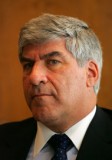
Bruce Kovner, founder of the multibillion-dollar hedge fund Caxton Associates, is a long-standing supporter of several rightist policy groups. He is the former chairman of the board of trustees of the American Enterprise Institute (AEI), an important bastion of neoconservative advocacy on U.S. foreign policy, and a former member of the board of trustees of the Manhattan Institute. He also provided financial backing for the right-wing New York Sun.[1]
During the 2012 presidential campaign, Kovner backed the candidacy of fellow hedge fund entrepreneur Mitt Romney.[2] In January 2012, Kovner gave $500,000 to Restore Our Future, the Romney-allied super-PAC that has been credited with helping Romney fend off challengers during the 2012 Republican primary. According to the Center for Public Integrity, “Restore Our Future was founded by veterans of the 2008 Romney campaign. It has been criticized for its negative advertising campaign. The group has reported spending $20.6 million to date during the GOP presidential primary with roughly 90 percent of the total, or $18.4 million, going toward attacks against Romney opponents Newt Gingrich and Rick Santorum.”[3]
Kovner helped found Caxton Associates in 1983, and served as chairman there until the end of 2011.[4] The firm eventually grew to become a $10-billion-dollar business.
Some observers have likened Kovner to Geroge Soros, dubbing him “Soros’s Right-Wing Twin.”[5] Both men made their fortunes in part by making broadly similar investments. Reported the New York Times in 2011, “Like Mr. Soros, Mr. Kovner has grown extremely wealthy betting on global market trends using stocks, currencies and commodities, among other things. He bought the former International Center for Photography on Fifth Avenue and 94th street for $17 million and spent another $10 million renovating it. An avid collector of rare books, Mr. Kovner named his hedge fund after the first printer of English-language books. Forbes magazine estimated Mr. Kovner’s wealth to be in excess of $4.5 billion. Unlike Mr. Soros, a generous donor to liberal causes, Mr. Kovner is a conservative supporter who counts among his associates former President George W. Bushand former Vice President Dick Cheney.”[6]
Kovner served as chairman of the Board of Trustees of the American Enterprise Institute from 2003 until 2008.[7] In announcing his selection as trustee chair, then-AEI president Christopher DeMuth said: “Bruce Kovner is a true intellectual. His extraordinary success with a highly intellectualized approach to investing gives some of us hope for a possible alternative career in the future.”[8]
Kovner has a reputation as being media shy. In a 2005 exposé about Kovner for New York Magazine, Philip Weiss wrote: "If no one knows anything about Bruce Kovner, it is because he likes it that way. Yet the unassuming manner is camouflage for one of the most powerful people in the country, culturally, financially, and politically." Regarding Kovner's purported political influence, Weiss reported: "He's a neoconservative godfather. He is among the backers of the Manhattan Institute and the fledgling right-wing daily the New York Sun. Most important, Kovner is chairman of the American Enterprise Institute. The right-wing think tank has supplied the government with the most powerful ideas in foreign policy in a generation, a vision of a supremely idealistic and militaristic American empire that must carry democracy out from its shores by force and begin by remaking the Middle East.”[9]
Norman Podhoretz, an early progenitor of neoconservatism who once hired Kovner as a music critic for Commentary, told Weiss: “Bruce is an intellectual. He understands the world of ideas. He would have been supremely well qualified to be an active member of that [academic] world had circumstances moved him in that direction. And what distinguishes him from most intellectuals is that he is also brilliant.”[10]
There is another reason neoconservatives like to claim Kovner as their own—his monetary generosity. Reported Weiss: "James Q. Wilson, a member of the AEI board, says that Kovner has pushed AEI to build an endowment so that scholars are more independent, so they don't have to hunt up grants for their work. Kovner's hedge fund manages the lion's share of the group's investments, which grew from $28 million to $40 million in 2003, the latest year collected by Guidestar.org."[11]
According to Weiss, Kovner first came in touch with early neoconservatives while in grad school at Harvard, where he became the "star student" of Edward C. Banfield, a former official in President Franklin Roosevelt's New Deal administration who eventually became disillusioned with liberal, big-government initiatives. Kovner, reported Weiss, became part of "a network that included Daniel Patrick Moynihan and James Q. Wilson," who were close to Banfield.[12]
Kovner's giving has not been only political. In early 2006, Kovner donated to the Juilliard School 140 musical manuscripts, which according to college president Joseph W. Polisi are "the very definition of priceless".[13] Kovner is also chairman of the Juilliard School. According to New York Magazine, Kovner is "New York's most unassuming philanthropist." He donated $25 million for the renovation of the Lincoln Center for the Performing Arts.[14] He has also donated to education. In 1997, Kovner and several other investors started the School Choice Scholarships Foundation, which awarded private scholarships to students from poor families. "We are doing this because of the importance of making choice available to kids who don't have real alternatives," Kovner said. "The public school system hasn't provided good opportunities for these kids; so we think the private schools should be given a chance to help out".[15]
His taste in culture seems offbeat when compared to many of the neoconservatives associated with outfits like AEI. According to Weiss, Kovner once showed up at a Tenth Avenue party for Surrender, "that paean to anal sex by former Balanchine dancer Toni Bentley." Wrote Weiss: "It goes without saying that a wide gulf separates the Surrender party from the American Enterprise Institute, whose female residents offer grating lectures on the evils of feminism, therapy, and The Vagina Monologues, where Robert Bork heaps abuse on Roe v. Wade."[16]
Wrote Weiss: "There can be no question that [Kovner] supports the militarist neoconservative agenda. Last October [2004], when George Bush's chestnuts were in the fire, Kovner helped to pull them out. He wrote checks for $110,000 to a 527 (political organization) called Softer Voices that was aimed at 'security moms' in swing states. Softer Voices is led by, among others, the writer Midge Decter, the wife of Norman Podhoretz, and Nina Rosenwald, a force in the pro-Israel lobby. Kovner was its largest financial backer. For all his reserved sagacity, Bruce Kovner has always been comfortable with radical ideas."[17]