
Foreign Policy Initiative
last updated: November 1, 2019
Please note: The Militarist Monitor neither represents nor endorses any of the individuals or groups profiled on this site.
Contact Information
Foreign Policy Initiative
11 Dupont Circle NW, Suite 325
Washington DC 20036
Key Staff
- Ellen Bork, senior fellow
- Eric Edelman, board member
- Chris Griffin, executive director
- Robert Kagan, board member
- William Kristol, board member
- Dan Senor, board member
Operating Period
2009-2017
Mission
“In this new era, the consequences of failure and the risks of retreat would be even greater than before. The challenges we face require 21st century strategies and tactics based on a renewed commitment to American leadership. The United States remains the world’s indispensable nation—indispensable to international peace, security, and stability, and indispensable to safe-guarding and advancing the ideals and principles we hold dear. The Foreign Policy Initiative (FPI) is a non-profit, non-partisan organization intending to qualify as a tax-exempt organization under Section 501(c)(3) of the U.S. Internal Revenue Code that promotes: continued U.S. engagement—diplomatic, economic, and military—in the world and rejection of policies that would lead us down the path to isolationism; robust support for America’s democratic allies and opposition to rogue regimes that threaten American interests; the human rights of those oppressed by their governments, and U.S. leadership in working to spread political and economic freedom; a strong military with the defense budget needed to ensure that America is ready to confront the threats of the 21st century; international economic engagement as a key element of U.S. foreign policy in this time of great economic dislocation. FPI looks forward to working with all who share these objectives, irrespective of political party, so that the United States successfully confronts its challenges and makes progress toward a freer and more secure future.”
The Foreign Policy Initiative (FPI) was a Washington D.C.-based advocacy group founded in 2009 by several high-profile neoconservative figures to promote militaristic U.S. policies in the Middle East and other global hotspots. Among its key benefactors was Republican hedge-fund billionaire Paul Singer, who has long been associated with right-wing “pro-Israel” advocacy efforts. FPI shuddered in 2017 because of loss of funding. An anonymous source told The Atlantic that after the election of Donald Trump, Singer decided that FPI was no longer worth the investment so he “decided to reduce the amount of money he was giving to FPI to a very low amount, and all the board members came to the conclusion that there was no point in continuing.”
The group was similar in its aims and operations to an earlier neoconservative advocacy initiative, the Project for the New American Century (PNAC), a now defunct letterhead organization associated with the American Enterprise Institute that played an important role pushing for the U.S. invasion of Iraq after the 9/11 terrorist attacks.[1]
FPI had five key agenda items: the promotion of “continued U.S. engagement—diplomatic, economic, and military—in the world and rejection of policies that would lead us down the path to isolationism; robust support for America’s democratic allies and opposition to rogue regimes that threaten American interests; the human rights of those oppressed by their governments, and U.S. leadership in working to spread political and economic freedom; a strong military with the defense budget needed to ensure that America is ready to confront the threats of the 21st century; international economic engagement as a key element of U.S. foreign policy in this time of great economic dislocation.”[2]
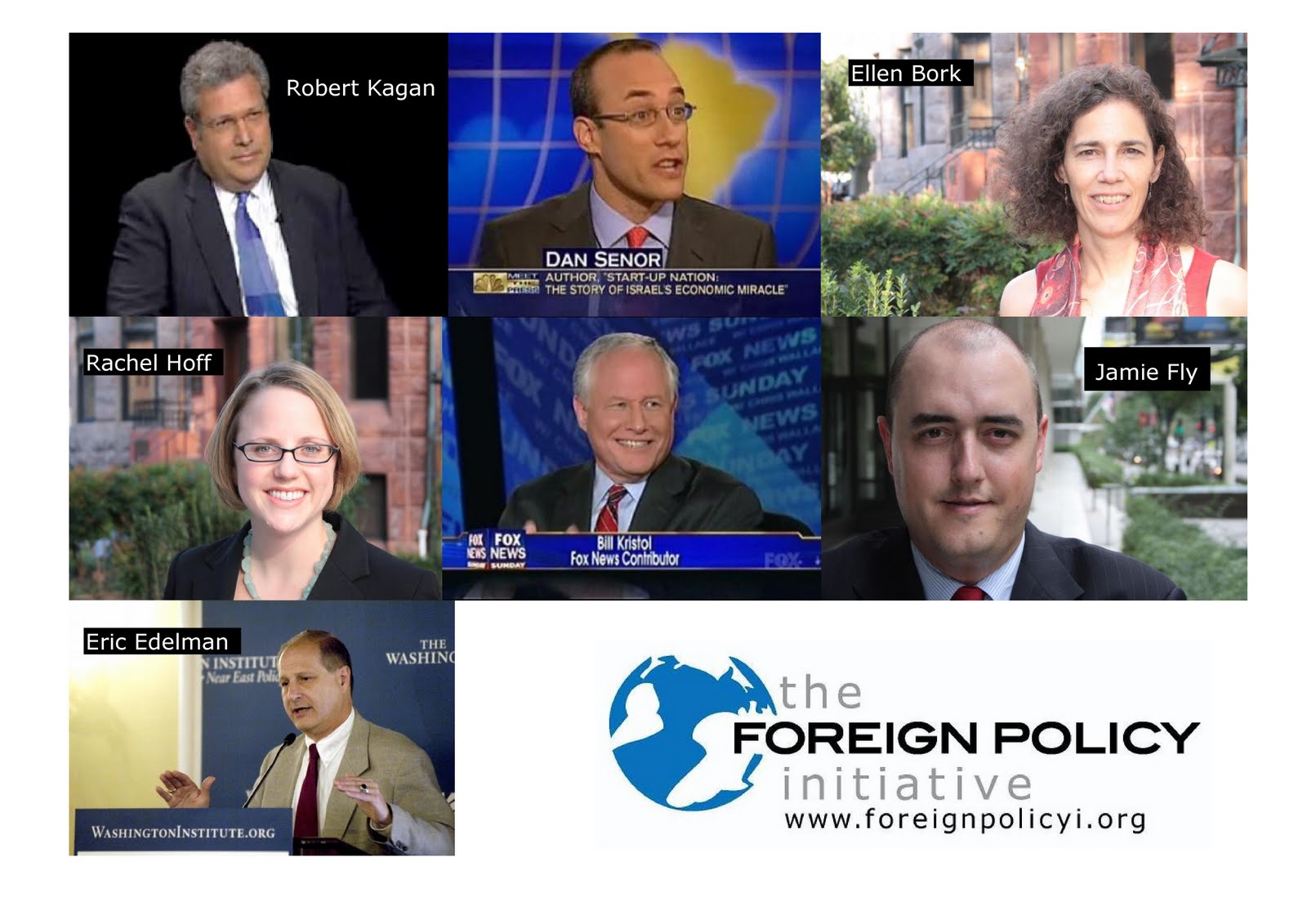
FPI’s board of directors included several individuals who were closely associated with the Bush administration’s “war on terror” policies: Robert Kagan and William Kristol, who cofounded PNAC and were high-profile proponents of the U.S.-led invasion of Iraq; investment banker Dan Senor, a former Bush administration spokesman in Iraq and lead foreign policy adviser to Mitt Romney; and career diplomat Eric Edelman.[3]
FPI’s executive director was Chris Griffin, a former staffer for Sen. Joe Lieberman. Staff members included: Ellen Bork, daughter of former Supreme Court Justice nominee Robert Bork and former acting director of the Project for the New American Century; the neoconservative writer Jamie Kirchick; and policy director Robert Zarate, a frequent Weekly Standard contributor and a proponent of the U.S. nuclear weapons program.[4] FPI was previously directed by Jamie Fly, who left the group in January 2013 to become an adviser to Sen. Marco Rubio (R-FL).[5]
FPI’s Mission Statement highlighted a number of “foreign policy challenges” confronting the United States: “They come from rising and resurgent powers, including China and Russia. They come from other autocracies that violate the rights of their citizens. They come from rogue states that work with each other in ways inimical to our interests and principles, and that sponsor terrorism and pursue weapons of mass destruction. They come from Al Qaeda and its affiliates who continue to plot attacks against the United States and our allies. They come from failed states that serve as havens for terrorists and criminals and spread instability to their neighbors.”[6]
Tactics and Strategies
FPI promoted its policy agenda in a number of ways, including producing policy briefings and issue memos, publishing op-eds in major newspapers, and teaming up with like-minded groups to co-host events with lawmakers and other government officials. For instance, in July 2014, FPI co-hosted a “public forum” with the Bipartisan Policy Center and the Foundation for Defense of Democracies to address ongoing negotiations with Iran over its nuclear program. Among the participants at the forum were several members of Congress, including then-Sen. Mark Kirk (R-IL) and Rep. Ileana Ros-Lehtinen (R-FL). Shortly after the event, FPI’s policy director Robert Zarate published an op-ed in USA Today calling for increased sanctions on Iran, claiming that “Iran retains substantial illicit nuclear infrastructure and could potentially produce explosive nuclear material for a weapon in two months.”[7]
Like other neoconservative groups, FPI appeared to seek out alliances that extended across ideological lines using the mechanism of sign-on letters. Reprising a role PNAC played in the run-up to the Iraq War, for instance, FPI released a letter in August 2013 calling for the U.S. government to consider “direct military strikes” on Syria and to provide more arms for “moderate elements of Syria’s armed opposition,” with the aim of tipping the balance of Syria’s civil war against the Assad regime. Alongside FPI’s Kristol, Edelman, Kagan, and Senor, signatories included prominent figures from the George W. Bush administration like Elliott Abrams, John Hannah, Douglas Feith, and Karl Rove; neoconservative writers like Eliot Cohen, James Kirchick, and Reuel Marc Gerecht; prominent Republicans like Gary Bauer, Norm Coleman, and Tim Pawlenty; and Democratic hawks like former Sen. Joe Lieberman and New Republic literary editor Leon Wieseltier.[8]
An early sign-on letter, from July 2009, urged President Obama to promote human rights during his summit in Russia with President Dmitry Medvedev. Among the signatories to the letter were several long-standing neoconservatives, including Max Boot, Jeffrey Gedmin, Carl Gershman, Max Kampelman, Bruce Jackson, Clifford May, Danielle Pletka, Randy Scheunemann, Gary Schmitt, Peter Wehner, and James Woolsey. In addition to these names, however, were those of several well known human rights and civil liberties experts, like Larry Cox of Amnesty International-USA, Clinton administration official Morton Halperin, and Stephen Rickard of the Open Society Institute.[9]
Commenting on the letter, one journalist wrote: “That several genuine human rights activists … should have chosen to associate themselves with such a group is remarkable and offers additional evidence that Kagan and Kristol are trying to reconstruct the neocon/liberal coalition that pressed the Clinton administration to intervene in the Balkans during the late 1990s. Mind you, I have no great disagreement with the sentiments expressed in the letter, but to the extent that prominent liberals publicly endorse it, neoconservatives, who have always been more excited about American power than the spread of human rights around the world … regain respectability. You would think there would be a sufficient number of serious human rights activists to write their own letter.”[10]
FPI followed up its 2009 alliance-building efforts with open letters in 2010 and 2011 that promoted human rights in countries like China and Belarus. A similar letter followed in 2013 regarding Turkey, a longtime U.S. ally that has increasingly fallen out of favor with neoconservatives because of its worsening relations with Israel. Like the early open letter, these also included an array of signatories from both neoconservative and more mainstream human rights groups.[11]
Issues
FPI sought to frame the 2014 midterm congressional elections as a “foreign policy election,” although exit polls indicated that only 13 percent of voters considered foreign policy a “top issue.”[12] Writing in theWeekly Standard after the elections, FPI directors Rachel Hoff and Caitlin Poling claimed “the dark horse issue of the 2014 election was foreign policy” and that “as Americans demonstrated when they went to the polls last week, the world is becoming an even more dangerous place.” The two went on to stress that “new Republican members of Congress should actively lead on foreign policy issues, keeping national security as a central focus,” and placed particular focus on Iran.[13]
Hoff and Polling argued that the Republican-controlled Senate should pass Sen. Robert Menendez’s controversial Nuclear Weapons Free Iran Act, which would impose additional sanctions on Iran and likely scuttle on-going negotiations with Iran. “The Republican Senate should move to swiftly approve these sanctions-in-waiting if negotiations are extended. Iran is worried about the Republican majority in Congress—as they well should be,” the FPI directors opined.[14]
In mid-2014, FPI also deployed many of its advocacy tactics to advocate escalation of U.S. intervention in Iraq and Syria to counter militants linked to the extremist Islamist State, also known as ISIS or IS. It published a briefing by Christopher Griffin and Evan Moore arguing that “A significant number of U.S. forces and intelligence personnel will be required to roll back ISIS in Iraq alone.” For specifics, Griffin and Moore pointed to proposals by other hawkish think tank figures: “Michael O’Hanlon of the Brookings Institution estimates that 10,000 U.S. troops will be required to conduct these critical missions,” they wrote, “while Max Boot of the Council on Foreign Relations believes that as many as 15,000 will be needed.” Urging U.S. involvement in Syria as well, they added that “the Assad regime [must] ultimately be defeated and replaced,” which they purported meant that the United States would have to “train and arm mainstream [rebel] groups on a large scale.”[15]
A separate bulletin by Moore argued that the Obama administration “should expand the range of its airstrike campaign, increase the number of personnel deployed to Iraq, and empower its regional allies to roll-back ISIS’ territorial gains.” In a bid to expand the war on both sides of the Iraqi-Syrian border, Moore added that “the United States should target ISIS forces in both Syria and Iraq.”[16] (Even before the rise of ISIS, however, FPI had urged “arming and training the mainstream, moderate elements of the armed Syrian opposition” and “prepar[ing] to strike the Syrian regime and military targets.”)[17]
Many analysts were not impressed by FPI’s suggestions. “Almost exactly four years after the last US combat brigade left Iraq,” noted journalist Jim Lobe, “these analysts are calling for US ground forces to play a key combat role alongside whatever presumably friendly forces can be mustered to fight ISIS in Iraq, if not Syria.” But, Lobe wondered, “what happens when those groups’ broader strategic aims are found to be mutually incompatible? … Neocons don’t like people to ponder such questions. Instead, they count on their ability to reduce extremely complicated and difficult situations to urgent, black-and-white choices that appeal more to fear than to reason.”[18]
As early as January 2013, FPI was pushing for an expansive U.S. role in Syria. That month, then FPI director Jamie Fly published an op-ed in the Wall Street Journal arguing that a more robust U.S. role in the conflict would be necessary to secure Syria’s stockpile of chemical weapons in the event of regime collapse. “If Mr. Obama is serious about ensuring that terrorists don’t get their hands on weapons that could be used against American interests or personnel in the region or even on the U.S. homeland, the only solution is early and sustained planning to stabilize a post-Assad Syria,” he wrote. “Veiled threats against the Assad regime—after nearly two years of benign neglect toward the chaos in Syria—won’t be enough to protect Americans and our allies. And they certainly won’t help Syrians rid themselves of Bashar Assad.”[19]
Similarly, in a quote published by right-wing Washington Post blogger Jennifer Rubin, Fly criticized the Obama administration’s tentative plans to leave a relatively small U.S. force in Afghanistan after its planned 2014 withdrawal. Fly said the force, then thought to number in the low thousands, “is nowhere near enough to achieve our goal of an Afghanistan that does not again become a safe haven for those trying to attack us. It appears that the White House has learned all the wrong lessons from its negotiations with Iraq over a post-2011 presence. The stakes in Afghanistan are, unfortunately, even higher.”[20]
FPI also advocated an aggressive Western posture against Russia in the wake of Moscow’s annexation of Crimea and support for pro-Russian rebels in Ukraine. In a September 2014 bulletin, Moore and Griffin asserted that Russian President “Vladimir Putin has foreclosed any prospect of a cooperative relationship between Russia and the West in the near future.” They argued that NATO “should provide Ukraine anti-tank and anti-aircraft weapons” in its fight against the rebels and, in what would be a particularly serious escalation, “establish a permanent and sizable [troop] presence in Eastern Europe to deter further Russian aggression”—which some observers said would be in violation of past NATO agreements with Russia. Although many critics saw the post-Cold War expansion of NATO as a key driver in Russia’s behavior, the authors also urged the Obama administration to “recommit to NATO expansion” and support bids for membership from Ukraine and Georgia.[21]
FPI partnered with other right-wing groups to press for a larger U.S. military budget. The group was vocal in its condemnation of “sequestration” cuts resulting from Congress’ inability to reach a deal on the U.S. deficit, which included large military spending cuts. In a joint “Defending Defense” initiative with the Heritage Foundation and the American Enterprise Institute, FPI argued in early 2013 that the proposed cuts would undercut the ability of the United States to intervene abroad. “Defense sequestration will fundamentally alter America’s strategic posture in the world, its capacity to keep the peace, and its ability to sustain its existing security commitments to allies and partners,” said a January 2013 statement on FPI’s website. “It’s long past time for President Obama and Congress not just to delay defense sequestration, but to stop it, once and for all.”[22]
In 2014, the group published a subsequent reader urging new investments in the U.S. nuclear arsenal, claiming that “America’s nuclear arsenal plays a central—and often underappreciated—role in protecting U.S. and allied security.”[23]
FPI played a vocal role in supporting President Obama’s initial troop surge in Afghanistan. The group’s inaugural conference, held in Washington on March 31, 2009, was titled “Afghanistan: Planning for Success.” Among the participants were Sen. John McCain (R-AZ), a long-time supporter of neocon-led causes like the Committee for the Liberation of Iraq; Fred Kagan, brother of Robert and coauthor of a 2007 American Enterprise Institute study that reportedly served as a blueprint for the “surge” in Iraq; and I. Lewis Libby, former Vice President Dick Cheney’s chief of staff who was convicted in connection with the federal investigation into the “outing” of CIA agent Valerie Plame.
Commented Matt Duss: “On March 31, FPI holds its first public event, ‘Afghanistan: Planning For Success,’ though, given the heavy representation of Iraq war advocates, I think a far better title would be ‘Afghanistan: Dealing With The Huge Problems Created By Many Of The People On This Very Stage.’ The broad consensus among national security analysts and aid officials is that the diversion of troops and resources toward Iraq beginning in 2002 was one of the main reasons the Taliban and Al Qaeda were able to re-establish themselves in the Afghanistan-Pakistan border areas. … Bush and the Iraq hawks handed the Obama administration a war that promises to be as difficult and costly as Iraq has been—if not more. It’s deeply absurd that some of the people most responsible for the crisis in Afghanistan would now presume to tell us how to deal with it.”[24]